URL SEO is the practice of designing web addresses so they’re clean, readable, and structured in a way that helps both search engines and users understand what a page is about. A well-optimized URL is short, descriptive, and free of unnecessary clutter — and it can quietly influence rankings, click-through rates, and how easily Google crawls and organizes your site.
If you’ve ever wondered why some websites rank with URLs like site.com/best-running-shoes while others struggle with site.com/index.php?id=4821&cat=12, the answer usually comes down to URL SEO fundamentals.
This guide breaks down exactly what makes a URL SEO-friendly, how to structure one correctly, and the mistakes that quietly hurt rankings — even on otherwise well-written pages.
Table of Contents
What Is a URL, and Why Does It Matter for SEO?
Before diving into optimization, it helps to understand the basics. A URL (Uniform Resource Locator) is the web address that tells a browser exactly where to find a specific page — for example, https://example.com/blog/url-seo.
URLs matter for SEO because they serve three audiences at once:
- Search engines — Google uses URLs to understand page topics and site structure.
- Users — People read URLs before clicking, especially in search results.
- Site owners — A logical URL structure makes a website easier to organize, maintain, and scale.
Not every visitor arrives through a search engine either. Some people search Google, while others type a URL directly into their browser. A clean, predictable URL structure supports both behaviors — it’s easier to guess, remember, and type correctly.
What Makes a URL “SEO-Friendly”?
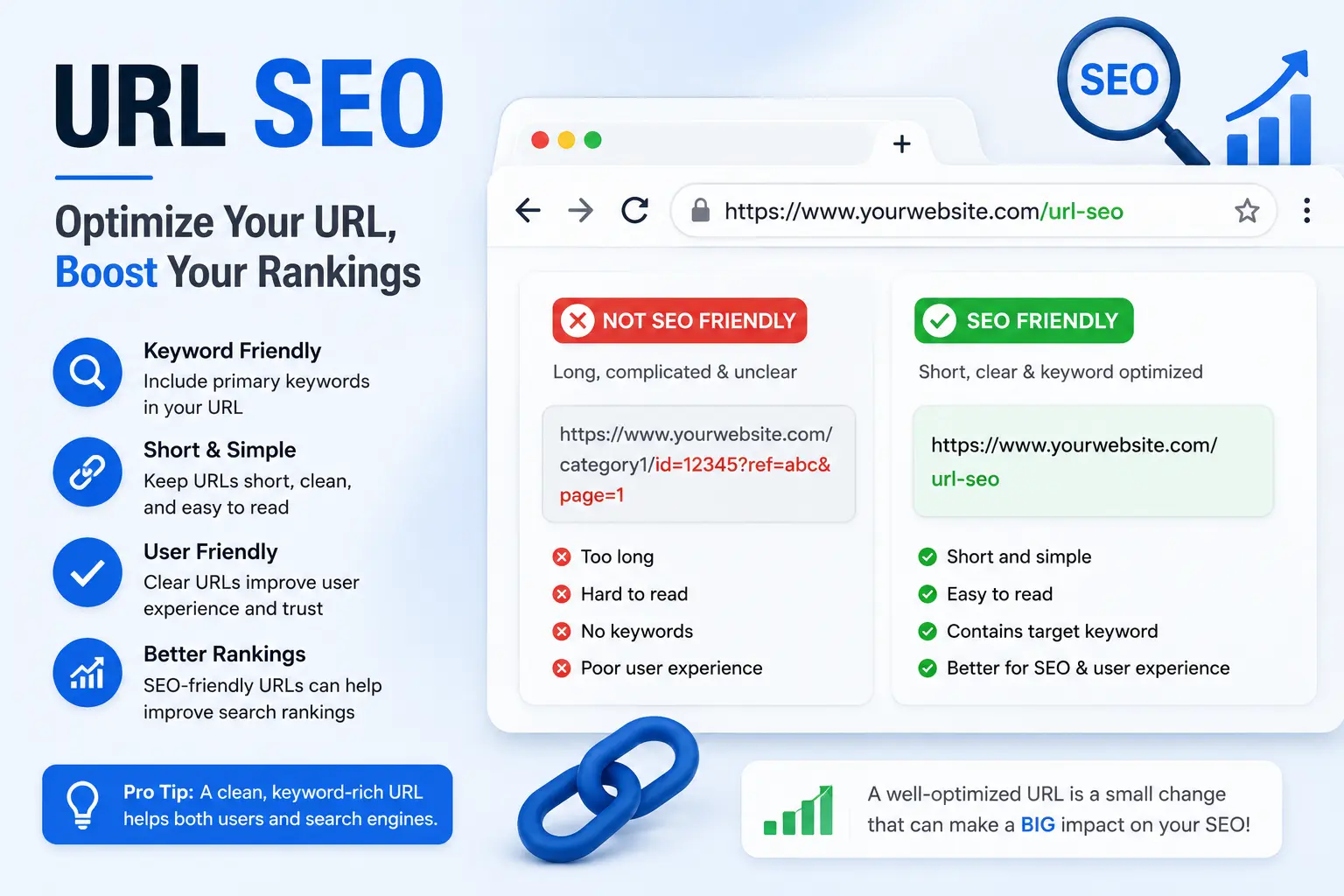
An SEO-friendly URL follows a few core principles: it’s short, descriptive, readable, and consistent. Here’s what that looks like in practice.
| Element | SEO-Friendly | Not SEO-Friendly |
| Length | Short and to the point | Long, with unnecessary words |
| Readability | Uses real words | Uses random IDs or codes |
| Case | Lowercase | Mixed or uppercase |
| Separators | Hyphens (-) | Underscores (_) or spaces |
| Keywords | Includes the target keyword | No relevant keywords |
| Parameters | Minimal or none | Long strings of tracking parameters |
Example comparison:
✅ SEO-friendly: example.com/url-seo-best-practices
❌ Not SEO-friendly: example.com/index.php?p=4821&cat=9&ref=xyz
The first version tells both Google and the user exactly what the page covers. The second gives no useful information at all.
Core Elements of URL Structure for SEO
A properly optimized URL is made up of several parts, and each one plays a role in SEO performance.
1. Protocol (HTTPS)
Always use https:// rather than http://. HTTPS is a confirmed ranking signal and protects data between the browser and server.
2. Domain Name
Your domain should be consistent, brandable, and free of unnecessary subdomains unless there’s a technical reason to use them.
3. Path (Folder Structure)
This is the part after the domain, such as /blog/ or /products/. It should reflect a logical hierarchy.
example.com/blog/url-seo
example.com/products/shoes/running-shoes
Avoid unnecessary depth. A URL like example.com/category/subcategory/sub-subcategory/product-name is harder to manage and dilutes topical clarity.
4. Slug
The slug is the final, unique part of the URL that identifies the specific page — for example, url-seo in example.com/blog/url-seo. This is where slug best practices matter most, since it’s usually the part most visible in search results.
5. Parameters (Optional)
Parameters are the extra information added after a ?, often used for tracking or filtering, such as ?sort=price&color=blue. These are useful functionally but can create SEO problems if left unmanaged — covered in detail below.
SEO URL Best Practices
Here are the core rules to follow when building or optimizing a URL structure for SEO.
1. Keep it short. Aim for a URL that clearly communicates the topic in as few words as possible. Shorter URLs tend to perform better in both readability and search snippet display.
2. Use hyphens, not underscores. Google treats hyphens as word separators, but underscores can cause words to be read as one connected string.
✅ url-seo-guide
❌ url_seo_guide
3. Include your target keyword. Placing the primary keyword in the URL reinforces topical relevance, but it should read naturally — never stuffed with repeated variations.
4. Use lowercase letters only. Some servers treat uppercase and lowercase URLs as different pages, which can create duplicate content issues.
5. Avoid stop words when possible. Words like “and,” “or,” “the,” and “of” can usually be removed without losing meaning.
Instead of: /guide-to-the-best-running-shoes-of-2026
Use: /best-running-shoes-2026
6. Avoid dates in evergreen URLs. If content will be updated over time, avoid hardcoding a year or date into the URL, since this can make the page look outdated even after updates.
7. Match the URL to the page content. The URL should accurately represent what the page is about — mismatched URLs confuse both users and search engines.
8. Maintain a shallow folder structure. Two or three levels deep is usually enough for most websites. Overly nested URLs make crawling and internal linking harder to manage.
URL Parameters and SEO
Parameters are common on e-commerce and filtered content pages, but they need careful handling.
Example of a parameter-heavy URL:
example.com/shoes?color=blue&size=10&sort=price&session=88231
This creates a problem: Google may treat each parameter combination as a separate, near-duplicate page, wasting crawl budget and diluting ranking signals across multiple URL versions of the same content.
How to manage this properly:
- Use canonical tags to point parameter variations back to the main URL
- Use Google Search Console’s URL parameter tools where available
- Avoid generating parameters for content that doesn’t need to be indexed separately
- Keep filtering/sorting parameters out of the core indexed URL structure when possible
Static URLs vs. Dynamic URLs
| Type | Example | SEO Impact |
| Static URL | example.com/url-seo-guide | Easy to read, crawl, and rank |
| Dynamic URL | example.com/page.php?id=482&cat=9 | Harder to read, can create duplicate content issues |
Static URLs are almost always preferred for SEO. Most modern content management systems, including WordPress, allow you to configure static, keyword-friendly URL structures instead of relying on default dynamic ones.
Vanity URLs and Their Role in URL SEO
Some brands take URL optimization a step further by using vanity URLs — short, branded links used in marketing campaigns, such as example.com/blackfriday instead of a long tracking URL.
While vanity URLs are mainly built for marketing readability rather than direct ranking benefits, they reinforce the same principle behind good URL SEO: short, clear, and human-readable URLs perform better across every channel, from search results to email campaigns to printed materials.
Common URL SEO Mistakes to Avoid
- Using long, keyword-stuffed URLs. Repeating the same keyword multiple times in a URL looks manipulative and provides no added SEO value.
- Changing URLs without redirects. If a URL changes, failing to add a 301 redirect can cause lost rankings and broken links.
- Mixing uppercase and lowercase letters. This can create duplicate URL versions of the same page.
- Using session IDs or tracking codes in indexed URLs. These generate near-infinite duplicate URL variations.
- Overly deep folder structures. Excessive nesting buries content and weakens internal link equity.
- Ignoring broken URLs. Dead links waste crawl budget and hurt user experience.
URL SEO Checklist
Use this quick checklist when creating or auditing a URL:
- ✅ Uses HTTPS
- ✅ Short and descriptive
- ✅ Includes the target keyword naturally
- ✅ Uses hyphens between words
- ✅ All lowercase
- ✅ No unnecessary parameters or session IDs
- ✅ Logical folder structure (2–3 levels max)
- ✅ Matches the page’s actual content
- ✅ Redirects properly if changed from a previous version
Frequently Asked Questions
What is URL SEO? URL SEO refers to structuring and optimizing web addresses so they’re short, descriptive, and easy for both search engines and users to understand.
Does URL structure really affect SEO rankings? Yes, though it’s a smaller ranking factor compared to content quality and backlinks. A clean URL structure supports crawlability, user experience, and click-through rates, all of which indirectly support rankings.
What is the best URL structure for SEO? The best structure is short, uses hyphens, includes the target keyword, avoids unnecessary parameters, and reflects a logical site hierarchy — for example, example.com/category/keyword-slug.
Should I include keywords in every URL slug? Yes, where it fits naturally. The slug should accurately describe the page content, and including the primary keyword helps reinforce relevance without forcing it.
Do URL parameters hurt SEO? They can, if left unmanaged. Parameters used for tracking, filtering, or sorting can create duplicate content issues unless handled with canonical tags or proper indexing controls.
Should URLs include dates? Only for time-specific content like news articles. Evergreen content generally performs better without a hardcoded date in the URL.
Final Thoughts
Good URL SEO isn’t about chasing a single ranking factor — it’s about building a URL structure that’s logical for search engines and effortless for real people to read, share, and trust. A short, descriptive, keyword-relevant URL supports crawlability, improves click-through rates, and keeps your site organized as it grows.
Whether you’re refining a blog’s slug structure or setting up a vanity URL for a marketing campaign, the same principle applies: clarity always outperforms clutter. And once your URL structure is solid, the rest of your on-page SEO has a much stronger foundation to build on.