Learning how to increase website traffic used to mean one thing: rank higher on Google. That’s still a huge part of the answer, but it’s no longer the whole picture. AI Overviews, chatbot-based search, and zero-click results now shape how people find information before they ever land on a website — which means the old playbook needs an update, not a replacement.
This guide covers proven, practical strategies that still work in 2026: SEO fundamentals, content strategy, technical health, and the newer discipline of showing up in AI-generated answers. Whether your site gets ten visitors a day or ten thousand, these are the levers that actually move the needle.
Table of Contents
Why Website Traffic Growth Looks Different in 2026
Organic search still drives roughly 47% of all website visits — far more than social media — so search remains the single most valuable traffic source for most sites. But the way people search has shifted:
- AI Overviews now appear in a large share of Google searches, often answering the question directly on the results page and reducing the click-through rate to any individual website.
- AI chatbots like ChatGPT and Perplexity are increasingly used as a starting point for research, especially for complex or comparative questions.
- Zero-click searches — where a user gets their answer without visiting any website — now make up a majority of mobile searches.
This doesn’t mean organic traffic is dying. It means the strategies that win are shifting from pure keyword-matching toward comprehensive, clearly structured, genuinely authoritative content that both traditional search engines and AI systems trust enough to cite.
How to Increase Organic Traffic to Your Website
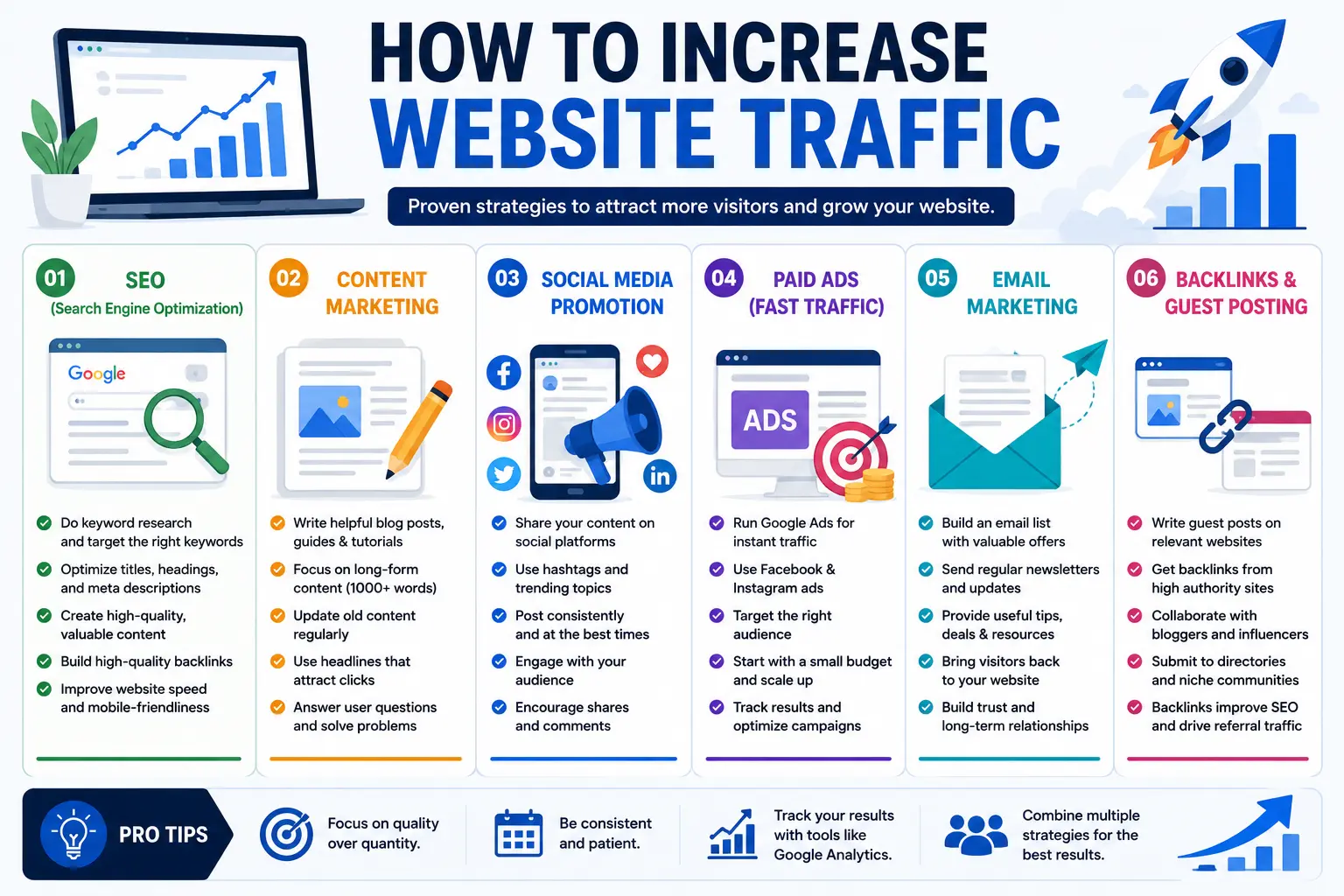
1. Target the Right Keywords, Including Long-Tail Ones
Ranking for a single high-volume keyword is harder than ever. Long-tail keywords — longer, more specific phrases like “how to grow organic traffic for a small business” instead of just “organic traffic” — face less competition and often convert better because they match a more specific search intent.
Use tools like Google Search Console, Google Keyword Planner, or a dedicated SEO platform to find keyword variations your target audience is actually searching for, then build content around clusters of related terms rather than a single phrase.
2. Publish Comprehensive, Well-Structured Content
Both search engines and AI models increasingly favor content that thoroughly covers a topic over scattered, thin posts touching on it lightly. A single definitive guide on a subject tends to outperform five shallow articles on the same theme.
Structure matters as much as depth:
- Use clear, descriptive headers instead of vague ones like “Overview” or “More Info.”
- Answer specific questions directly, ideally within the first sentence or two after the heading.
- Break complex topics into scannable sections with bullet points and short paragraphs.
This kind of structure helps human readers scan your content quickly, and it also helps AI systems parse and cite your content accurately — a growing factor in visibility.
3. Build Topical Authority With Content Clusters
Instead of publishing isolated articles, build a “pillar and cluster” structure: one comprehensive pillar page on a broad topic, linked to multiple supporting articles that each go deep on a specific subtopic. This structure signals topical authority to search engines and creates natural internal linking opportunities that keep visitors — and search engine crawlers — moving through your site.
4. Fix Technical SEO Issues
Even great content underperforms if search engines struggle to crawl or understand your site. Common technical issues worth auditing regularly:
- Slow page load times, which hurt both rankings and user experience.
- Broken links and redirect chains, which waste crawl budget and confuse both users and search engines.
- Missing or duplicate meta titles and descriptions.
- Poor mobile responsiveness, since the majority of searches now happen on mobile devices.
- Messy URL structure. Clean, descriptive URLs are easier for both users and search engines to understand — see our guide on URL SEO and how to write an effective URL slug for practical guidance here.
5. Earn Backlinks From Relevant, Authoritative Sites
Backlinks remain one of the strongest ranking signals in search. Rather than chasing volume, focus on relevance and authority: a handful of links from respected sites in your niche typically outweighs dozens of low-quality ones.
Practical ways to earn backlinks include:
- Publishing original research, data, or surveys other sites want to cite.
- Guest posting on reputable, relevant publications.
- Building genuinely useful free tools or resources that naturally attract links.
- Reaching out to sites that mention your brand without linking, and asking for a link to be added.
6. Optimize for Featured Snippets and AI Overviews
Featured snippets and AI Overviews often occupy the most visible real estate on a search results page, so appearing in them — even without a top organic ranking — can meaningfully increase visibility and clicks.
To improve your odds:
- Answer the target question directly and concisely near the top of the relevant section.
- Use structured formats (numbered lists, tables, clear step-by-step instructions) that are easy for AI systems to extract.
- Include the exact phrasing of common questions as headers where it reads naturally.
How to Get Traffic to Your Website Beyond Organic Search
Search shouldn’t be your only traffic source. A healthy site draws visitors from multiple channels, which also protects you if any single channel’s algorithm shifts.
Email Marketing
An email list is one of the few traffic sources you fully control, unaffected by algorithm changes. Building a list through gated content, newsletters, or simple sign-up incentives gives you a direct, repeatable way to drive traffic back to new content or offers.
Social Media
While social media drives a much smaller share of overall traffic than organic search, it’s valuable for building brand awareness, distributing content quickly, and driving traffic to time-sensitive posts. Focus on the one or two platforms where your actual audience spends time, rather than spreading effort thin across every platform.
Referral Traffic and Partnerships
Getting mentioned or linked from other relevant websites — through partnerships, co-marketing, directories, or press coverage — drives both direct referral traffic and the backlinks that support your SEO efforts simultaneously.
Paid Traffic
Paid search and social ads can supplement organic growth, particularly for new sites that haven’t yet built up search authority. Paid traffic won’t compound the way organic traffic does, but it can generate immediate visibility while your SEO efforts mature.
Understanding AI Traffic and Generative Engine Optimization (GEO)
A newer strategy worth understanding in 2026 is Generative Engine Optimization (GEO) — the practice of optimizing content specifically to be cited and referenced by AI tools like ChatGPT, Perplexity, and Google’s AI Overviews, rather than only aiming for a traditional blue-link ranking.
Sites with strong E-E-A-T signals (Experience, Expertise, Authoritativeness, Trustworthiness) tend to be cited significantly more often by AI systems than generic, low-authority content. Practical steps to improve your visibility in AI-generated answers:
- Write in clear, direct language that answers questions the way a knowledgeable person would explain them.
- Structure content with descriptive headers that mirror how people actually phrase questions.
- Build genuine topical authority through comprehensive coverage rather than thin, keyword-stuffed pages.
- Monitor which of your pages get cited in AI Overviews or referenced by AI tools, and reinforce the content types that perform well there.
This doesn’t replace traditional SEO — it works alongside it. The sites that show up reliably in both traditional rankings and AI-generated answers tend to be the ones that were already producing genuinely useful, well-organized content.
Common Mistakes That Hold Back Website Traffic
- Chasing search volume over search intent. A high-volume keyword that doesn’t match what your content actually delivers will rank poorly or convert badly even if you do rank.
- Publishing thin content just to hit a posting schedule. Consistency matters, but not at the expense of depth — a handful of comprehensive articles typically outperforms dozens of shallow ones.
- Ignoring technical SEO. Great content on a slow, poorly structured site will underperform regardless of how well it’s written.
- Relying on a single traffic channel. A site dependent entirely on organic search is vulnerable to algorithm changes; diversifying channels protects against sudden drops.
- Measuring only raw visitor counts. As zero-click searches rise, engagement metrics like time on page, bounce rate, and conversions matter as much as total traffic volume.
- Neglecting internal linking. Poor internal linking makes it harder for both users and search engines to discover your best content — and misses an easy opportunity to distribute authority across your site.
Website Traffic Growth Checklist
| Strategy | Effort Level | Typical Payoff Timeline |
| Fixing technical SEO issues | Low–Medium | Weeks |
| Optimizing existing content for target keywords | Low | Weeks–Months |
| Publishing new comprehensive content | Medium–High | Months |
| Building backlinks | Medium–High | Months |
| Growing an email list | Medium | Ongoing, compounding |
| Optimizing for AI Overviews/GEO | Medium | Months, still evolving |
Frequently Asked Questions
How long does it take to increase website traffic through SEO? Meaningful organic traffic growth typically takes three to six months, since search engines need time to crawl, index, and evaluate new or updated content against competitors. Technical fixes and quick content optimizations can show smaller gains sooner.
What’s the fastest way to increase website traffic? Paid search or social ads generate the fastest visible traffic increase, though it stops as soon as the budget does. For sustainable growth, optimizing existing high-potential content and fixing technical SEO issues typically shows results faster than building entirely new content from scratch.
Does social media actually drive meaningful website traffic? It drives a smaller share of overall traffic compared to organic search, but it’s valuable for brand awareness, distributing time-sensitive content, and driving referral traffic that can indirectly support SEO through backlinks and brand searches.
How do I get organic traffic to a brand-new website? Start with less competitive, long-tail keywords where a new site can realistically rank, build a small number of comprehensive, well-structured pages, and focus on earning a handful of relevant backlinks before competing for higher-volume terms.
Do AI Overviews reduce website traffic? They can reduce click-through rates for queries where the AI Overview fully answers the question. The counterstrategy is optimizing content to be the source AI systems cite, which can still drive meaningful referral traffic and brand visibility even when direct clicks decline.
What’s the difference between traffic and qualified traffic? Raw traffic counts total visitors, while qualified traffic measures visitors genuinely interested in what you offer, based on how they behave once they arrive — time on page, pages viewed, and conversions. Growing qualified traffic matters more for most business goals than growing total visitor numbers alone.
Final Thoughts How to Increase Website Traffic
Increasing website traffic in 2026 still starts with the fundamentals: relevant keywords, genuinely useful content, and a technically healthy site. What’s changed is the environment around those fundamentals — AI Overviews, chatbot search, and zero-click results mean visibility now depends on being cited and understood by machines, not just ranked by them.
The sites that grow steadily are the ones treating traffic growth as an ongoing system, not a one-time project — combining organic SEO, diversified traffic channels, and increasingly, optimization for how AI tools discover and cite trustworthy sources.