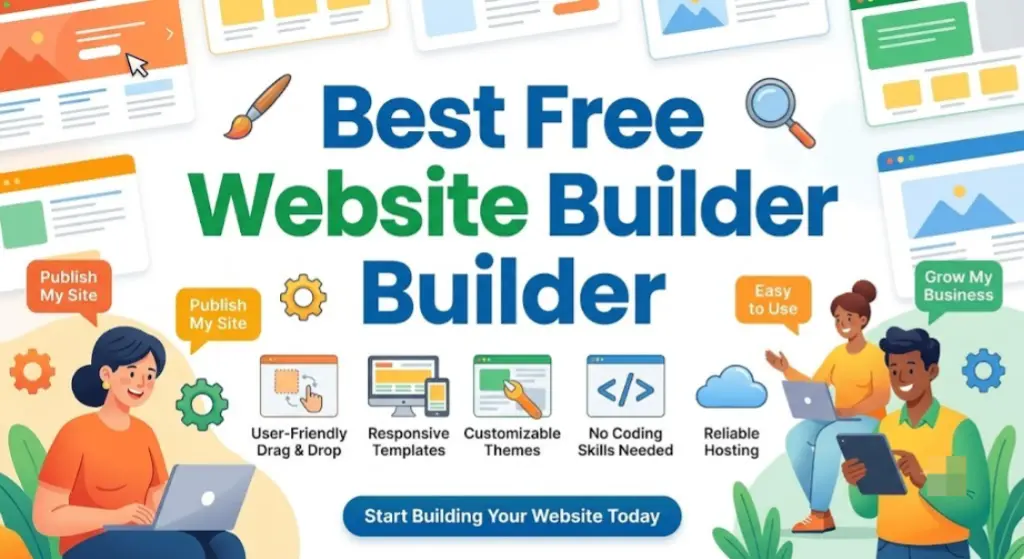
If you want to get a site online without paying a developer or learning to code, the best free website builder for you depends on one thing most articles skip: what “free” actually includes once you dig into the fine print.
Some free plans give you a real, usable website. Others are little more than a 7-day trial with a friendlier name. In this guide, we tested nine popular builders side by side — checking what you can build for $0, what gets locked behind a paywall, and which tool fits different kinds of users, from a hobby blogger to a small business owner setting up their first website.
By the end, you’ll know exactly which free website builder matches your goal, and what trade-offs to expect before you commit your time to one.
Table of Contents
Quick Answer: Best Free Website Builders at a Glance
| Builder | Best For | Free Plan Includes | Biggest Limitation |
| Wix | Beginners who want design freedom | Drag-and-drop editor, templates, hosting | Wix branding + subdomain URL |
| WordPress.com | Bloggers and content sites | Free hosting, basic themes | Limited plugins, WordPress subdomain |
| Google Sites | Simple internal or personal pages | Unlimited pages, Google integration | Very basic design tools |
| Weebly | Small business starter sites | Store front (limited), templates | Ads and Weebly branding |
| Site123 | Absolute beginners | Guided setup wizard | Small storage limit |
| Carrd | One-page sites, landing pages | Clean single-page design | Only one page on free plan |
| Webflow | Designers who want control | Visual CSS-level editing | Steep learning curve |
| Squarespace | Not truly free — trial only | 14-day full trial | No permanent free plan |
| Strikingly | Portfolios and simple landing pages | One-page free sites | Strikingly branding |
What “Free” Really Means With a Website Builder
Before comparing tools, it helps to understand the three levels of “free” you’ll run into. Almost every competitor guide skips this, and it’s the reason people get frustrated after picking a builder.
1. Genuinely free forever plans These let you publish a live, working website with no time limit — but usually with the builder’s branding on your site and a subdomain URL like yourname.wixsite.com/mysite instead of your own domain.
2. Free trials disguised as free plans Some brands market themselves as offering a free builder, but the “free” version can’t actually publish a live site — it only lets you design and preview. Squarespace works this way: it’s a 14-day trial, not a permanent free tier.
3. Freemium tools You get a real free website, but core features — like removing ads, connecting a custom domain, or accepting payments — sit behind a paid upgrade.
Knowing which category a builder falls into before you start saves hours of rebuilding work later.
The 9 Best Free Website Builders, Tested
1. Wix — Best Overall Free Website Builder
Wix remains one of the most complete free plans on the market. You get a drag-and-drop editor, over 900 templates, free hosting, and access to an app marketplace.
What you can do for free:
- Build unlimited pages on one site
- Use Wix’s AI site generator to create a first draft in minutes
- Add basic e-commerce (limited to a few products)
The catch: your site lives on a Wix subdomain and carries Wix ads until you upgrade. For most personal sites and portfolios, though, the free plan alone is genuinely usable.
Best for: beginners who want strong design control without touching code.
2. WordPress.com — Best for Blogs and Content Sites
WordPress powers a huge share of the web, and its free hosted plan (WordPress.com, not the self-hosted WordPress.org software) is a solid entry point for writers and bloggers.
What you can do for free:
- Publish unlimited blog posts and pages
- Choose from a curated set of free themes
- Get basic SEO tools built in
The catch: you can’t install custom plugins or most premium themes on the free tier, and your address will look like yoursite.wordpress.com.
Best for: anyone starting a blog, newsletter, or content-first site.
3. Google Sites — Best for Simple, No-Frills Pages
Google Sites is free, requires only a Google account, and integrates directly with Google Drive, Docs, and Calendar. It’s not built for flashy design — it’s built for function.
What you can do for free:
- Create unlimited pages
- Embed Google Docs, Sheets, Forms, and Maps directly
- Publish instantly with no approval process
The catch: design options are minimal. You won’t get the visual polish of Wix or Squarespace.
Best for: internal team pages, class projects, event pages, or simple resumes.
4. Weebly — Best for a Basic Free Online Store
Weebly (now part of Square) offers a free plan that includes limited e-commerce features, which is rare among truly free builders.
What you can do for free:
- Drag-and-drop store builder with a small product limit
- Mobile-responsive templates
- Basic SEO settings for page titles and descriptions
The catch: Weebly displays ads on the free tier and adds its branding in the footer.
Best for: someone testing a small product idea before committing to a paid e-commerce plan.
5. Site123 — Best for First-Time Website Owners
Site123 is built around a step-by-step wizard that asks what kind of site you want, then builds a starting layout for you. There’s very little to configure manually.
What you can do for free:
- Guided setup with pre-built sections
- Built-in image gallery and contact forms
- Automatic mobile version of your site
The catch: free storage and bandwidth are limited, so media-heavy sites will hit a wall fast.
Best for: people who feel overwhelmed by open-ended editors and want the tool to make decisions for them.
6. Carrd — Best for One-Page Sites
Carrd is intentionally simple: it builds fast, clean, single-page sites. Think landing pages, “link in bio” pages, or a personal profile page.
What you can do for free:
- Build and publish one site with a clean, modern look
- Add forms, galleries, and simple animations
The catch: you’re limited to one page and one project on the free plan. It’s not meant for multi-page business sites.
Best for: freelancers, event pages, or a lightweight personal landing page.
7. Webflow — Best Free Tool for Learning Web Design
Webflow’s free plan is aimed at designers who want visual control over HTML and CSS without writing code line by line.
What you can do for free:
- Build up to two projects with full design customization
- Use the free plan as a portfolio or staging site
- Export clean code (on select plans)
The catch: there’s a real learning curve. It’s closer to a visual code editor than a simple drag-and-drop tool.
Best for: aspiring designers or developers who want to understand how sites are structured, not just decorated.
8. Squarespace — Free Trial, Not a Free Plan
We’re including Squarespace because it ranks heavily in “best free website builder” searches, but it’s important to be direct: Squarespace does not have a permanent free plan. It offers a 14-day free trial with full access to its design tools.
What the trial includes:
- Full access to premium templates and design features
- Ability to preview the entire site-building experience
The catch: you cannot publish your site publicly, and it cannot stay live for free, past the trial window without payment.
Best for: people who’ve already decided on a paid builder and want to test the interface first, not for anyone needing an ongoing free site.
9. Strikingly — Best for Simple Portfolios
Strikingly focuses on single-page, mobile-first sites, similar to Carrd but with a slightly more guided template system.
What you can do for free:
- Build one live site with a decent template selection
- Add a simple contact form and social links
The catch: Strikingly branding appears on the free tier, and you’re capped at a limited amount of monthly traffic.
Best for: portfolios, personal brand pages, and simple product landing pages.
How to Choose the Right Free Website Builder for You
Instead of asking “which builder is best,” a more useful question is “what does my site actually need to do?” Use this quick decision path:
- Want a blog or content site? Start with WordPress.com.
- Want full design freedom for a personal or portfolio site? Choose Wix.
- Want a single landing page? Use Carrd or Strikingly.
- Want to sell a few products? Try Weebly.
- Want the simplest possible setup? Go with Site123.
- Want to learn real design skills? Use Webflow’s free plan.
- Just need a basic internal or informational page? Google Sites will do it in minutes.
Common Mistakes People Make With Free Website Builders
Assuming “free” means “custom domain included.” Almost every free plan gives you a subdomain, not your own web address. If you want something like yourbusiness.com instead of yourbusiness.wixsite.com, you’ll need to look into how to register a domain name and connect it, which usually requires a paid plan upgrade.
Not checking storage and bandwidth limits before uploading media. Free tiers often cap how many images, videos, or visitors your site can handle per month. A photography portfolio can hit that ceiling fast.
Ignoring the page URL structure. Search engines and visitors both respond better to clean, readable web addresses. Before publishing, it’s worth understanding what a URL is and how a well-structured URL slug can make pages easier to find and share.
Skipping basic SEO settings. Even free builders usually let you edit page titles, meta descriptions, and image alt text. Skipping this step means your new site is harder for Google to understand and rank, and it also affects URL SEO fundamentals like keyword placement in your page paths.
Not planning for growth. If you expect to add e-commerce, a blog, or more pages later, check whether the builder lets you upgrade smoothly. Some tools make it painful to migrate content once you outgrow the free tier — which matters if you’re already thinking about how much a website costs as your project scales.
Free Website Builder vs. Buying Hosting and a Domain Separately
Some people skip website builders entirely and instead buy hosting plus a domain and install software like self-hosted WordPress. Here’s how the two approaches compare:
| Factor | Free Website Builder | Domain + Hosting Setup |
| Cost to start | $0 | Domain + hosting fees apply immediately |
| Setup difficulty | Very easy | Requires more technical steps |
| Design flexibility | Limited to builder’s tools | Full control |
| Custom domain | Usually a paid upgrade | Included from day one |
| Long-term scalability | Can be limited | Generally more scalable |
If you eventually go the domain-and-hosting route, it helps to understand domain name services, how to pick a best domain name registrar, and what a fully qualified domain name actually is, since these concepts apply whether you’re using a builder or hosting a site yourself.
Frequently Asked Questions
What is the best free website builder overall? For most beginners, Wix offers the strongest balance of design flexibility, ease of use, and features on its free plan. WordPress.com is the better choice specifically for blogs and written content.
Is there a truly 100% free website builder with no ads? Not really. Nearly every free plan includes either the builder’s branding, ads, or both. Removing them typically requires a paid upgrade.
Can I use my own domain name with a free website builder? Usually not on the free tier. Connecting a custom domain — instead of a subdomain like yoursite.wixsite.com — is one of the most common reasons people upgrade to a paid plan. If you already own a domain, some builders let you point it at your free site, though the process varies by provider.
Which free website builder is best for a small business? Weebly and Wix are the strongest options if you need basic e-commerce or a professional-looking small business site. For a deeper comparison focused specifically on business needs, see our guide on the best website builder for small business.
Do free website builders hurt my Google ranking? Not directly. Search engines don’t penalize a site for using a builder. What matters more is page speed, mobile-friendliness, and content quality. That said, subdomains (like yoursite.wixsite.com) can look less credible to visitors than a custom domain, which indirectly affects clicks and trust.
How do I know if a “free” builder is actually a trial? Check whether the plan lets you publish a live, public website with no time limit. If it only lets you preview or design without publishing — like Squarespace’s 14-day trial — it’s a trial, not a free plan.
What’s the easiest free website builder for a complete beginner? Site123 and Google Sites are the simplest, since both use guided setups that remove most design decisions. Wix’s AI site generator is also a strong beginner option if you want more visual customization.
Can I later move my website to a different platform? It depends on the builder. Some, like WordPress.com, make exporting content easier. Others, especially fully proprietary drag-and-drop tools, make migration harder since your design doesn’t transfer directly to another platform.
Final Thoughts
There isn’t a single “best” free website builder for everyone — there’s a best fit for what you’re building. A blogger, a small business owner, and a freelancer showing off a portfolio all have different needs, and the right free plan reflects that.
Start with the tool that matches your specific goal from the comparison above, publish a working version of your site, and treat the free plan as your starting point rather than your final destination. Once your traffic grows, you can evaluate whether a custom domain and a paid upgrade — or even how to increase website traffic through better SEO — make sense for where your project is headed.