Choosing the best domain name registrar matters more than most people realize when they first buy a domain. The registrar you pick affects your pricing long after the first year, how well your domain is protected from hijacking, and how much friction you’ll deal with if you ever need to transfer or manage it.
There’s no single “best” registrar for everyone — the right choice depends on whether you value the lowest possible renewal price, the strongest security features, or the easiest beginner experience. This guide compares the top domain name providers by pricing, security, and features, so you can match your choice to what actually matters for your situation.
Table of Contents
What Makes a Domain Name Registrar “Best”?
Before comparing providers, it helps to know what separates a genuinely good registrar from one that just looks appealing at checkout.
- Transparent renewal pricing – Many registrars advertise low first-year rates that jump significantly at renewal
- Free WHOIS privacy – This should be standard, not a paid add-on, since it protects your personal contact details from public databases
- Strong account security – Two-factor authentication (2FA), domain locking, and DNSSEC support all matter
- Straightforward transfer policy – A good registrar makes it easy to leave, not just easy to join
- Reliable DNS management – Fast, stable DNS infrastructure keeps your website and email running smoothly
If you haven’t registered a domain yet, our guide on how to register a domain name walks through the full process once you’ve picked a provider.
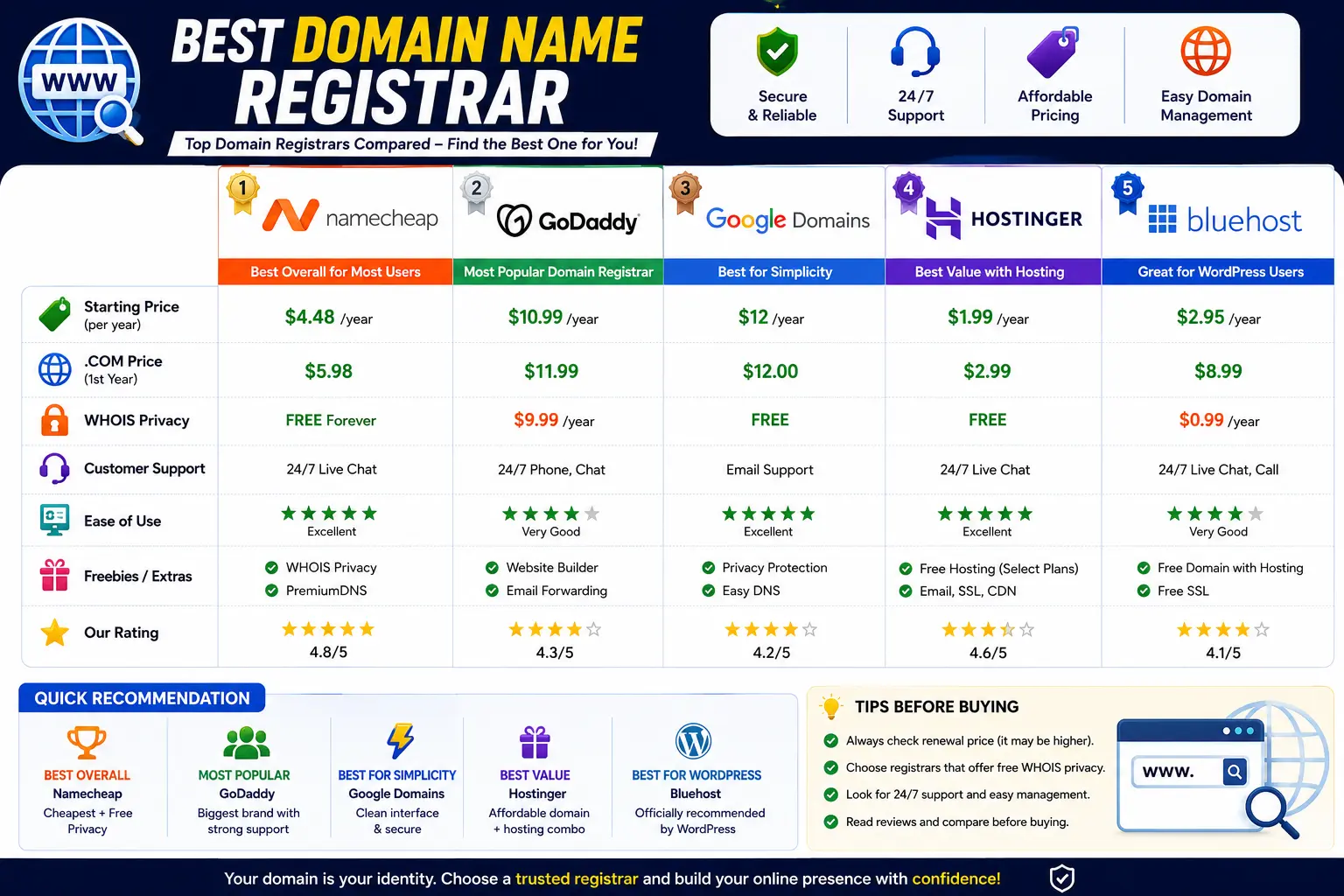
Best Domain Name Registrars Compared
| Registrar | Best For | Approx. .com Pricing | WHOIS Privacy | Security Features |
| Cloudflare Registrar | Lowest long-term cost, developers | At-cost, zero markup | Free | <cite index=”38-1″>Free DNSSEC, 2FA, and domain lock included</cite> |
| Porkbun | Beginners wanting low renewal pricing | <cite index=”29-1″>Flat, low renewal pricing</cite> | Free | 2FA, DNSSEC |
| Namecheap | Overall balance of price and usability | Competitive first-year and renewal pricing | Free | <cite index=”35-1″>Hardware security key (U2F/FIDO2) support for 2FA</cite> |
| Spaceship | Modern interface, fast setup | <cite index=”35-1″>Below-cost renewals around $9.98</cite> | Free | Free WHOIS privacy and DNSSEC |
| Dynadot | Domain investors and bulk management | <cite index=”27-1″>Competitive pricing across many TLDs</cite> | <cite index=”27-1″>Free with every domain</cite> | 2FA available |
| NameSilo | Budget buyers and bulk portfolios | Affordable across most TLDs | Free | Registration change notifications |
| DNSimple | DNS-focused technical users | Budget-friendly plans | Free | Strong DNS-layer security tools |
| GoDaddy | Beginners wanting bundled tools | <cite index=”28-1″>Higher renewal pricing than most competitors</cite> | Free with 2FA | 2FA, domain lock |
Pricing changes frequently across the industry, so always confirm current rates directly on a registrar’s site before purchasing. For a deeper breakdown of what drives these numbers, see our guide on how much does a domain name cost.
Best Domain Name Provider by Use Case
If You Want the Lowest Long-Term Cost
Cloudflare Registrar and Porkbun consistently come out ahead here. <cite index=”31-1″>For buyers focused purely on lowest total cost, Cloudflare (where the extension is supported) and Porkbun or NameSilo elsewhere are the strongest picks</cite>. Cloudflare in particular passes domains through at the exact price it pays the registry, without adding a markup.
If You’re a Complete Beginner
Namecheap and Porkbun are frequently recommended for first-time domain buyers because of their <cite index=”29-1″>clean interfaces and beginner-friendly checkout process</cite>. Both also include free WHOIS privacy by default, which removes one extra decision during setup.
If You Want Bundled Website Tools
GoDaddy remains a common choice for beginners who want a domain, hosting, email, and a website builder from a single provider, since it <cite index=”28-1″>offers a wide range of domains alongside bundled services such as web hosting, email, and website-building tools</cite>. Just be aware that its renewal pricing tends to run higher than more DNS-focused competitors.
If You’re a Developer or Manage Multiple Domains
Cloudflare and Dynadot stand out here. <cite index=”35-1″>Cloudflare Registrar offers at-cost pricing with strong REST API access and automatic DNSSEC</cite>, while <cite index=”35-1″>NameSilo and Dynadot provide stronger bulk management tools with volume discounts</cite> for larger domain portfolios.
Most Secure Domain Name Registrar: What to Look For
Security should weigh just as heavily as price, especially if your domain supports a business, since losing control of it can take your website, email, and customer trust down with it.
Key Security Features to Prioritize
- Two-factor authentication (2FA) – Ideally with hardware key support, not just SMS codes
- DNSSEC – <cite index=”35-1″>Now offered free by nearly every major registrar, though implementation quality varies</cite>
- Registry lock or domain lock – Prevents unauthorized transfers or changes without additional verification
- Free WHOIS privacy – <cite index=”33-1″>Any registrar still charging extra for basic WHOIS privacy in 2026 is an outdated practice worth avoiding</cite>
- Audit logs and account activity alerts – Useful for catching suspicious changes early
Registrars Known for Strong Security
<cite index=”34-1″>GoDaddy, Namecheap, Dynadot, IONOS, Hostinger, and Name.com all stand out for offering free WHOIS privacy alongside account-level two-factor authentication</cite>. For teams managing especially sensitive domains, <cite index=”35-1″>Namecheap leads with support for hardware security keys (U2F/FIDO2)</cite>, which offers stronger protection than SMS-based 2FA alone.
A Note on Registrar Reputation and Terms of Service
Registrar reputation isn’t static — policies and terms can change, sometimes significantly. <cite index=”35-1″>As one example, GoDaddy updated its Terms of Service in February 2026 to reclassify its customer base as “Business Customers,” which affected certain consumer protections previously in place for EU users</cite>. This is a useful reminder to periodically review your registrar’s current terms, rather than assuming the reputation you researched when signing up still applies years later.
Domain Name Registrar Reviews: What Real Users Value Most
Across independent comparisons and technical communities, a few consistent themes stand out:
- Renewal pricing matters more than sign-up pricing. <cite index=”33-1″>The difference between the cheapest and most expensive registrar can add up to hundreds of dollars over a domain portfolio’s lifetime</cite>, so always check renewal rates before committing.
- Free WHOIS privacy is now the baseline expectation, not a premium feature.
- Transfer-out fees are worth checking. <cite index=”33-1″>Some registrars still charge to leave, even though ICANN rules prohibit blocking the transfer itself</cite>.
- DNS quality varies more than people expect. Strong Anycast networks and reliable DNSSEC implementation directly affect your website’s speed and resilience.
Common Mistakes When Choosing a Domain Registrar
- Focusing only on the first-year price. A cheap introductory rate can mask a much higher renewal cost.
- Assuming all WHOIS privacy is equal. Some registrars offer full privacy by default; others require manually enabling it or charge extra.
- Skipping 2FA setup after registering. Even the most secure registrar can’t protect an account that hasn’t enabled its own security features.
- Ignoring transfer policies until you need to leave. By then, hidden transfer-out fees or restrictions can catch you off guard.
- Choosing based on brand recognition alone. A well-known name doesn’t automatically mean better pricing, security, or support than smaller, more specialized registrars.
Best Practices When Selecting and Managing a Registrar
- Compare renewal pricing, not just registration pricing, using our guide on domain name cost as a reference point.
- Enable 2FA immediately after registering a new domain, ideally with a hardware key if the registrar supports it.
- Keep contact information current. Outdated contact details can delay recovery if something goes wrong with your domain.
- Consider splitting critical domains across two registrars if you manage a larger portfolio, reducing the risk of a single point of failure.
- Review your registrar’s terms periodically, since policies and consumer protections can change over time.
Frequently Asked Questions
What is the best domain name registrar overall?
There isn’t a single universal answer — Cloudflare and Porkbun are strong picks for lowest long-term cost, Namecheap and Porkbun are popular with beginners, and GoDaddy remains common for users wanting bundled hosting and website tools.
What is the most secure domain name registrar?
Registrars offering free 2FA (ideally with hardware key support), DNSSEC, domain locking, and free WHOIS privacy — such as Namecheap, Cloudflare, and Dynadot — are generally considered among the most secure options.
Is a more expensive domain registrar always better?
No. Price doesn’t always correlate with quality. Some of the most affordable registrars, like Cloudflare and Porkbun, also rank among the most secure and reliable.
What should I check before choosing a domain name provider?
Compare renewal pricing (not just sign-up pricing), confirm whether WHOIS privacy is included for free, and check what security features — like 2FA and domain locking — are available by default.
Can I switch domain registrars later if I’m not happy?
Yes. Domain transfers between registrars are a standard process, though most require the domain to be at least 60 days old. Our guide on transfer domain name covers the full process.
Do all registrars offer the same domain extensions?
No. While nearly every registrar supports common extensions like .com and .net, support for specialized or country-specific TLDs varies between providers.
Final Thoughts
The best domain name registrar for you depends on what you’re optimizing for — rock-bottom renewal pricing, strong security, or an all-in-one beginner experience. Cloudflare and Porkbun tend to win on long-term cost, Namecheap balances price with strong security options, and GoDaddy remains a solid choice for anyone who wants hosting and domain management bundled together.
Once you’ve chosen a provider, check out our guides on how to register a domain name and how to choose a domain name to make sure the rest of your setup is just as solid as the registrar behind it.