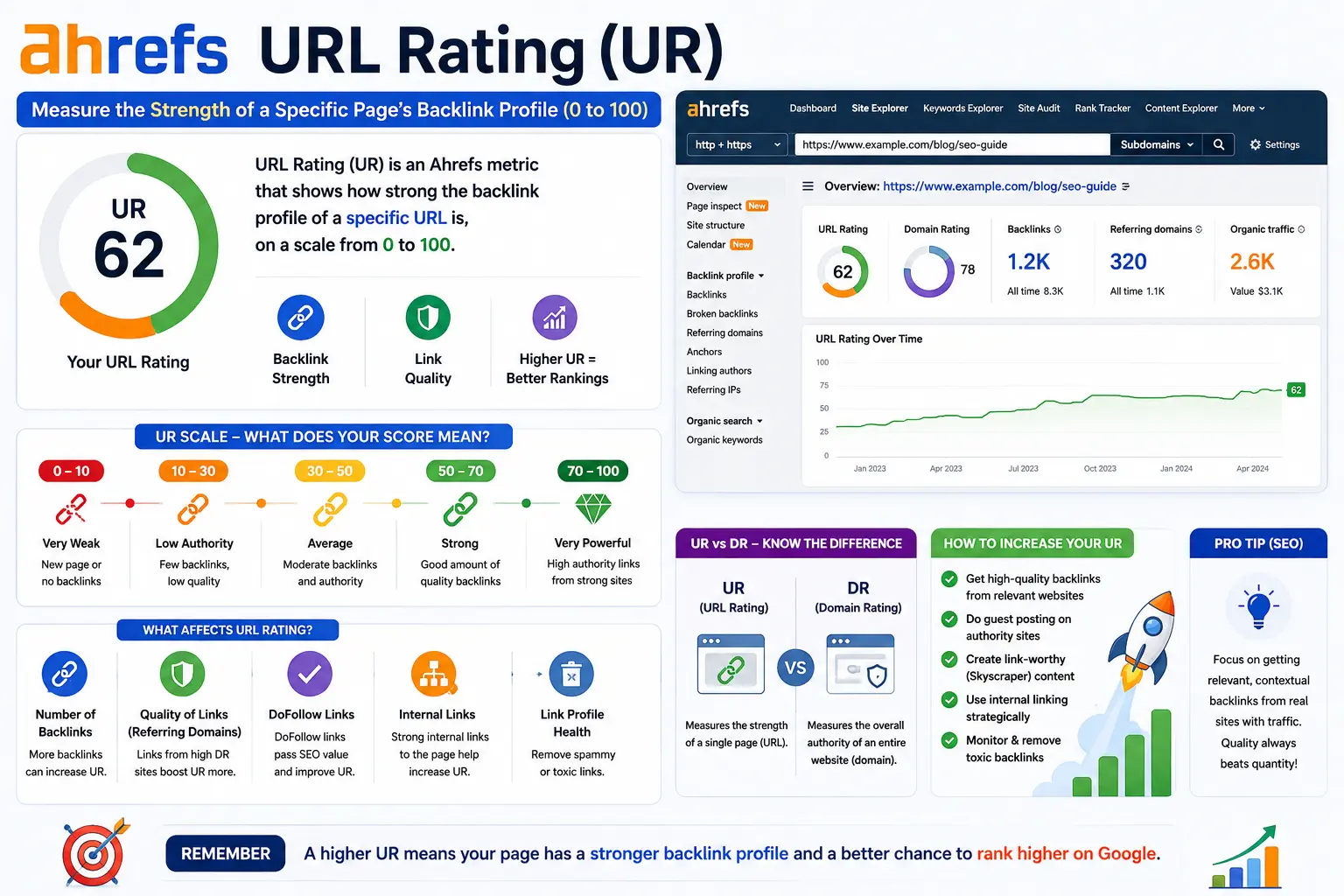
Ahrefs URL Rating (UR), usually shown as UR, is a page-level metric that measures how strong a single webpage’s backlink profile is, scored on a scale from 0 to 100. The higher the number, the more link authority that specific page has earned — not the whole website, just that one URL.
If you’ve ever opened Ahrefs and seen a number sitting next to a page, that’s URL Rating. It’s one of Ahrefs’ core proprietary metrics, alongside Domain Rating (DR), and understanding the difference between the two can completely change how you plan link building and evaluate competitor pages.
This guide breaks down exactly what URL Rating means, how Ahrefs calculates it, how it compares to Domain Rating, and what you can actually do to improve it.
Table of Contents
What Is URL Rating (UR)?
URL Rating is Ahrefs’ way of estimating how much link-based authority one specific page has accumulated. It works similarly to how a URL itself identifies one exact page rather than an entire website — UR follows that same page-specific logic, scoring one URL at a time instead of a domain as a whole.
Every individual page on a website — a homepage, a blog post, a product page — gets its own separate UR score, because each page earns links independently of the rest of the site.
Key facts about URL Rating:
- Scored on a 0–100 scale
- Measured on a logarithmic curve, not a straight line
- Based on both backlinks and internal links
- Only dofollow (followed) links pass UR
- Higher UR generally correlates with stronger ranking potential
How Is Ahrefs URL Rating Calculated?
Ahrefs doesn’t publish its exact formula, but the underlying concept is modeled after Google’s original PageRank system — link equity flows from one page to another, and pages that receive links from already-authoritative pages accumulate more of that equity themselves.
Here’s what’s known to factor into the calculation:
- Number and quality of backlinks pointing directly to that specific URL
- The UR of the linking pages — a link from a high-UR page passes more value than one from a low-UR page
- Internal links from other pages on the same site
- Only dofollow links count — nofollow, sponsored, and user-generated content links don’t pass UR
- Link scheme detection — Ahrefs filters out artificial link patterns designed to inflate scores, similar to how Google devalues manipulative linking
Why URL Rating Uses a Logarithmic Scale
One detail that trips up beginners is that UR isn’t a simple, evenly-spaced scale. It’s logarithmic, meaning the gap between low scores is much smaller in real-world effort than the gap between high scores.
| Movement | Difficulty |
| UR 10 → UR 20 | Relatively easy |
| UR 30 → UR 40 | Moderate |
| UR 60 → UR 70 | Difficult |
| UR 80 → UR 90 | Very difficult |
In practice, this means a brand-new page can jump from UR 5 to UR 20 with a handful of decent backlinks, but pushing an already-strong page from UR 70 to UR 80 requires a significantly larger and higher-quality link profile.
URL Rating vs. Domain Rating: What’s the Difference?
This is the single most common point of confusion when people first start using Ahrefs. Both metrics use a 0–100 logarithmic scale, but they measure completely different things.
| Feature | URL Rating (UR) | Domain Rating (DR) |
| What it measures | One specific page | The entire website |
| Scale | 0–100 (logarithmic) | 0–100 (logarithmic) |
| Based on | Backlinks + internal links to that URL | Referring domains to the whole site |
| Can vary within a site? | Yes — every page has its own UR | No — one DR score per domain |
| Best used for | Evaluating one page’s link strength | Evaluating overall site authority |
A simple way to remember it: DR is the reputation of the entire company. UR is the reputation of one specific employee within that company. A well-known company (high DR) can still have a brand-new employee (low UR) who hasn’t built a reputation yet.
This also explains a pattern many SEOs notice: a page on a high-DR website can still have a very low UR if almost nobody links directly to that specific page, while a single standout page on a smaller, lower-DR site can have a high UR if it’s earned strong backlinks of its own.
How to Check a Page’s URL Rating
You can find any page’s UR using Ahrefs’ Site Explorer tool:
- Log in to Ahrefs (or use the free Site Explorer for limited data).
- Paste the exact page URL into the search bar.
- Select Exact URL mode (not the whole domain).
- The UR score appears at the top of the report, alongside DR, referring domains, and backlink counts.
Since UR is tied to one exact address, checking it correctly means pasting the specific page’s full URL — protocol, domain, and path included — rather than just the domain name alone.
What’s a “Good” URL Rating?
There’s no single universal benchmark, because a “good” UR depends entirely on the competitiveness of what you’re trying to rank for. A more reliable approach is comparing your page’s UR against the pages currently ranking for your target keyword.
| UR Range | General Interpretation |
| 0–10 | New or unlinked page |
| 11–30 | Modest link profile |
| 31–50 | Solid, competitive link profile |
| 51–70 | Strong authority for that page |
| 71–100 | Very strong, typically major or highly-linked pages |
If the top-ranking pages for your target keyword all sit around UR 40+ and your page is at UR 10, that’s a signal you likely need stronger backlinks — and possibly better internal linking — before that page can realistically compete.
How to Improve URL Rating
1. Earn backlinks directly to that specific page Since UR is page-specific, links to your homepage won’t boost a blog post’s UR. You need links pointing directly at the page you’re trying to strengthen.
2. Prioritize quality over quantity A single backlink from a high-UR, relevant page is worth far more than dozens of links from weak, low-authority pages.
3. Use internal linking strategically Internal links pass UR too, and it’s one of the most overlooked levers. Linking from your strongest, highest-UR pages to newer or weaker ones helps distribute authority across your site.
4. Avoid nofollow-only link building Since nofollow, sponsored, and UGC links don’t pass UR, a backlink strategy built entirely on these link types won’t move the needle on this specific metric — even if it still brings referral traffic.
5. Watch out for manipulative link patterns Ahrefs’ algorithm actively filters out artificial link loops and manipulative linking schemes, so chasing UR through low-quality link exchanges tends to produce little lasting benefit.
Common Mistakes People Make With URL Rating
- Confusing UR with DR. A high-DR website doesn’t automatically mean every page on it has a high UR — each page earns its own score.
- Assuming UR is a Google ranking factor. It isn’t. UR is Ahrefs’ own proprietary metric, used as a directional indicator, not something Google itself calculates or uses.
- Chasing the number instead of real authority. Building spammy links purely to inflate UR often gets filtered out by Ahrefs’ algorithm and provides no real ranking benefit.
- Checking the wrong URL variant. Ahrefs treats slightly different URLs — such as one with a trailing slash and one without — as separate pages, which can lead to checking the wrong version and seeing a misleadingly low score.
- Ignoring internal linking entirely. Many site owners focus only on external backlinks and overlook internal links as a real, controllable way to raise a page’s UR.
Frequently Asked Questions
What is Ahrefs URL Rating (UR)? It’s a page-level metric from Ahrefs that scores the backlink strength of one specific webpage on a 0–100 logarithmic scale, with higher scores indicating a stronger link profile for that page.
What’s the difference between Domain Rating and URL Rating? Domain Rating measures the backlink authority of an entire website, while URL Rating measures the backlink authority of one individual page. A site can have a high DR with individual pages that still have very low UR.
Is URL Rating a Google ranking factor? No. URL Rating is Ahrefs’ own proprietary metric, not something Google calculates or uses directly. However, it tends to correlate with ranking performance because it models a similar concept to Google’s original link-based authority system.
What is a good Ahrefs URL Rating score? It depends on your niche and competition. A more useful benchmark is comparing your page’s UR to the UR of pages currently ranking for the same target keyword.
Do internal links affect URL Rating? Yes. Internal links from other pages on your own site pass authority and can meaningfully raise a page’s UR, especially when linked from your site’s stronger, higher-UR pages.
Do nofollow links affect UR? No. Only dofollow (followed) links pass URL Rating. Nofollow, sponsored, and user-generated content links do not contribute to the score.
Final Thoughts
Ahrefs URL Rating gives you a focused, page-by-page view of link authority that Domain Rating simply can’t provide on its own. Instead of asking how strong your whole website is, UR asks a much more specific and often more useful question: how strong is this exact page’s link profile?
Used correctly — alongside real ranking data, content quality, and competitor research — URL Rating becomes a genuinely practical tool for prioritizing link building, planning internal linking, and understanding exactly why some pages outrank others even on similarly authoritative websites.