If you’ve ever clicked on blue, underlined text inside an article, you’ve used anchor text. But anchor text in SEO is more than just clickable words — it’s one of the strongest signals search engines use to understand what a linked page is about.
In this guide, you’ll learn exactly what anchor text is, why it matters for rankings, the different types you can use, real examples, and the mistakes that can get a site penalized. No jargon — just a clear, practical explanation you can apply today.
Table of Contents
What Is Anchor Text?
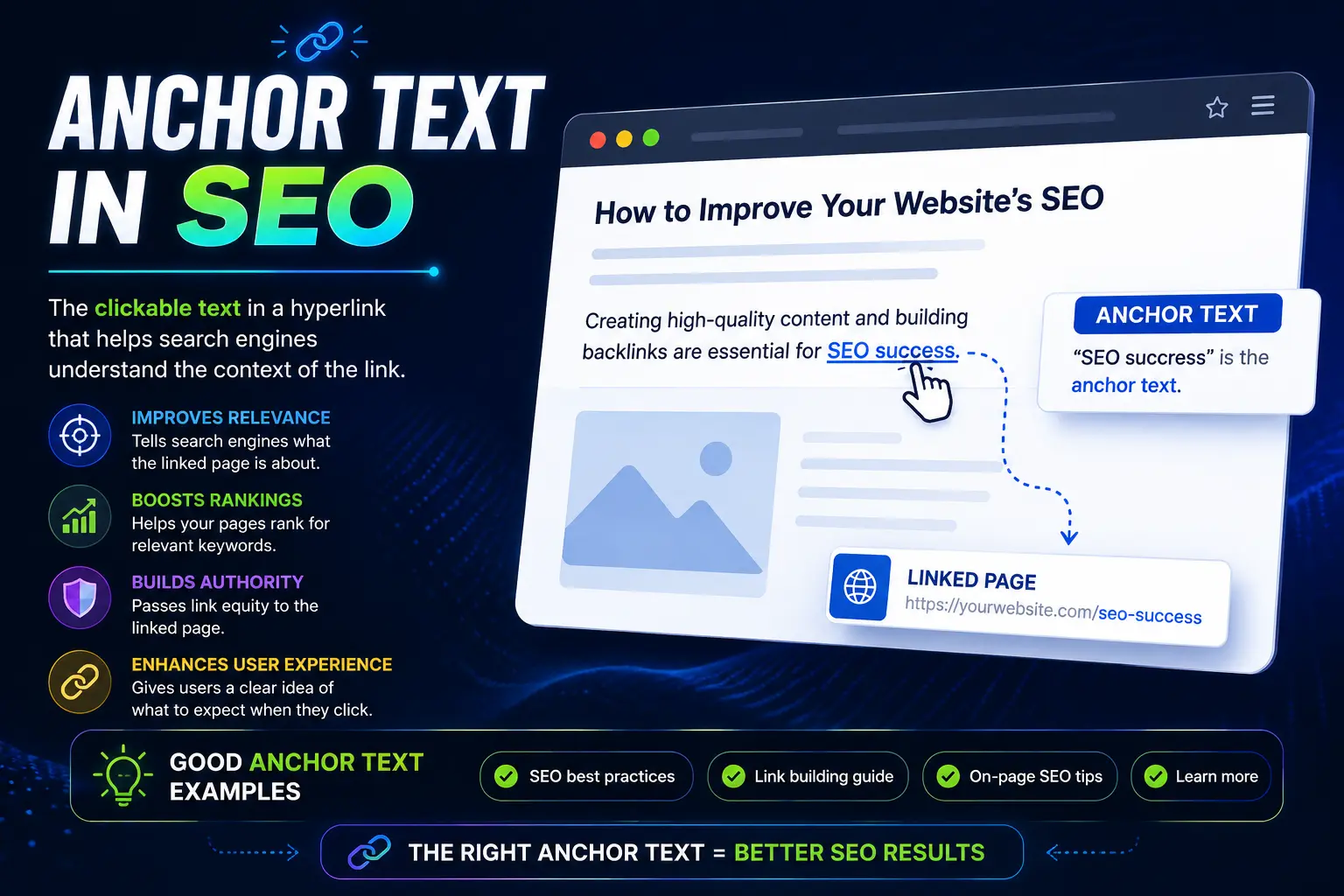
Anchor text is the clickable, visible text of a hyperlink. It’s usually styled in a different color (often blue) and underlined so readers can spot it easily.
For example, in the sentence below, the underlined phrase is the anchor text:
Learn more about content marketing strategies for beginners.
Behind that visible text sits a URL — the destination the link points to. In HTML, anchor text lives inside an <a> tag, like this:
<a href=”https://example.com/content-marketing”>content marketing strategies</a>
The words between <a href=”…”> and </a> are the anchor text. Everything else (the href attribute) is the link destination that the reader doesn’t see directly.
Why Is It Called “Anchor” Text?
The term comes from the HTML <a> tag itself, which historically stood for “anchor.” Early web pages used anchor tags to jump between sections of a document, much like an anchor holds a boat in place at a specific spot. Over time, “anchor” became the standard term for any link’s clickable text.
Why Anchor Text Matters for SEO
Anchor text does two main jobs, one for humans and one for search engines.
For users: It sets expectations. Good anchor text tells a reader exactly what they’ll find if they click, which builds trust and improves the experience.
For search engines: It acts as a relevance signal. Google uses the words in anchor text to understand what the linked page is likely about — almost like a mini description written by whoever created the link.
This matters because links from other sites (backlinks) are one of Google’s oldest and most reliable ranking factors. When multiple websites link to your page using similar, relevant anchor text, it reinforces to Google that your page is a strong match for that topic.
Google itself has confirmed that anchor text contributes to how it evaluates the topic and relevance of a linked page, which is why SEOs pay close attention to it during both content creation and link building.
Types of Anchor Text (With Examples)
Not all anchor text looks the same. Here’s a breakdown of the main types used in SEO, with examples of each.
| Type | Description | Example |
| Exact Match | The anchor text matches the target keyword word-for-word | “email marketing tools” links to a page about email marketing tools |
| Partial Match | Contains the keyword plus extra words | “best email marketing tools for startups” |
| Branded | Uses a company or brand name | “HubSpot” or “Mailchimp” |
| Generic | Vague, non-descriptive phrases | “click here,” “read more,” “this page” |
| Naked URL | The raw URL is used as the anchor text | “https://example.com/blog” |
| Image Anchor | An image is the clickable element; its alt text acts as the anchor text | An image with alt text “email marketing dashboard” |
| LSI / Related Keyword | Uses synonyms or semantically related terms instead of the exact keyword | “newsletter automation software” for a page about email marketing tools |
| Long-Tail | A longer, more specific phrase | “how to choose an email marketing tool in 2026” |
Exact Match Anchor Text
This is when the anchor text is identical to the keyword the target page is trying to rank for.
Example: Linking the phrase “anchor text in SEO” directly to this article.
Exact match anchor text is powerful for relevance signals, but overusing it — especially in backlinks from other websites — can look unnatural and trigger algorithmic scrutiny. Use it sparingly and only where it reads naturally.
Partial Match Anchor Text
This includes the target keyword along with additional words that make the phrase read more naturally.
Example: Instead of “anchor text,” you might use “understanding anchor text in SEO.”
Partial match is generally safer and more natural-sounding than exact match, which is why most experienced SEOs lean on it more heavily.
Branded Anchor Text
This uses a recognizable brand or company name instead of a keyword.
Example: “According to Ahrefs, backlinks remain a top ranking factor.”
Branded anchor text is considered the safest and most natural type because it mirrors how people actually talk and link online. A healthy backlink profile typically has a high percentage of branded anchors.
Generic Anchor Text
Phrases like “click here,” “this article,” or “learn more” fall into this category. They give no topical information to search engines but are common in natural, everyday writing — which is exactly why a healthy link profile includes some of them.
Naked URL Anchor Text
This happens when the URL itself is pasted as the anchor, such as https://searchglossary.com/anchor-text-in-seo. It’s common in reference lists, citations, and forum posts, and it looks completely natural to Google since real websites link this way too.
Image Anchor Text
When an image is wrapped in a hyperlink, Google reads the image’s alt attribute as the anchor text. This is why writing descriptive, keyword-relevant alt text matters even when you’re not directly using written anchor text.
Internal vs. External Anchor Text
Anchor text works differently depending on where the link lives.
Internal anchor text connects pages within your own website. You have full control over the wording, so this is the safest place to use keyword-rich anchors. For example, linking the phrase “on-page SEO checklist” from a blog post to your dedicated on-page SEO guide helps both users and Google understand your site structure.
External anchor text (also called backlink anchor text) comes from other websites linking to yours. You have far less control here, since it depends on how other site owners choose to link to you. This is also the type of anchor text Google scrutinizes most closely for manipulation, because it’s traditionally been used to “vote” for a page’s relevance.
How to Choose the Right Anchor Text
There’s no single “correct” anchor text for every link. Instead, follow these principles:
- Match the anchor to the destination page’s actual topic. Don’t link the words “digital marketing” to a page that’s only about email subject lines.
- Keep it natural and readable. The anchor should fit the sentence grammatically, not feel forced in.
- Vary your anchor text types. Mix branded, partial match, and generic anchors rather than repeating the same exact-match phrase every time.
- Prioritize the reader first. If the anchor text clearly tells someone what they’ll get by clicking, it’s usually also good for SEO.
- Keep it reasonably short. Long, sentence-length anchors dilute relevance and look spammy.
A Simple Example
Imagine you run a site about home coffee brewing and you’re linking to a guide on pour-over coffee.
- Poor: “Click here to read more.”
- Better (generic + descriptive): “check out this pour-over guide.”
- Best (natural partial match): “our step-by-step guide to pour-over coffee.”
The last option tells both the reader and Google exactly what the linked page covers, without sounding robotic.
Anchor Text Best Practices
- Use descriptive, specific anchor text instead of “click here” whenever possible.
- Keep exact-match anchors to a small percentage of your overall backlink profile — most SEOs recommend well under 10-20%.
- Vary anchor text naturally across branded, partial-match, generic, and naked URL types.
- Make sure the anchor text accurately represents the linked page’s content — never mislead readers.
- For internal links, use anchor text that reflects the target page’s main keyword or topic.
- Write alt text for linked images as if it were anchor text, since Google treats it that way.
- Avoid linking the same exact phrase to different, unrelated pages across your site.
Common Anchor Text Mistakes to Avoid
1. Over-optimizing with exact match anchors. Repeating the same keyword-rich anchor text across dozens of backlinks looks manipulative to Google’s algorithms and has been linked to ranking penalties in the past.
2. Using vague anchors everywhere. A site built entirely on “click here” and “read more” wastes an easy opportunity to reinforce topical relevance.
3. Mismatched anchor and destination. Linking the phrase “best running shoes” to a page about running socks confuses both users and search engines.
4. Ignoring internal linking. Many site owners focus only on backlinks and forget that internal anchor text is a free, fully controllable SEO lever.
5. Keyword-stuffed anchors. Cramming multiple keywords into one anchor (“cheap best affordable running shoes 2026 sale”) reads as spam and rarely converts clicks.
6. Forgetting mobile and accessibility. Screen readers announce anchor text out loud, so vague links create a poor experience for users relying on assistive technology.
Anchor Text and Google’s Algorithm
Anchor text has been part of Google’s ranking systems since the original PageRank research, which recognized that the text surrounding and describing a link carries meaningful information about the linked page’s topic.
Over the years, algorithm updates — most notably Penguin — specifically targeted sites using unnatural, manipulative anchor text patterns as part of aggressive link-building schemes. Since then, Google has become significantly better at detecting anchor text profiles that look artificially optimized rather than naturally earned.
This is why modern SEO advice leans toward diversity and naturalness in anchor text rather than heavy exact-match repetition. A natural backlink profile typically looks messy — a mix of branded mentions, naked URLs, generic phrases, and only occasional exact-match keywords.
Anchor Text FAQs
What is anchor text in SEO with an example? Anchor text in SEO is the clickable text of a hyperlink that tells users and search engines what the linked page is about. For example, in the phrase “learn more about email marketing tools,” the words “email marketing tools” are the anchor text if they’re hyperlinked.
What does anchor text mean in simple terms? It simply means the visible words you click on to follow a link. If a word or phrase is underlined and clickable, that’s the anchor text.
Is anchor text still important for SEO in 2026? Yes. While Google’s algorithms have grown more sophisticated, anchor text remains one of the clearest relevance signals for both internal linking and backlinks, and it directly affects how well search engines understand a page’s topic.
How much anchor text should be exact match? Most SEO practitioners recommend keeping exact-match anchor text to a small share of your total backlinks, often cited around 5-10%, with the rest spread across branded, partial-match, generic, and naked URL types.
Can too much anchor text optimization hurt rankings? Yes. Over-optimized, repetitive exact-match anchor text is a known pattern associated with algorithmic penalties, since it signals manipulation rather than natural link earning.
What is the difference between anchor text and a hyperlink? A hyperlink is the entire clickable element, including its destination URL. Anchor text is specifically the visible, readable portion of that hyperlink that users see and click.
Does anchor text affect image links? Yes. When an image functions as a link, Google treats the image’s alt text as the equivalent of anchor text, so descriptive alt text still contributes to relevance signals.
Key Takeaways
- Anchor text is the clickable text of a hyperlink, and it helps both users and search engines understand what a linked page is about.
- The main types are exact match, partial match, branded, generic, naked URL, image, and long-tail anchor text.
- Internal anchor text is fully within your control and should be used strategically; external anchor text needs to look natural and varied.
- Over-optimizing with exact-match anchor text can trigger algorithmic penalties, so diversity and natural phrasing matter more than keyword density.
- Good anchor text always prioritizes clarity for the reader first — SEO benefits follow naturally from that.