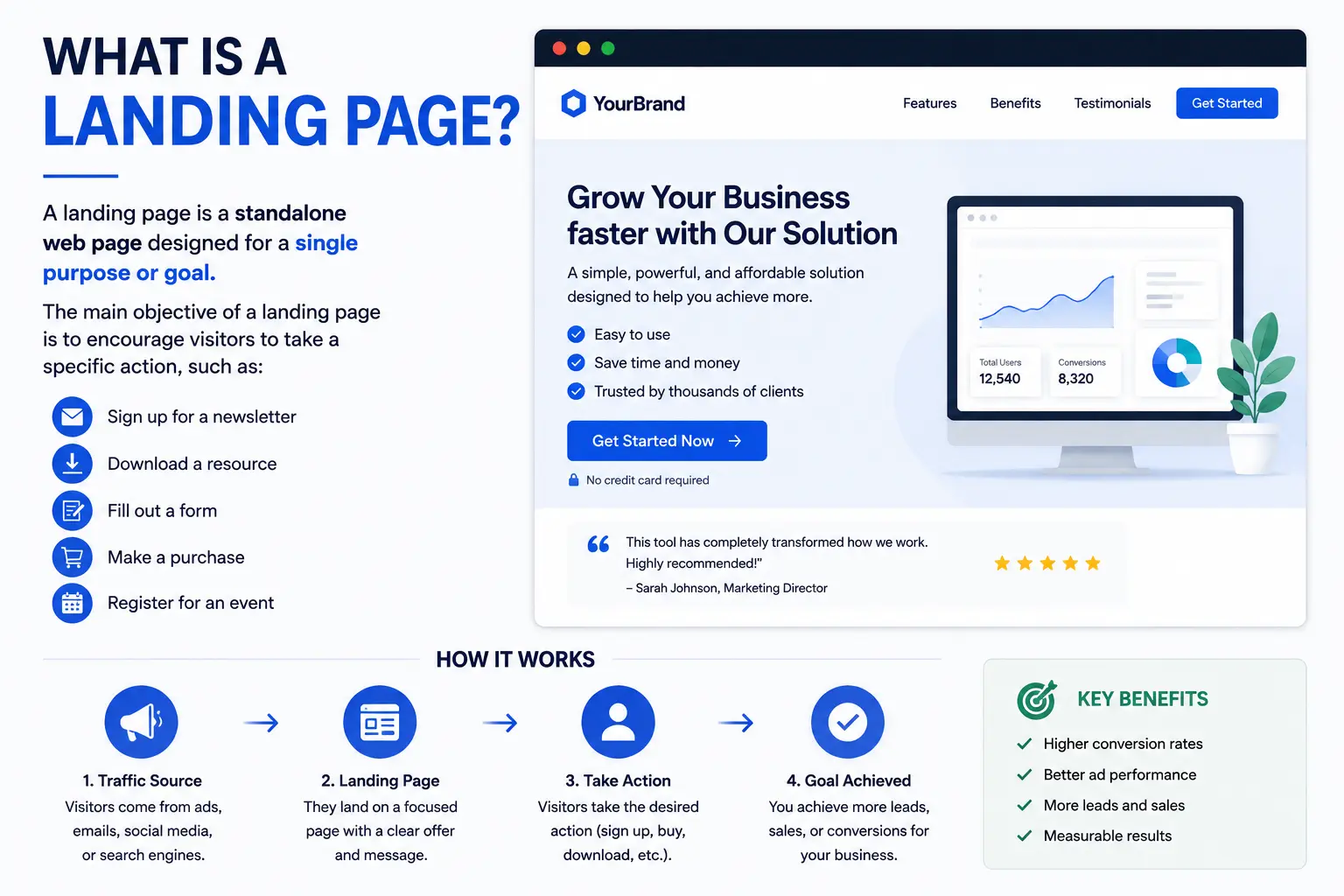
What is a landing page conversion? It’s the moment a visitor completes the specific action a landing page was built for — signing up, buying, registering, or downloading — turning them from an anonymous visitor into a lead, customer, or subscriber.
Every landing page exists to produce this one moment. This guide covers exactly what counts as a conversion, how to calculate your landing page’s conversion rate, what a realistic benchmark actually looks like, and the specific changes that move that number in the right direction.
Table of Contents
Landing Page Conversion: The Core Definition
A conversion happens when a visitor takes the exact action a landing page was designed around. What that action is depends entirely on the page’s specific goal:
- Filling out a lead form
- Completing a purchase
- Registering for a webinar or event
- Downloading a resource (an ebook, template, or guide)
- Starting a free trial
- Booking a call or consultation
Important distinction: a conversion isn’t just any activity on the page — it’s specifically the one action the page was built to drive. A visitor who reads the entire page, scrolls to the bottom, and leaves without clicking the button did not convert, even though they engaged with the content.
Landing Page Conversion Rate: The Formula
Your landing page conversion rate is the percentage of visitors who complete the desired action, out of total visitors to that page.
Formula:
Conversion Rate = (Number of Conversions ÷ Total Visitors) × 100
Example: If your landing page received 2,000 visitors in a month and 60 of them completed the sign-up form, your conversion rate is:
(60 ÷ 2,000) × 100 = 3%
This single number is the primary way marketers judge whether a landing page is actually doing its job — traffic volume alone doesn’t matter much if very few visitors ever convert.
What’s a Good Landing Page Conversion Rate?
This is one of the most commonly asked follow-up questions, and the honest answer is: it depends heavily on your industry, traffic source, and the specific action you’re asking visitors to take.
| Landing Page Type | Typical Conversion Rate Range |
| Lead generation (contact form, free consultation) | 3%–7% |
| Free trial or free tool sign-up | 5%–15% |
| E-commerce/sales page | 1%–4% |
| Webinar/event registration | 10%–20% |
| Email opt-in (lead magnet/squeeze page) | 15%–30% |
Why the range is so wide: the lower the commitment being asked of a visitor (an email address vs. a purchase), the higher the conversion rate tends to be. A squeeze page asking only for an email in exchange for a free guide will almost always convert at a much higher rate than a sales page asking someone to spend money.
These figures are general reference points, not guarantees — a landing page in a highly competitive or high-consideration industry (like enterprise software or financial services) may convert well below these ranges and still be considered strong, depending on the value of each individual conversion.
What Is Landing Page Optimization?
Landing page optimization is the ongoing process of testing and refining a page’s elements — headlines, images, form length, button wording, layout — specifically to increase its conversion rate over time.
This is different from simply designing a landing page once and leaving it alone. Optimization treats the page as something to continuously improve, using real visitor data to guide each change rather than guesswork or personal preference.
How landing page optimization typically works
- Establish a baseline. Know your current conversion rate before making any changes, so you can measure whether future changes actually help.
- Form a hypothesis. Identify a specific element you believe is holding back conversions — a weak headline, a form that’s too long, a CTA button that doesn’t stand out.
- Test one change at a time, typically through A/B testing (showing two versions of the page to different visitor segments and comparing results).
- Measure and decide. Keep the version that performs better, and move on to testing the next element.
- Repeat continuously. Optimization isn’t a one-time project — audiences, competition, and expectations shift over time, so ongoing testing keeps a page performing well.
What a High-Converting Landing Page Actually Looks Like
Rather than chasing trends, high-converting pages consistently share a specific set of traits:
- Message match: the headline and content mirror exactly what the visitor expected based on the ad or link they clicked.
- One clear call to action, without competing offers pulling attention in different directions.
- A form that only asks for what’s necessary. Every additional field reduces the likelihood of completion.
- Visible trust signals — testimonials, reviews, security badges, or client logos — placed near the point of decision.
- Fast load time. Even a one-second delay in loading can measurably reduce conversion rates, since visitors abandon slow pages before the content even appears.
- Mobile-first layout, since a large share of landing page traffic originates from mobile ads and social platforms.
Landing Page Optimization Tools
Several categories of tools support the optimization process described above, each handling a different part of the job:
| Tool Category | What It Does | Examples of Use |
| A/B testing platforms | Show visitors different page versions and compare results | Testing two headline variations |
| Heatmap/behavior tools | Show where visitors click, scroll, and hesitate | Spotting a CTA button visitors overlook |
| Landing page builders | Let you create and edit pages without coding | Building and updating pages quickly |
| Analytics platforms | Track visitor counts, conversion rates, and traffic sources | Measuring which campaign drives the best conversion rate |
| Session recording tools | Replay individual visitor sessions | Diagnosing exactly where confused visitors give up |
Using these tools together — rather than relying on just one — gives a fuller picture: heatmaps and session recordings explain why a page underperforms, while A/B testing confirms whether a specific fix actually works.
How to Calculate and Track Your Landing Page Conversion Rate Over Time
Beyond the basic formula, tracking conversion rate meaningfully requires a bit more structure:
- Segment by traffic source. A landing page might convert well from email traffic but poorly from social ads — tracking these separately reveals where the real opportunity (or problem) is.
- Track over consistent time periods, rather than judging a page based on a single day or an unusually small sample of visitors.
- Watch for statistical significance in A/B tests. A small difference in conversion rate between two versions, with too few visitors, may just be random variation rather than a genuine improvement.
- Compare against your own baseline, not just general industry benchmarks — your specific audience, offer, and traffic quality matter more than any external average.
Common Mistakes That Hurt Landing Page Conversion
- Treating traffic volume as the main success metric. A page with high traffic but a low conversion rate is underperforming, even if the total number of conversions looks respectable on the surface.
- Testing too many changes at once. Changing the headline, image, and button color simultaneously makes it impossible to know which change actually caused a shift in conversion rate.
- Ending tests too early. Small sample sizes can produce misleading results — a test needs enough visitors and enough time to reflect real visitor behavior, not early noise.
- Ignoring mobile performance specifically. A page that converts well on desktop but poorly on mobile can quietly be losing a large share of potential conversions if most traffic is mobile.
- Asking for too much information upfront. Long forms consistently reduce completion rates — every unnecessary field is a chance for a visitor to abandon the page.
- Sending mismatched traffic to the page. A landing page built for one audience or offer will underperform if traffic sources don’t actually match what the page delivers.
Best Practices for Improving Landing Page Conversion
- Start with message match. Before testing smaller details, confirm the page’s headline and offer clearly match what brought the visitor there in the first place.
- Prioritize load speed. Compress images and minimize unnecessary scripts, since speed issues quietly suppress conversion rates before a visitor even sees your content.
- Test high-impact elements first — headline, primary CTA, and hero image tend to influence conversion rate more than smaller details like font choice.
- Use heatmaps or session recordings before guessing at what to fix, so changes are based on actual visitor behavior rather than assumptions.
- Set a minimum sample size before ending an A/B test, so results reflect genuine performance differences rather than random short-term fluctuation.
- Review conversion rate by traffic source regularly, adjusting campaigns or messaging for any source that consistently underperforms.
Frequently Asked Questions
What is a landing page conversion, in simple terms?
It’s the moment a visitor completes the specific action a landing page was designed for — like signing up, buying, or registering — rather than just visiting or browsing the page.
How do I calculate my landing page conversion rate?
Divide the number of conversions by the total number of visitors to the page, then multiply by 100. For example, 50 conversions from 1,000 visitors equals a 5% conversion rate.
What is considered a good landing page conversion rate?
It varies by goal and industry. Low-commitment actions like email sign-ups often convert at 15–30%, while higher-commitment actions like purchases or free trials typically range from 1–15%, depending on the offer and audience.
What is landing page optimization?
It’s the ongoing process of testing and refining a landing page’s elements — like headlines, forms, and calls to action — using real visitor data to gradually increase its conversion rate over time.
What tools help improve landing page conversion?
A/B testing platforms, heatmap and session recording tools, landing page builders, and analytics platforms are commonly used together to identify weak points on a page and measure whether specific changes actually improve results.
Why is my landing page getting traffic but no conversions?
This usually points to a mismatch between what visitors expected (based on the ad or link they clicked) and what the page actually delivers, a form that’s too long or complicated, slow load times, or a call to action that isn’t clear or visible enough.
Final Thoughts
A landing page conversion is the single moment that justifies everything else about the page — the traffic, the design, the copy. Understanding your conversion rate, tracking it consistently, and optimizing based on real visitor behavior turns a landing page from a static asset into a continuously improving part of your marketing.
Start by calculating your current baseline, identify the one element most likely holding conversions back, and test changes methodically rather than all at once. Small, measured improvements compound into a meaningfully better-performing page over time.