Following the right landing page best practices is the difference between a page that quietly underperforms and one that consistently turns visitors into leads, subscribers, or customers. The challenge is that “best practices” often gets treated as one generic list — when in reality, what works for a lead generation form isn’t identical to what works for an ecommerce product page or a page built specifically to rank in search.
This guide breaks best practices into the areas that actually matter: design, copywriting, technical/SEO setup, and goal-specific guidance for lead generation and ecommerce. Use it as a practical checklist, not just a list of ideas.
Table of Contents
Core Landing Page Best Practices (Apply to Every Page)
These fundamentals apply regardless of what your landing page is trying to achieve.
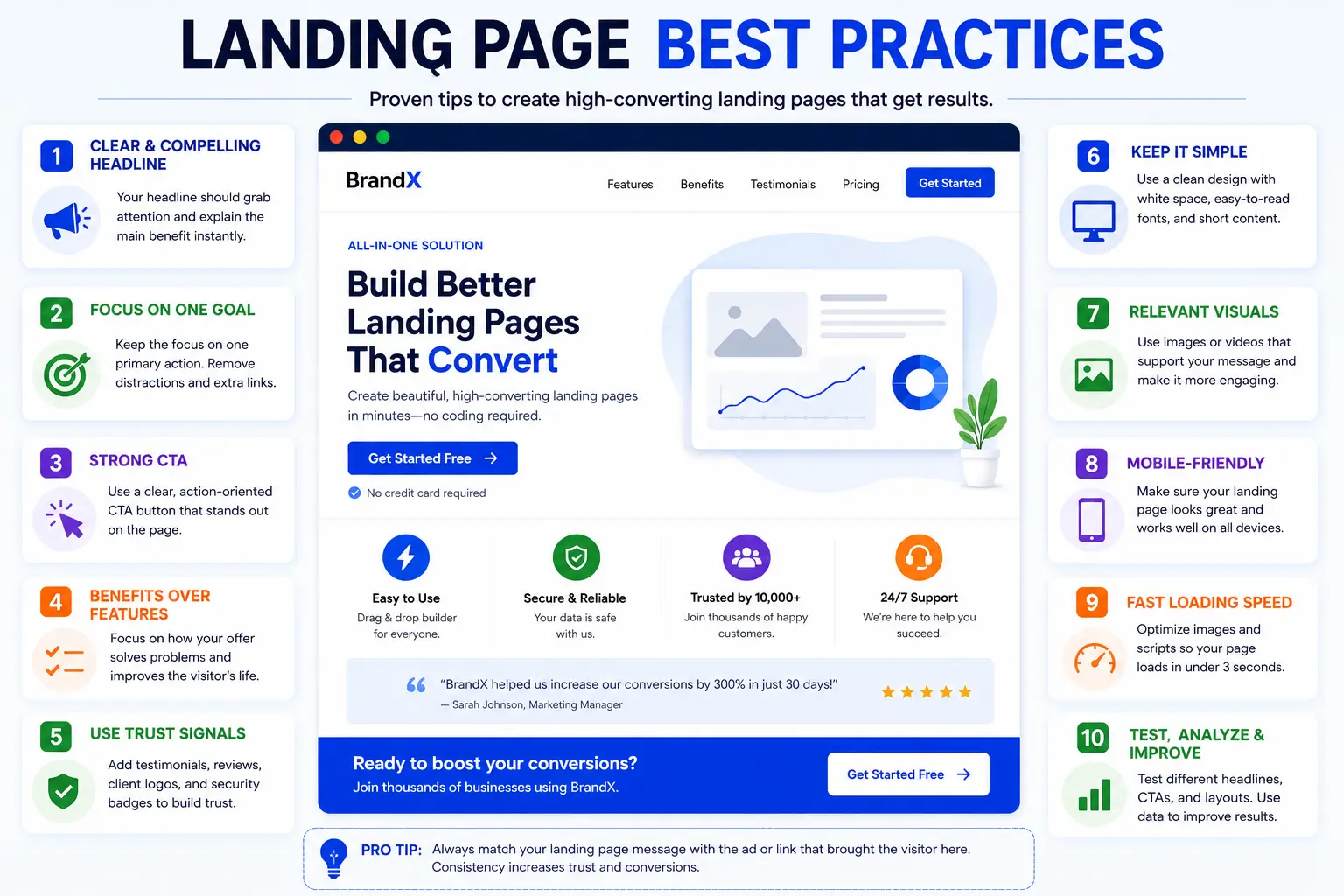
1. Match the message to the traffic source
The headline and content should mirror exactly what the visitor expected based on the ad, email, or link they clicked. A visitor who clicked “20% off your first order” should see that exact offer immediately — not a generic homepage-style welcome.
2. Focus on one goal only
A landing page built around a single conversion action consistently outperforms one juggling multiple competing offers. If you’re tempted to add a second CTA “just in case,” that’s usually a sign the page needs to be split into two separate landing pages instead.
3. Keep the primary CTA visible early
Visitors shouldn’t have to scroll extensively to understand what action they’re being asked to take. Place your main call to action above the fold (visible without scrolling), and repeat it at natural points further down the page.
4. Reduce friction wherever possible
Every extra form field, unclear instruction, or unnecessary click reduces the chance a visitor completes the action. Ask only for what’s genuinely needed at this specific stage.
5. Design mobile-first
A significant share of landing page traffic comes from ads and social platforms viewed on phones. Build and test the mobile layout first, then adapt it upward for desktop — not the reverse.
6. Optimize page load speed
Compress images, limit heavy scripts, and avoid unnecessary embedded elements. Slow-loading pages lose visitors before the content even finishes appearing, regardless of how good the design is once it loads.
Landing Page Design Best Practices
Design decisions shape how easily visitors process the page and move toward the CTA.
- Use visual hierarchy deliberately. Size, spacing, and contrast should guide the eye to the headline and CTA first, with supporting details visually secondary.
- Reserve one distinct color for your CTA button, used nowhere else on the page, so it’s immediately recognizable as the action to take.
- Use generous white space. Cluttered layouts make every element compete for attention, weakening the impact of all of them.
- Limit fonts and colors. One or two fonts and a restrained color palette read as more trustworthy and professional than a visually busy page.
- Show, don’t just tell. A product screenshot, short demo video, or outcome-focused image builds more confidence than text descriptions alone.
Landing Page Copywriting Best Practices
Design gets attention; the words on the page do the actual convincing.
- Lead with benefits, not just features. Explain what the visitor gets out of taking action, not just what the product or service technically does.
- Write specific CTA button text. “Start My Free Trial” or “Get My Discount” outperforms vague text like “Submit” or “Click Here,” since specific language reduces uncertainty about what happens next.
- Address objections directly. Anticipate the hesitations a visitor is likely having — cost, time commitment, complexity — and answer them before they become a reason to leave.
- Use social proof near the decision point. Testimonials, reviews, or client logos placed close to the CTA reduce hesitation right when it matters most.
- Keep sentences and paragraphs short. Landing page visitors skim; dense blocks of text get skipped entirely.
SEO Landing Page Best Practices
If your landing page also needs to rank in organic search (rather than relying solely on paid traffic or email), a few additional practices matter.
- Include your target keyword naturally in the page title, headline, and early content — without forcing it in ways that read awkwardly.
- Write a clear, descriptive meta title and meta description, since these directly affect whether someone clicks your result in search listings.
- Use proper heading structure (one H1, followed by logically nested H2s and H3s), which helps both search engines and visitors understand the page’s structure.
- Make sure the page is genuinely indexable. Some landing pages are intentionally excluded from search (common for time-limited campaign pages) — if organic visibility matters, confirm the page isn’t accidentally blocked from indexing.
- Balance SEO and conversion goals carefully. A page optimized purely for search rankings (long, keyword-dense content) can sometimes work against conversion-focused design (short, focused content). When both matter, prioritize a clear structure that serves real visitors first, with SEO elements layered in without disrupting that clarity.
How to Optimize a Landing Page for Lead Generation
Lead generation pages have a specific goal — collecting contact information — which shapes what “best practice” actually means here.
- Keep the form as short as possible. Every additional field (phone number, company size, job title) reduces completion rates. Ask only for what’s essential to qualify or follow up with the lead.
- Offer something valuable in exchange. A generic “sign up for updates” converts far lower than a specific incentive — a free guide, template, discount, or consultation.
- State clearly what happens after submission. Visitors are more likely to complete a form when they know exactly what to expect next (an email, a call, immediate access to a download).
- Use a two-step form for longer information requests, if more detail is genuinely needed. Starting with just an email address (a smaller first ask) before requesting more detail on a second step often improves overall completion rates.
- Follow up quickly. The value of a landing page conversion depends heavily on how promptly and relevantly the resulting lead is contacted afterward.
Ecommerce Landing Page Best Practices
Ecommerce landing pages carry a different kind of friction — asking for a purchase, not just contact information — so best practices shift accordingly.
- Show clear, high-quality product images from multiple angles. Since customers can’t physically examine the product, images carry much of the trust-building work.
- Display pricing and shipping information early, rather than surprising visitors with extra costs only at checkout — unexpected fees are one of the most common reasons for cart abandonment.
- Include reviews or ratings directly on the landing page, not just on a separate reviews tab, since social proof at the point of decision measurably increases purchase confidence.
- Simplify the path to checkout. Fewer steps between “Add to Cart” and completed purchase generally means higher conversion rates.
- Highlight guarantees or return policies visibly. Reducing perceived purchase risk (free returns, satisfaction guarantees) directly addresses one of the biggest hesitations before a sale.
- Use urgency authentically, when applicable. Limited-time offers or low-stock indicators can improve conversion, but only when genuinely accurate — false urgency erodes trust once visitors notice it repeatedly.
Comparison: Best Practices by Landing Page Goal
| Practice | Lead Generation | Ecommerce/Sales |
| Primary friction point | Form length | Price and trust |
| Key trust signal | Free resource value | Reviews and guarantees |
| Ideal CTA | “Get My Free Guide” | “Add to Cart” / “Buy Now” |
| Common mistake | Asking for too much info upfront | Hiding shipping costs until checkout |
| Follow-up importance | Very high (lead nurture) | Lower (transaction complete) |
How to Test and Improve a Landing Page Over Time
Best practices provide a strong starting point, but ongoing testing is what actually confirms what works for your specific audience.
- Establish a conversion rate baseline before making changes.
- Test one significant element at a time — headline, CTA text, or hero image — through A/B testing, so you can clearly attribute any change in performance.
- Let tests run long enough to gather a meaningful sample size, rather than concluding too early based on a small number of visitors.
- Use heatmaps or session recordings to understand why a page underperforms, not just that it does.
- Apply what you learn to future pages, building a growing internal understanding of what specifically works for your audience, rather than relying only on generic best practices indefinitely.
Common Mistakes That Violate Landing Page Best Practices
- Sending paid or campaign traffic to a general homepage instead of a dedicated, matching landing page.
- Including full site navigation, giving visitors an easy way to leave before completing the intended action.
- Testing multiple major changes simultaneously, making it impossible to know which change actually affected performance.
- Ignoring mobile performance, especially when a large share of traffic originates from social or mobile ad platforms.
- Overloading the page with every possible feature or offer, rather than focusing on the single goal the page exists to achieve.
- Neglecting page speed, allowing a slow-loading page to quietly suppress conversions before visitors even see the content.
Frequently Asked Questions
What are the most important landing page best practices?
Matching the page’s message to the traffic source, focusing on a single clear call to action, minimizing form friction, and ensuring fast mobile load times are consistently the highest-impact practices across nearly every type of landing page.
Are landing page best practices different for SEO vs. paid traffic?
Yes, to an extent. SEO-focused landing pages need clear keyword usage, proper heading structure, and indexability, while paid traffic pages can prioritize tighter message match to a specific ad without needing the same broader search visibility considerations.
How do I optimize a landing page for lead generation specifically?
Keep the form short, offer a genuinely valuable incentive in exchange for contact information, clearly state what happens after submission, and follow up with new leads quickly to maximize the value of each conversion.
What’s different about ecommerce landing page best practices?
Ecommerce pages need to address purchase-specific friction — clear pricing, visible shipping costs, product reviews, and return policies — since the ask (spending money) carries more hesitation than simply providing an email address.
How often should I update or test my landing page?
There’s no fixed schedule, but reviewing performance regularly (monthly is common) and running structured A/B tests whenever traffic volume allows for meaningful results helps keep a landing page’s conversion rate improving over time, rather than stagnating after the initial launch.
Can one landing page follow both design and SEO best practices at once?
Yes, though it requires balance. Prioritize a clear, focused structure that serves real visitors first, then layer in SEO elements (keywords, meta tags, heading structure) in ways that don’t disrupt that clarity or add unnecessary length.
Final Thoughts
Landing page best practices aren’t a single universal checklist — the right priorities shift depending on whether you’re generating leads, driving ecommerce sales, or optimizing for organic search visibility. What stays constant across all of them is the underlying goal: remove friction, match the page to visitor expectations, and focus entirely on one clear action.
Use the fundamentals here as your starting structure, then let real performance data — not assumptions — guide what you refine next. Best practices get a page most of the way there; ongoing testing against your specific audience closes the rest of the gap.