Building a website is the easy part. Learning how to promote a website so real people actually find it is where most beginners get stuck. A beautifully designed site with zero visitors doesn’t generate leads, sales, or an audience — it just sits there.
The good news: promoting a website doesn’t require a huge budget. It requires a mix of the right strategies, applied consistently, matched to what your website actually offers.
This guide covers both free and paid promotion methods, explains exactly how each one works, and shows you how to build a simple promotion plan instead of randomly trying everything at once. Whether you’re promoting a brand-new site or trying to grow traffic to an existing one, you’ll find a clear, practical path here.
Table of Contents
Why Promoting a Website Matters More Than People Expect
A common misconception is that a website will naturally attract visitors once it’s published. In reality, search engines and social platforms don’t know your site exists until something points them to it — a link, a mention, or a search query that matches your content closely enough to rank.
Think of a website like a new store that just opened on a quiet street. No one drives past it by accident. You need signs, word of mouth, and a reason for people to walk in — that’s what promotion does for a website.
Free Ways to Promote a Website
Free promotion takes more time than paid promotion but builds a foundation that keeps working long after you stop actively pushing it — unlike ads, which stop the moment you stop paying.
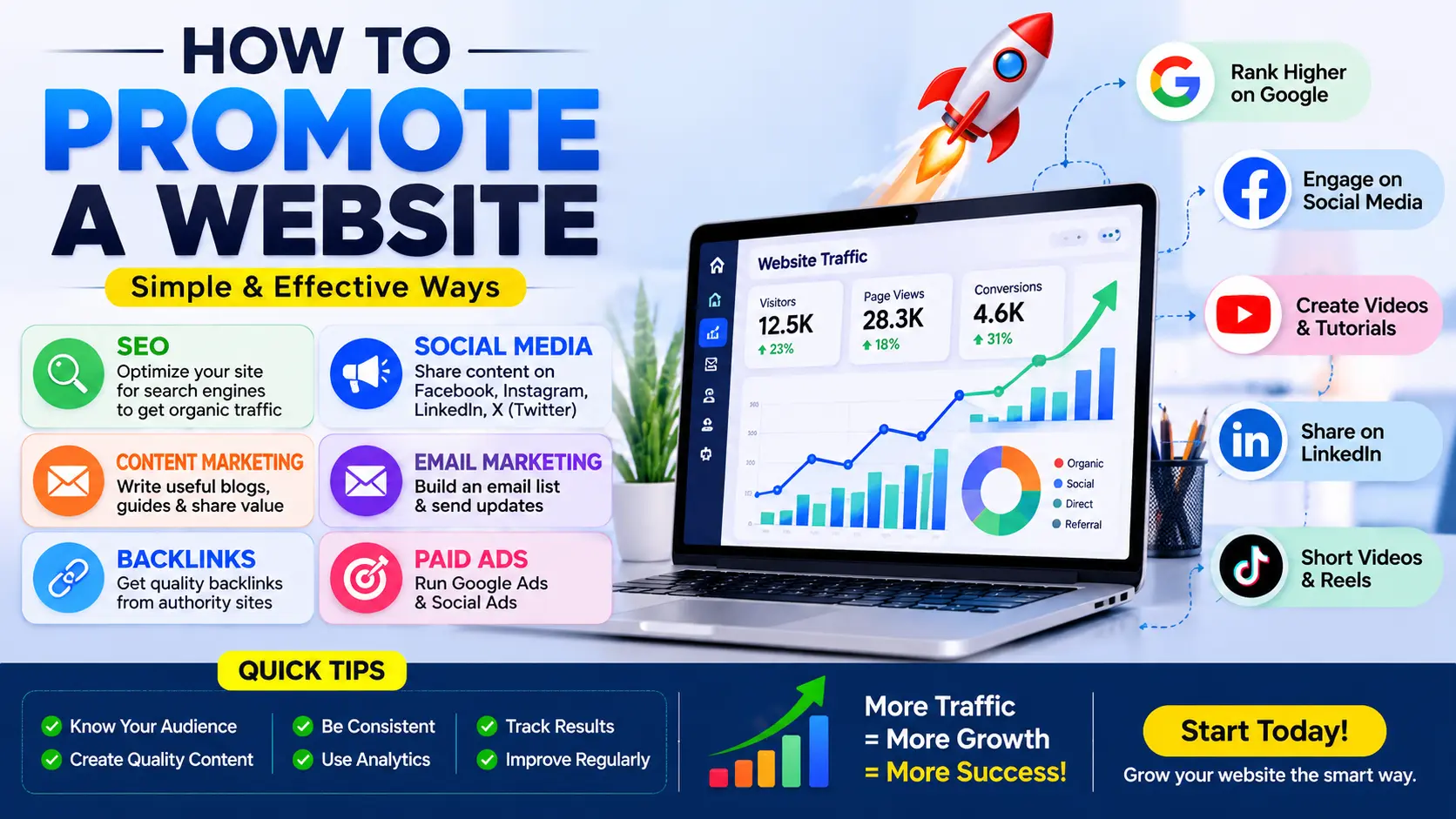
1. Optimize for search engines (SEO)
Search Engine Optimization (SEO) is the process of structuring your website’s content so search engines like Google can understand it and rank it for relevant searches.
- Research the exact phrases your audience searches for, and write content that directly answers those searches.
- Use your target keyword naturally in the page title, headings, and early paragraphs.
- Make sure your site loads quickly and works well on mobile devices — both affect ranking.
- Write clear, descriptive page titles and meta descriptions, since these directly influence whether someone clicks your result in search listings.
SEO is slower than most methods (often taking a few months to show results), but it’s the most sustainable source of consistent, free traffic.
2. Publish content that answers real questions
Content marketing means creating blog posts, guides, videos, or resources that genuinely help your target audience — which naturally attracts both search traffic and shares.
Example: A local bakery promoting its website might publish a guide on “how to store sourdough bread so it stays fresh,” attracting readers who later discover the bakery sells sourdough.
3. Get active on relevant social media platforms
Choose platforms based on where your specific audience actually spends time, not every platform available.
| Platform Type | Best For | Content Style |
| Instagram/Pinterest | Visual products, design, food, lifestyle brands | Images, short video |
| B2B services, professional expertise, career-related sites | Articles, industry insights | |
| X (Twitter) | News, tech, real-time commentary | Short-form updates, threads |
| TikTok/YouTube Shorts | Younger audiences, tutorials, entertainment | Short video |
| Reddit/niche forums | Highly specific communities and interests | Genuine participation, not direct promotion |
Posting a link once rarely works. What builds traffic is showing up consistently, providing value in the content itself, and letting the link be a natural addition — not the entire post.
4. Build an email list
Email remains one of the highest-converting promotion channels because the people on your list already chose to hear from you.
- Add a simple sign-up form to your homepage or blog posts, offering something useful in exchange (a checklist, discount, or guide).
- Send updates when you publish new content, launch a product, or have relevant news — consistency matters more than frequency.
5. Get backlinks from other websites
A backlink is a link from another website pointing to yours. Search engines treat backlinks as a signal of trust — if other reputable sites link to you, your site is more likely to rank higher.
Ways to earn backlinks without paying for them:
- Write guest posts for blogs or publications in your niche.
- Get listed in relevant industry directories.
- Create genuinely useful resources (original research, free tools, in-depth guides) that other sites naturally want to reference.
- Reach out to sites that mention your brand or topic without linking, and politely ask them to add a link.
6. List your website on relevant directories and platforms
For local or niche businesses, directory listings (like Google Business Profile, Yelp, or industry-specific directories) provide both direct traffic and additional backlinks.
7. Engage in online communities
Forums, Reddit communities, Discord servers, and Facebook Groups related to your topic are valuable — but only if you participate genuinely. Answering questions and offering real help, with an occasional relevant link when it truly adds value, builds trust. Dropping links without contributing gets flagged as spam and can get you banned.
8. Collaborate with others in your niche
Partnering with a complementary (not competing) business or creator for a joint newsletter feature, guest content swap, or shared giveaway exposes your website to an audience that’s already interested in similar topics.
Paid Ways to Advertise a Website
Paid promotion delivers faster, more predictable results, which makes sense for new sites, product launches, or time-sensitive campaigns.
9. Search engine advertising (PPC)
Pay-per-click (PPC) advertising, such as Google Ads, places your website at the top of search results for specific keywords. You only pay when someone clicks your ad, which makes budgets easier to control and measure.
This works especially well for high-intent searches — terms that show someone is ready to buy or take action, rather than just browsing.
10. Social media advertising
Platforms like Meta (Facebook/Instagram), LinkedIn, TikTok, and Pinterest offer targeted ad placements based on interests, demographics, and behavior. This is useful when you want to reach a specific audience that doesn’t already know your brand.
11. Retargeting ads
Retargeting shows ads specifically to people who already visited your site but didn’t take action. Since these visitors already know your brand, retargeting typically converts better than ads shown to a completely cold audience.
12. Influencer or creator partnerships
Paying a relevant creator to feature your website or product taps into an audience that already trusts that person’s recommendations — often more effective than a generic ad for the same budget.
Comparison: Free vs. Paid Website Promotion
| Factor | Free Methods (SEO, Content, Social) | Paid Methods (PPC, Social Ads) |
| Speed of results | Slow (weeks to months) | Fast (immediate to days) |
| Ongoing cost | Time, not money | Continuous budget required |
| Long-term value | Compounds over time | Stops when spending stops |
| Best for | New sites building authority, limited budgets | Launches, promotions, urgent traffic needs |
Most effective websites use both: paid promotion for quick, immediate traffic while free methods like SEO and content build up in the background.
Common Mistakes When Promoting a New Website
- Trying every channel at once. Spreading thin effort across ten platforms usually produces worse results than focusing deeply on two or three that fit your audience.
- Posting links without providing value. Communities and social platforms penalize (or ignore) accounts that only self-promote.
- Expecting instant SEO results. Search rankings typically take months to build; treating SEO as a quick fix leads to giving up too early.
- Ignoring analytics. Without tracking where visitors come from, you can’t tell which promotion efforts are actually working.
- Neglecting mobile experience. Ads and social content often drive mobile traffic — if your site is hard to use on a phone, promotion budget gets wasted.
- No clear next step for visitors. Driving traffic to a page with no clear call to action (sign up, buy, contact) wastes the visit itself.
Best Practices for Promoting a Website Long-Term
- Pick 2–3 channels and commit, rather than attempting a shallow presence everywhere.
- Track where your traffic comes from using a free tool like Google Analytics, so you can double down on what’s actually working.
- Repurpose content across channels — turn one blog post into social captions, an email, and a short video instead of creating everything from scratch each time.
- Be patient with organic methods while using paid promotion for short-term goals.
- Build relationships, not just links — genuine partnerships and community engagement tend to outperform one-off promotional tactics.
Frequently Asked Questions
How do I promote a new website with no budget?
Focus on SEO, content creation, active participation in relevant online communities, and organic social media posting. These require time rather than money and can build sustainable traffic over several months.
How long does it take to see results from promoting a website?
Paid advertising can drive traffic within hours of launching a campaign. Organic methods like SEO and content marketing typically take 3–6 months to show meaningful, consistent traffic growth.
What is the fastest way to advertise a website?
Search engine advertising (PPC) and social media ads are the fastest methods, since they place your site in front of a targeted audience immediately after the campaign goes live.
Do I need social media to promote my website?
It’s not mandatory, but it helps, especially for building brand awareness and driving traffic between search visits. The right platform depends entirely on where your specific target audience spends time.
How many backlinks does a website need to rank well?
There’s no fixed number — quality matters far more than quantity. A handful of backlinks from reputable, relevant sites outperforms dozens of low-quality or irrelevant links.
Can I promote a website using only free methods?
Yes. Many successful websites grow entirely through free methods like SEO, content marketing, and community engagement, though it typically takes longer than combining free strategies with some paid promotion.
Final Thoughts How to Promote a Website
Promoting a website successfully comes down to matching the right strategy to your goals, budget, and timeline — not chasing every trend at once. Free methods like SEO, content, and community engagement build lasting traffic, while paid advertising delivers speed when you need it.
Start with two or three channels that fit your audience, track what actually drives results, and stay consistent. Website promotion isn’t a single action — it’s an ongoing habit that compounds the longer you stick with it.