Learning how to make money from a website sounds simple in theory: build a site, add some way to earn, and watch the income roll in. In practice, most websites make very little money in their first year, and understanding why is just as important as knowing the methods themselves.
This guide breaks down the real, proven ways websites generate revenue, how much traffic and time each one typically requires, and how to choose the right monetization method based on what your site actually offers. No exaggerated income claims — just a clear, honest picture of what’s achievable and what it takes to get there.
Why Most Websites Don’t Make Money Right Away
Before covering methods, it’s worth setting realistic expectations, since this is where most beginners get discouraged and quit too early.
A website makes money by converting visitor attention into revenue — through ads, sales, or subscriptions. That means monetization almost always depends on having an audience first. A site with 50 visitors a month will earn very little from any method, no matter how well it’s monetized. A site with 50,000 visitors a month has real earning potential, even with a modest strategy.
The typical timeline: most websites take 6–18 months of consistent content and traffic-building before they generate meaningful income. Sites that “suddenly” seem profitable have usually been quietly building an audience for a while first.
Website Monetization Methods, Compared
| Method | Traffic Needed | Effort to Set Up | Income Potential | Best For |
| Display ads | High | Low | Low to moderate | High-traffic content sites, blogs |
| Affiliate marketing | Moderate to high | Moderate | Moderate to high | Review sites, niche blogs, comparison content |
| Selling digital products | Low to moderate | High (upfront) | High | Creators, educators, experts |
| Selling physical products | Low to moderate | High | High | Makers, brands, retailers |
| Sponsored content | Moderate to high | Low per post | Moderate to high | Established niche or lifestyle sites |
| Memberships/subscriptions | Low to moderate | Moderate | Moderate to high (recurring) | Communities, exclusive content |
| Freelance/service lead generation | Low | Low | Varies (indirect) | Consultants, agencies, freelancers |
| Selling the website itself | N/A (long-term) | High (over time) | One-time, potentially large | Site builders planning an exit |
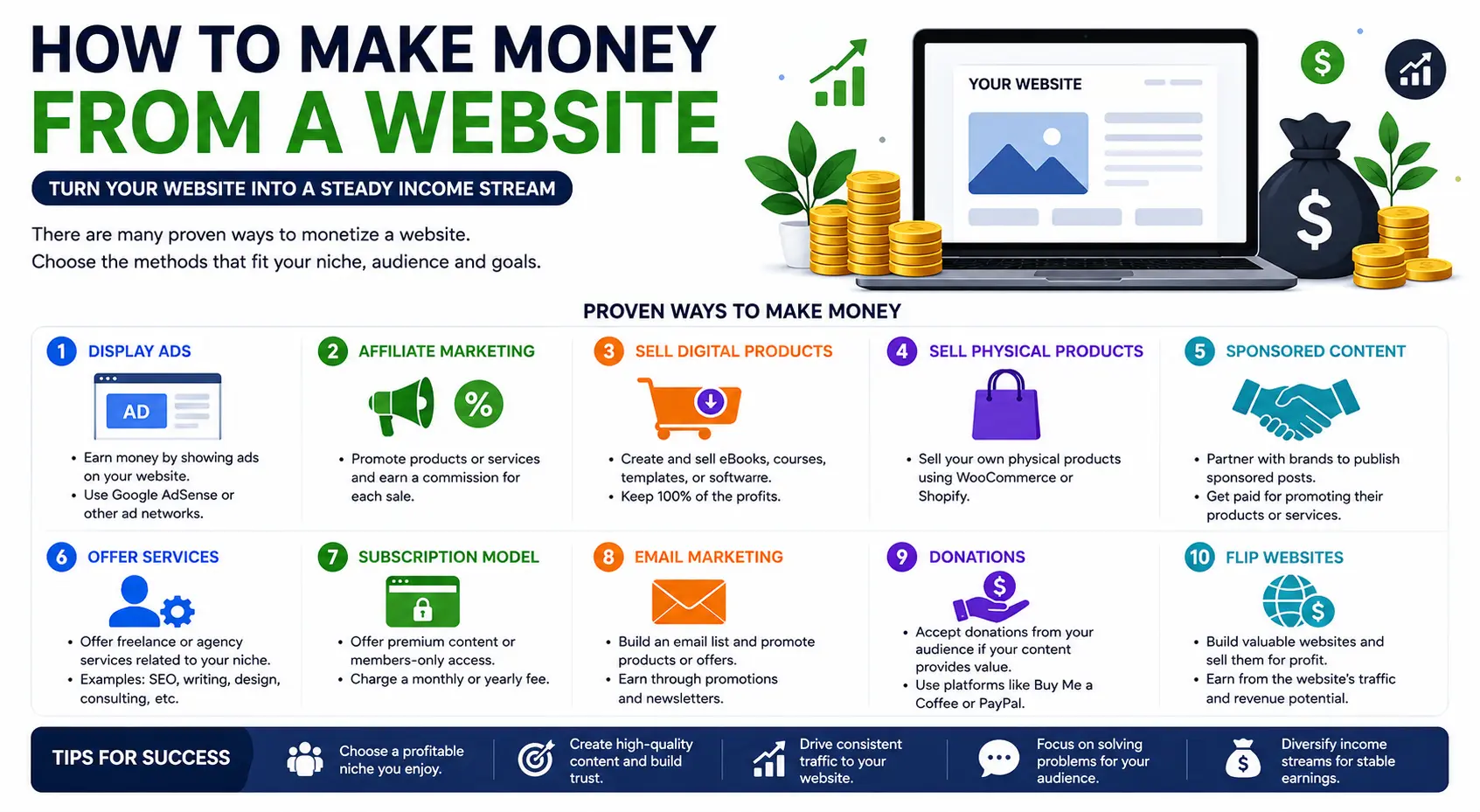
1. Display Advertising
Display ads are the most familiar monetization method — banner or video ads placed on your site, where you earn money based on views or clicks.
How it works: You join an ad network (Google AdSense is the most common starting point for beginners), place ad code on your site, and the network automatically shows relevant ads. You earn a share of what advertisers pay, calculated per thousand views (a metric called RPM, or revenue per mille) or per click.
Realistic expectations: Display ads generally require significant traffic — often tens of thousands of monthly visitors — before earnings become meaningful. This method works best as one revenue stream among several, not a sole strategy for smaller sites.
2. Affiliate Marketing
Affiliate marketing means recommending other companies’ products or services and earning a commission when someone buys through your unique link.
Example: A website reviewing kitchen gadgets links to specific products on a retailer’s site. When a reader clicks the link and buys the product, the website earns a percentage of that sale.
Why it works well for content sites: Affiliate marketing pairs naturally with review articles, comparison guides, and “best of” lists — content people are already searching for when they’re close to making a purchase decision.
Key requirement: Trust. Readers need to believe your recommendations are genuine, not just profit-driven, so disclosing affiliate relationships clearly (which is also a legal requirement in the U.S.) actually helps rather than hurts credibility.
3. Selling Digital Products
Digital products — ebooks, online courses, templates, presets, or downloadable guides — let you earn money without needing massive traffic, because each sale can be worth significantly more than an ad view or affiliate click.
How it works: You create something once (a course, guide, or tool) and sell it repeatedly without needing to remake it for each customer. This is often the most profitable method relative to the traffic required, since you keep the vast majority of each sale.
Best fit: Sites built around genuine expertise — a specific skill, craft, or knowledge area where visitors are actively looking to learn or solve a problem.
4. Selling Physical Products
If your website supports a product-based business — handmade goods, branded merchandise, or a curated shop — an integrated online store turns website visitors directly into customers.
This overlaps with running an e-commerce website, but the core idea is that content (blog posts, guides, reviews) drives traffic that converts into product sales, rather than the website being a pure content-and-ads model.
5. Sponsored Content and Brand Partnerships
Once a website has an established, engaged audience in a specific niche, brands may pay directly for a mention, review, or dedicated article featuring their product or service.
How it differs from affiliate marketing: Sponsored content is typically a flat fee paid upfront, regardless of resulting sales, whereas affiliate income depends entirely on actual purchases. Sponsored posts usually require a demonstrable, engaged audience before brands take interest.
6. Memberships and Subscriptions
Some websites earn recurring revenue by offering premium content, community access, or exclusive resources behind a paywall or membership tier.
Example: A website offering free general content might reserve in-depth guides, downloadable templates, or a private community for paying members.
This model rewards depth over broad traffic — a smaller, highly engaged audience willing to pay monthly can outperform a much larger audience relying only on ad views.
7. Lead Generation for Services
If your website represents a service-based business (consulting, freelancing, local services), the website itself may not directly process payments. Instead, it generates leads — visitors who contact you, book a call, or request a quote, which then convert into paid client work.
This is indirect monetization: the website’s job is building trust and generating inquiries, while the actual revenue comes from the resulting service work.
8. Selling the Website Itself
Once a website generates consistent, documented revenue over time, it becomes a sellable asset. Website marketplaces allow buyers to purchase established, income-generating sites, similar to buying an existing small business.
This is a longer-term strategy — it requires 1–2+ years of stable earnings and clean records (traffic, revenue, and expenses) before a website is attractive to serious buyers.
How to Choose the Right Monetization Method for Your Website
Match your method to your site’s actual strengths, rather than picking whatever seems trendiest.
- High traffic, broad topic (news, entertainment, general blog): Display ads plus affiliate marketing.
- Specific expertise or skill (finance, fitness, design, cooking): Digital products and affiliate marketing.
- Physical product or craft: Direct product sales, supported by content that drives traffic to the store.
- Professional service (consulting, coaching, freelance work): Lead generation, with the website acting as a credibility-building tool rather than the direct revenue source.
- Loyal, returning audience with in-depth interest: Memberships or subscriptions.
Most successful websites don’t rely on just one method — they layer two or three that complement each other, such as affiliate links inside blog posts, a digital product for deeper engagement, and display ads as a passive baseline.
Common Mistakes When Trying to Make Money From a Website
- Adding monetization before building any real traffic. Ads and affiliate links need visitors to be worth anything — focus on audience first.
- Overloading a site with ads. Too many ads slow load times and hurt user experience, which can reduce both traffic and trust over time.
- Recommending products you haven’t used or don’t believe in, purely for commission. This erodes trust and reduces long-term affiliate performance.
- Expecting fast results. Most legitimate methods take months of consistent effort before producing steady income.
- Ignoring SEO and content quality while focusing entirely on monetization. Traffic — the actual fuel for every method above — comes primarily from search visibility and genuinely useful content.
- Choosing a monetization method that doesn’t match the audience. A highly technical B2B blog, for example, is a poor fit for consumer display ads but a strong fit for lead generation or sponsored content.
Best Practices for Building a Profitable Website
- Focus on traffic and trust before monetization. A smaller, engaged, trusting audience monetizes better than a large, disengaged one.
- Diversify revenue streams. Relying on a single method (especially ad revenue alone) leaves your income vulnerable to algorithm or policy changes outside your control.
- Track your numbers. Know your traffic sources, conversion rates, and which content or products actually generate revenue, so you can double down on what works.
- Disclose sponsored and affiliate relationships clearly. This is both a trust-builder and a legal requirement in the United States under FTC guidelines.
- Reinvest early earnings into better content, tools, or promotion rather than withdrawing everything immediately — this compounds growth faster.
- Be patient with organic growth methods like SEO and content marketing, since they build the traffic foundation every other monetization method depends on.
Frequently Asked Questions
How much traffic do I need to make money from a website?
It depends on the method. Display ads generally need tens of thousands of monthly visitors to earn meaningfully, while digital products, services, or memberships can generate real income with just a few hundred to a few thousand engaged visitors.
Can you really make money from a website?
Yes, but it typically requires consistent effort over months, not days. Websites that succeed usually combine useful content, real traffic, and a monetization method that fits their specific audience and niche.
What is the fastest way to make money from a website?
Selling a digital product or offering a service through the site tends to generate income faster than ad revenue or affiliate marketing, since a single sale can be worth far more than a single ad view or click, even with modest traffic.
Do I need a large audience to make money from a website?
Not necessarily. Methods like digital products, memberships, and service-based lead generation can work well with a smaller, highly engaged audience, while ad revenue specifically depends on high traffic volume.
How does a website make money without selling anything directly?
Through display advertising, affiliate marketing commissions, and sponsored content — all of which generate revenue based on traffic and audience engagement rather than a direct product sale on the site itself.
Is affiliate marketing still profitable?
Yes, especially for niche sites with content that closely matches what people search for right before making a purchase decision, such as product reviews and comparison guides.
Final Thoughts
Making money from a website isn’t about picking one “best” method — it’s about matching monetization to what your site genuinely offers, and being patient enough to build real traffic and trust first.
Start with the method that fits your content and audience most naturally, track what actually converts, and layer in additional revenue streams as your site grows. Real, sustainable website income is built gradually — not through a single trick, but through consistent value delivered to real visitors over time.
How to Make Money From a Website: A Realistic Guide to What Actually Works
Learning how to make money from a website sounds simple in theory: build a site, add some way to earn, and watch the income roll in. In practice, most websites make very little money in their first year, and understanding why is just as important as knowing the methods themselves.
This guide breaks down the real, proven ways websites generate revenue, how much traffic and time each one typically requires, and how to choose the right monetization method based on what your site actually offers. No exaggerated income claims — just a clear, honest picture of what’s achievable and what it takes to get there.
Why Most Websites Don’t Make Money Right Away
Before covering methods, it’s worth setting realistic expectations, since this is where most beginners get discouraged and quit too early.
A website makes money by converting visitor attention into revenue — through ads, sales, or subscriptions. That means monetization almost always depends on having an audience first. A site with 50 visitors a month will earn very little from any method, no matter how well it’s monetized. A site with 50,000 visitors a month has real earning potential, even with a modest strategy.
The typical timeline: most websites take 6–18 months of consistent content and traffic-building before they generate meaningful income. Sites that “suddenly” seem profitable have usually been quietly building an audience for a while first.
Website Monetization Methods, Compared
| Method | Traffic Needed | Effort to Set Up | Income Potential | Best For |
| Display ads | High | Low | Low to moderate | High-traffic content sites, blogs |
| Affiliate marketing | Moderate to high | Moderate | Moderate to high | Review sites, niche blogs, comparison content |
| Selling digital products | Low to moderate | High (upfront) | High | Creators, educators, experts |
| Selling physical products | Low to moderate | High | High | Makers, brands, retailers |
| Sponsored content | Moderate to high | Low per post | Moderate to high | Established niche or lifestyle sites |
| Memberships/subscriptions | Low to moderate | Moderate | Moderate to high (recurring) | Communities, exclusive content |
| Freelance/service lead generation | Low | Low | Varies (indirect) | Consultants, agencies, freelancers |
| Selling the website itself | N/A (long-term) | High (over time) | One-time, potentially large | Site builders planning an exit |
1. Display Advertising
Display ads are the most familiar monetization method — banner or video ads placed on your site, where you earn money based on views or clicks.
How it works: You join an ad network (Google AdSense is the most common starting point for beginners), place ad code on your site, and the network automatically shows relevant ads. You earn a share of what advertisers pay, calculated per thousand views (a metric called RPM, or revenue per mille) or per click.
Realistic expectations: Display ads generally require significant traffic — often tens of thousands of monthly visitors — before earnings become meaningful. This method works best as one revenue stream among several, not a sole strategy for smaller sites.
2. Affiliate Marketing
Affiliate marketing means recommending other companies’ products or services and earning a commission when someone buys through your unique link.
Example: A website reviewing kitchen gadgets links to specific products on a retailer’s site. When a reader clicks the link and buys the product, the website earns a percentage of that sale.
Why it works well for content sites: Affiliate marketing pairs naturally with review articles, comparison guides, and “best of” lists — content people are already searching for when they’re close to making a purchase decision.
Key requirement: Trust. Readers need to believe your recommendations are genuine, not just profit-driven, so disclosing affiliate relationships clearly (which is also a legal requirement in the U.S.) actually helps rather than hurts credibility.
3. Selling Digital Products
Digital products — ebooks, online courses, templates, presets, or downloadable guides — let you earn money without needing massive traffic, because each sale can be worth significantly more than an ad view or affiliate click.
How it works: You create something once (a course, guide, or tool) and sell it repeatedly without needing to remake it for each customer. This is often the most profitable method relative to the traffic required, since you keep the vast majority of each sale.
Best fit: Sites built around genuine expertise — a specific skill, craft, or knowledge area where visitors are actively looking to learn or solve a problem.
4. Selling Physical Products
If your website supports a product-based business — handmade goods, branded merchandise, or a curated shop — an integrated online store turns website visitors directly into customers.
This overlaps with running an e-commerce website, but the core idea is that content (blog posts, guides, reviews) drives traffic that converts into product sales, rather than the website being a pure content-and-ads model.
5. Sponsored Content and Brand Partnerships
Once a website has an established, engaged audience in a specific niche, brands may pay directly for a mention, review, or dedicated article featuring their product or service.
How it differs from affiliate marketing: Sponsored content is typically a flat fee paid upfront, regardless of resulting sales, whereas affiliate income depends entirely on actual purchases. Sponsored posts usually require a demonstrable, engaged audience before brands take interest.
6. Memberships and Subscriptions
Some websites earn recurring revenue by offering premium content, community access, or exclusive resources behind a paywall or membership tier.
Example: A website offering free general content might reserve in-depth guides, downloadable templates, or a private community for paying members.
This model rewards depth over broad traffic — a smaller, highly engaged audience willing to pay monthly can outperform a much larger audience relying only on ad views.
7. Lead Generation for Services
If your website represents a service-based business (consulting, freelancing, local services), the website itself may not directly process payments. Instead, it generates leads — visitors who contact you, book a call, or request a quote, which then convert into paid client work.
This is indirect monetization: the website’s job is building trust and generating inquiries, while the actual revenue comes from the resulting service work.
8. Selling the Website Itself
Once a website generates consistent, documented revenue over time, it becomes a sellable asset. Website marketplaces allow buyers to purchase established, income-generating sites, similar to buying an existing small business.
This is a longer-term strategy — it requires 1–2+ years of stable earnings and clean records (traffic, revenue, and expenses) before a website is attractive to serious buyers.
How to Choose the Right Monetization Method for Your Website
Match your method to your site’s actual strengths, rather than picking whatever seems trendiest.
- High traffic, broad topic (news, entertainment, general blog): Display ads plus affiliate marketing.
- Specific expertise or skill (finance, fitness, design, cooking): Digital products and affiliate marketing.
- Physical product or craft: Direct product sales, supported by content that drives traffic to the store.
- Professional service (consulting, coaching, freelance work): Lead generation, with the website acting as a credibility-building tool rather than the direct revenue source.
- Loyal, returning audience with in-depth interest: Memberships or subscriptions.
Most successful websites don’t rely on just one method — they layer two or three that complement each other, such as affiliate links inside blog posts, a digital product for deeper engagement, and display ads as a passive baseline.
Common Mistakes When Trying to Make Money From a Website
- Adding monetization before building any real traffic. Ads and affiliate links need visitors to be worth anything — focus on audience first.
- Overloading a site with ads. Too many ads slow load times and hurt user experience, which can reduce both traffic and trust over time.
- Recommending products you haven’t used or don’t believe in, purely for commission. This erodes trust and reduces long-term affiliate performance.
- Expecting fast results. Most legitimate methods take months of consistent effort before producing steady income.
- Ignoring SEO and content quality while focusing entirely on monetization. Traffic — the actual fuel for every method above — comes primarily from search visibility and genuinely useful content.
- Choosing a monetization method that doesn’t match the audience. A highly technical B2B blog, for example, is a poor fit for consumer display ads but a strong fit for lead generation or sponsored content.
Best Practices for Building a Profitable Website
- Focus on traffic and trust before monetization. A smaller, engaged, trusting audience monetizes better than a large, disengaged one.
- Diversify revenue streams. Relying on a single method (especially ad revenue alone) leaves your income vulnerable to algorithm or policy changes outside your control.
- Track your numbers. Know your traffic sources, conversion rates, and which content or products actually generate revenue, so you can double down on what works.
- Disclose sponsored and affiliate relationships clearly. This is both a trust-builder and a legal requirement in the United States under FTC guidelines.
- Reinvest early earnings into better content, tools, or promotion rather than withdrawing everything immediately — this compounds growth faster.
- Be patient with organic growth methods like SEO and content marketing, since they build the traffic foundation every other monetization method depends on.
Frequently Asked Questions
How much traffic do I need to make money from a website?
It depends on the method. Display ads generally need tens of thousands of monthly visitors to earn meaningfully, while digital products, services, or memberships can generate real income with just a few hundred to a few thousand engaged visitors.
Can you really make money from a website?
Yes, but it typically requires consistent effort over months, not days. Websites that succeed usually combine useful content, real traffic, and a monetization method that fits their specific audience and niche.
What is the fastest way to make money from a website?
Selling a digital product or offering a service through the site tends to generate income faster than ad revenue or affiliate marketing, since a single sale can be worth far more than a single ad view or click, even with modest traffic.
Do I need a large audience to make money from a website?
Not necessarily. Methods like digital products, memberships, and service-based lead generation can work well with a smaller, highly engaged audience, while ad revenue specifically depends on high traffic volume.
How does a website make money without selling anything directly?
Through display advertising, affiliate marketing commissions, and sponsored content — all of which generate revenue based on traffic and audience engagement rather than a direct product sale on the site itself.
Is affiliate marketing still profitable?
Yes, especially for niche sites with content that closely matches what people search for right before making a purchase decision, such as product reviews and comparison guides.
Final Thoughts
Making money from a website isn’t about picking one “best” method — it’s about matching monetization to what your site genuinely offers, and being patient enough to build real traffic and trust first.
Start with the method that fits your content and audience most naturally, track what actually converts, and layer in additional revenue streams as your site grows. Real, sustainable website income is built gradually — not through a single trick, but through consistent value delivered to real visitors over time.