The term domain name services has two very different meanings, and confusing them can cost you money. In the general sense, domain name services refer to the legitimate tools and infrastructure — registration, DNS management, renewals, and privacy protection — that let you own and manage a website address. But if you’ve searched this term because you received a letter or email using this exact name, you’re likely dealing with something else entirely: a well-documented mail solicitation scam that has caused real financial harm to small business owners.
This guide covers both. First, we’ll explain what domain name services actually are in the legitimate, technical sense. Then we’ll break down the “Domain Name Services” mailer that prompts most people to search this term in the first place — including how to recognize it, why it isn’t outright illegal, and exactly what to do if you receive one.
Table of Contents
What Is Domain Name Services (The Legitimate Meaning)?
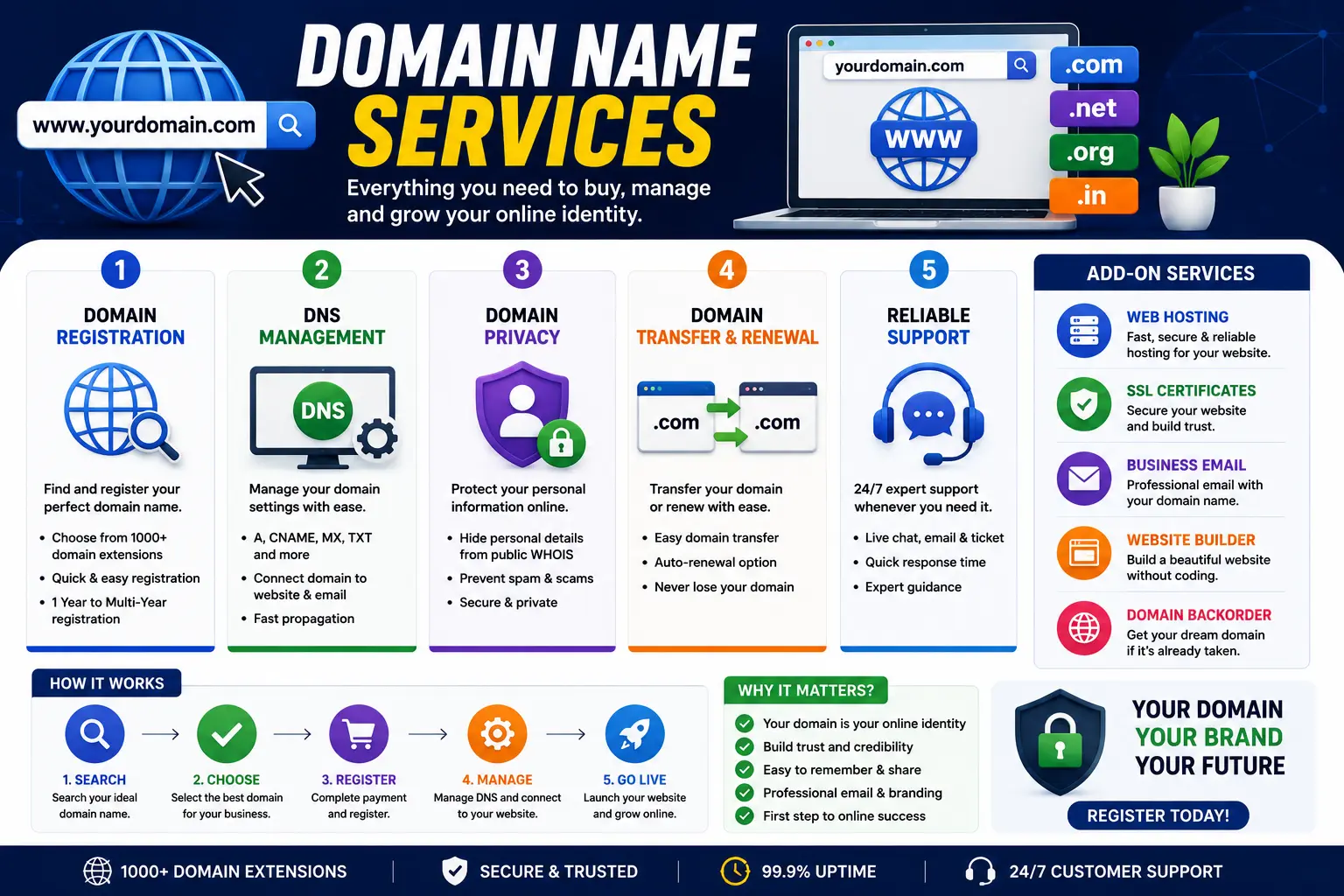
In the general sense, domain name services describe the full set of functions a domain registrar or provider offers to help you manage your website’s address. This typically includes:
- Domain registration – Reserving a domain name for your exclusive use, as explained in our guide on how to register a domain name
- DNS management – Controlling where your domain points, including connecting it to hosting or email
- Renewal management – Keeping your domain active year over year
- WHOIS privacy protection – Shielding your personal contact information from public databases
- Domain transfers – Moving a domain between registrars, covered in detail in our guide on transfer domain name
If you’re just getting started and want to understand how a domain fits into your overall web address, our explainer on what is a URL is a good foundation before diving deeper into domain management.
Is “Domain Name Services” Legit? (The Scam Mailer)
If you searched “is domain name services legit” because of a letter in your mailbox, here’s the direct answer: it’s not a scam in the strict legal sense, but it is a well-known deceptive solicitation, and you should not pay it.
<cite index=”25-1″>This practice is formally known as “domain slamming” — sending renewal-style notices that are actually disguised solicitations to switch your domain to a different, often more expensive, provider</cite>.
What the Letter Typically Looks Like
Businesses across the country have reported receiving a letter that <cite index=”19-1″>appears professional and urgent, listing the recipient’s actual domain name and expiration date, along with an offer like a multi-year “renewal” for a set fee</cite>. These letters commonly include:
- A payment stub or remittance slip designed to resemble an invoice
- A QR code or reply deadline creating urgency
- Language like “act today to retain exclusive rights to your domain”
- Small-print disclaimers such as <cite index=”17-1″>”this notice is not a bill”</cite>, buried within otherwise alarming wording
Why It’s Not Technically Illegal
<cite index=”19-1″>The company operating under this name is a real, registered business</cite>, and <cite index=”17-1″>the letter does technically disclose that it is not a bill</cite> if you read the fine print carefully. This careful wording is what allows the practice to continue without crossing into outright fraud — it’s deceptive marketing, not forgery.
Where They Get Your Information
<cite index=”17-1″>Your domain name and registration details are typically public information, which allows companies like this to look up your domain, find your contact details, and identify your expiration date</cite>. This is one of the reasons WHOIS privacy protection is worth enabling, even though it doesn’t stop every solicitation, since some mailers pull from other compiled business data sources as well.
How to Verify If a Domain Name Services Notice Is Legitimate
Follow these steps before responding to any letter or email claiming your domain is about to expire.
Step 1: Check Your Actual Registrar
Log into the account you originally used to register your domain and check your real expiration date directly.
Step 2: Use an Independent WHOIS Lookup
<cite index=”25-1″>You can verify your domain’s actual registrar and expiration date through ICANN’s official lookup tool</cite>, which gives you an unbiased answer independent of anything sent to you by mail or email.
Step 3: Compare the Sender’s Name to Your Real Registrar
If the company name on the letter doesn’t match the registrar you originally signed up with, that’s a strong signal you’re looking at a solicitation, not a genuine renewal notice.
Step 4: Check for a Business Complaint History
<cite index=”19-1″>Companies operating this type of mailer have accumulated numerous consumer complaints with organizations like the Better Business Bureau</cite>, which is worth checking if you’re still unsure.
Step 5: Never Pay Directly From the Letter
<cite index=”20-1″>Never enter your credit card information directly on one of these mailers</cite>. If you want to renew or switch registrars, always initiate that process yourself through your account, not through a mailed form.
Red Flags That Indicate a Deceptive Domain Notice
| Red Flag | Why It Matters |
| Addressed to your domain name, not your business name | <cite index=”20-1″>Mass mailers often skip personalization entirely</cite> |
| Arrives months before your actual expiration date | <cite index=”20-1″>Designed to catch you off guard before you’d normally think about renewal</cite> |
| Company name doesn’t match your real registrar | A clear sign this isn’t your existing provider |
| Pricing is far above standard renewal rates | Genuine registrars rarely charge multiples of standard pricing |
| Payment requested by check, wire, or card directly on the form | Legitimate renewals happen through your account, not a mailed slip |
| Urgent deadline language | A common pressure tactic used to discourage careful reading |
What to Do If You Receive a Domain Name Expiration Notice
- Don’t panic — and don’t pay yet. A domain name expiration notice from an unfamiliar company is not proof that action is urgently required.
- Log into your actual registrar account to confirm your real expiration date.
- Cross-check ownership using an independent WHOIS lookup, rather than trusting the letter itself.
- Shred or discard the letter once you’ve confirmed it’s a solicitation, not a real bill.
- Renew directly through your existing registrar when your actual expiration date approaches — never through a third-party mailer.
- Report it if appropriate. If a letter crosses from deceptive marketing into outright fraudulent claims, filing a complaint with the Better Business Bureau or the FTC helps track the pattern.
Domain Name Services: Legitimate vs. Deceptive Comparison
| Legitimate Domain Name Services | Deceptive “Domain Name Services” Mailers | |
| Who sends it | Your actual registrar | An unrelated third-party company |
| Timing | Sent close to your real expiration date | Often sent months early |
| Format | Email or dashboard notification from your provider | Physical mail designed to resemble an invoice |
| Pricing | Matches your registrar’s standard renewal rate | Frequently inflated well above market rate |
| Action required | Renew through your existing account | None — discard and verify independently |
Common Mistakes People Make
- Paying the letter without checking their real registrar first. This is how most people accidentally overpay or unintentionally transfer their domain elsewhere.
- Assuming “not a scam” means “safe to ignore the warning.” Even though it’s not outright fraud, it’s still designed to mislead you.
- Not enabling WHOIS privacy protection, which reduces (though doesn’t eliminate) how easily these companies can find your contact information.
- Throwing away the letter without checking their real expiration date first. Occasionally, people become so used to ignoring these letters that they miss a genuine renewal reminder mixed in.
- Providing payment information over the phone after calling a number listed on a suspicious letter, rather than contacting their actual registrar directly.
Frequently Asked Questions
What does “domain name services” mean?
In general terms, domain name services refer to the tools a registrar provides — registration, renewal, DNS management, and privacy protection — used to manage a website’s address.
Is Domain Name Services a scam?
It operates as a real, registered company, but its mailers are widely recognized as deceptive solicitations designed to look like renewal invoices. It’s not outright fraud, but you should not pay it without independently verifying your actual domain status first.
Why did I receive a domain name expiration notice from a company I don’t recognize?
Domain registration details are publicly accessible, which allows unrelated companies to look up your domain name and expiration date, then mail you a solicitation designed to resemble an official notice.
How do I know if my domain is actually about to expire?
Log into the account with your original registrar, or run an independent WHOIS lookup through ICANN’s official tool to confirm your real expiration date.
Should I pay a Domain Name Services invoice?
No. Renew your domain directly through your existing registrar’s account instead of paying a third-party company that sent you an unsolicited notice.
What happens if I accidentally pay one of these letters?
You may end up paying significantly more than your standard renewal rate, and in some cases, your domain could be transferred to a new registrar without you fully realizing it. Contact your original registrar immediately if this happens.
Final Thoughts
The term domain name services covers two very different things: the legitimate infrastructure that keeps your website address active, and a specific, well-documented mailer that mimics an official renewal notice. If you’ve received one of these letters, the safest move is always the same — verify your actual expiration date directly with your registrar before taking any action.
Once you’ve confirmed your domain is secure, take a look at our guides on how much does a domain name cost and transfer domain name to make sure you’re only ever renewing or moving your domain through channels you initiated yourself.