If you just launched a website, you might assume Google and Bing will find it automatically — and eventually, they usually do. But if you want your site indexed quickly rather than waiting weeks, you need to know how to submit website to search engines correctly.
This guide explains exactly how modern search engine submission works, why most “instant submission” tools you’ll find online don’t actually help, and the specific steps that get real results with Google, Bing, and beyond.
Table of Contents
What Does “Submitting a Website to Search Engines” Actually Mean?
Before search engines can show your site in results, they need to go through two steps:
- Crawling — a search engine’s automated program (called a “crawler” or “bot”) visits your pages and reads their content.
- Indexing — the search engine stores that content in its database so it can be shown in relevant search results.
“Submitting” your website simply means telling a search engine, directly, that your site (or a specific page) exists and is ready to be crawled — instead of waiting for it to be discovered on its own through links from other sites.
It’s important to understand what submission does not do: it doesn’t guarantee ranking, and it doesn’t guarantee immediate indexing. It simply speeds up discovery.
Do You Actually Need to Submit Your Website?
In most cases, yes — especially for a brand-new site. Search engines discover pages primarily by following links from sites they already know about. A brand-new website often has no incoming links yet, so there’s nothing pointing a crawler toward it.
Submitting your website directly solves that problem by giving the search engine a starting point.
You should prioritize submission if:
- Your website is brand new.
- You’ve just published an important new page.
- You’ve made major structural changes (like a redesign or URL changes).
- Your site currently doesn’t appear at all when you search site:yourdomain.com on Google.
How to Submit Your Website to Google
Google is the largest search engine in most markets, so this should be your first stop.
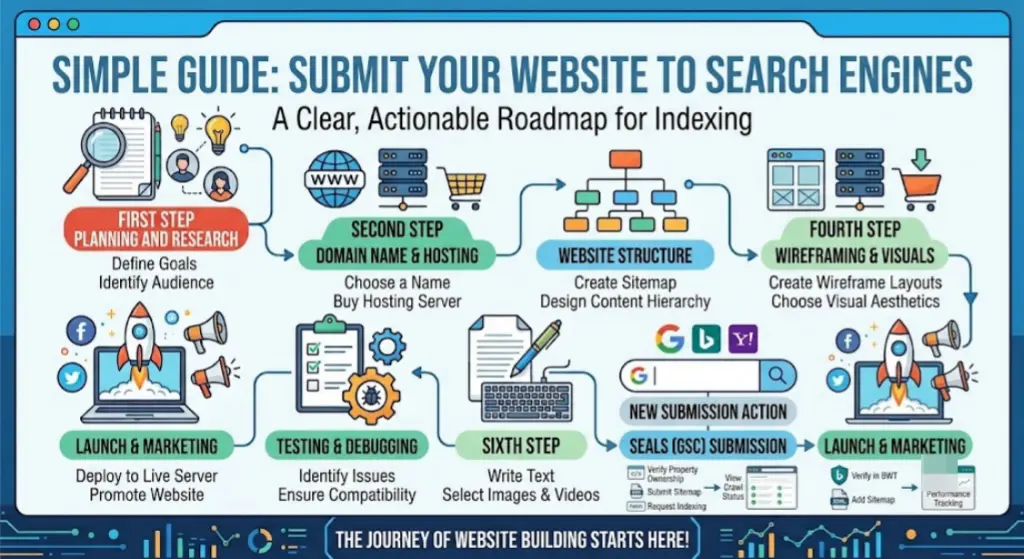
Step 1: Create a Google Search Console Account
Google Search Console is a free tool from Google that lets website owners monitor and manage how their site appears in search results. Sign up using a Google account at Search Console, and add your website as a “property.”
Step 2: Verify Ownership
Google needs proof that you actually own the site before showing you its data. Common verification methods include:
- Adding a small HTML file to your website
- Adding a meta tag to your homepage’s code
- Verifying through your domain registrar (DNS record)
- Verifying through Google Analytics, if already installed
Website builders like Wix, Squarespace, and WordPress usually offer a simple built-in option for this step.
Step 3: Submit a Sitemap
A sitemap is a file (usually found at yoursite.com/sitemap.xml) that lists every page on your website in a structured format, helping search engines understand your site’s full structure at once.
Inside Search Console, go to the “Sitemaps” section and submit your sitemap URL. Most website builders and CMS platforms (like WordPress with an SEO plugin) generate this automatically.
Step 4: Request Indexing for Individual Pages
For a specific important page — like your homepage or a new service page — use the URL Inspection tool inside Search Console. Paste in the page’s URL, and if it hasn’t been indexed yet, you’ll see an option to request indexing directly.
This step tells Google, “please crawl this specific page now,” rather than waiting for it to be discovered through the sitemap or links.
How to Submit Your Website to Bing
Bing powers its own search engine and also supplies results to Yahoo and some AI assistants, so it’s worth setting up separately.
- Create a free account with Bing Webmaster Tools.
- Add and verify your website (Bing offers a convenient option to import verified sites directly from Google Search Console).
- Submit your sitemap under the “Sitemaps” section.
- Use the “URL Submission” tool to request indexing of specific pages.
Bing Webmaster Tools also allows submitting a batch of URLs at once, which is useful if you’re launching several pages simultaneously.
Do You Need to Submit to Other Search Engines?
| Search Engine | Submission Method | Priority |
| Search Console (sitemap + URL inspection) | Essential | |
| Bing | Bing Webmaster Tools | Recommended |
| Yahoo | Uses Bing’s index automatically | Not needed separately |
| DuckDuckGo | Uses a mix of sources, including Bing | Not needed separately |
| Yandex | Yandex Webmaster (mainly relevant for Russian-language markets) | Only if targeting that region |
For most businesses targeting the U.S. or general English-speaking audiences, submitting to Google and Bing covers the vast majority of your potential search traffic.
Free “Instant Submission” Tools: Do They Work?
Many websites promise to submit your site to “500+ search engines” instantly. Here’s the honest answer: these tools provide little to no real value today.
Here’s why:
- The overwhelming majority of real search traffic comes from Google and Bing — the “hundreds” of other engines these tools submit to have negligible market share.
- These bulk submission tools often just add your URL to low-quality directory lists, which can occasionally do more harm than good if the directories are considered spammy by Google.
- Google and Bing have never confirmed that third-party bulk-submission services speed up indexing on their platforms.
The only submissions that reliably matter are direct ones through Google Search Console and Bing Webmaster Tools — the official, free tools provided by the search engines themselves.
What Actually Speeds Up Indexing (Beyond Submission)
Submitting your sitemap is a starting point, not a guarantee. These factors influence how quickly and how well your site gets indexed:
- Internal linking — link between your own pages so crawlers can easily navigate your whole site.
- Backlinks from other websites — when other legitimate sites link to yours, it signals credibility and gives crawlers another path to discover your content.
- Site speed — slow-loading sites can be crawled less efficiently.
- Clean site structure — a logical navigation and URL structure helps crawlers understand your content.
- No crawl blockers — check your robots.txt file (a file that tells crawlers which pages they’re allowed to access) to make sure you’re not accidentally blocking search engines from your own site.
- Fresh, original content — regularly updated, genuinely useful content tends to get crawled more frequently over time.
How Long Does It Take to Get Indexed After Submission?
There’s no fixed timeline, but general patterns include:
- A few hours to a few days — for pages on an established site with good internal linking and existing search engine trust.
- 1–2 weeks — typical for a brand-new website with no existing backlinks.
- Several weeks or longer — if there are technical issues (like accidental robots.txt blocks or noindex tags) preventing indexing altogether.
If a page still isn’t indexed after a few weeks, check Search Console’s coverage report — it usually explains exactly why (blocked by robots.txt, marked as duplicate content, low quality signals, etc.).
Common Mistakes When Submitting a Website to Search Engines
- Relying only on third-party “submit to 500 search engines” tools instead of using Google Search Console and Bing Webmaster Tools directly.
- Forgetting to submit an updated sitemap after a site redesign or URL structure change.
- Accidentally blocking crawlers through a misconfigured robots.txt file or a stray noindex tag left over from a staging site.
- Submitting once and never checking back — Search Console reports ongoing issues that are worth reviewing periodically.
- Expecting instant top rankings after submission. Submission affects discovery and indexing, not ranking position.
- Not verifying both www and non-www versions (or HTTP vs HTTPS) of the site, which can cause Search Console to show incomplete data.
Best Practices Checklist
- [ ] Google Search Console account created and website verified
- [ ] Bing Webmaster Tools account created and website verified
- [ ] Sitemap submitted in both tools
- [ ] Homepage and key pages checked with the URL Inspection tool
- [ ] robots.txt reviewed to confirm search engines aren’t blocked
- [ ] Internal links connect all important pages
- [ ] site:yourdomain.com search checked periodically to confirm pages are indexed
Frequently Asked Questions
How do I submit my website to search engines for free? Google Search Console and Bing Webmaster Tools are both completely free and are the only submission methods that reliably matter. Sign up, verify your site, and submit your sitemap through each.
Is it necessary to submit my website to search engines, or will it get found automatically? Established sites with existing backlinks are often found automatically over time. New sites, however, usually have no incoming links yet, so direct submission significantly speeds up discovery.
How long does it take after I submit my website to search engines to appear in results? It varies from a few hours to a few weeks, depending on the site’s existing authority, technical setup, and whether any crawl-blocking issues exist.
Do paid website submission services actually help my SEO? Most paid “submit to hundreds of search engines” services provide little real benefit, since the vast majority of search traffic comes from Google and Bing, both of which offer free, official submission tools directly.
Can I submit just one page instead of the whole website? Yes. Google Search Console’s URL Inspection tool and Bing Webmaster Tools’ URL Submission feature both let you request indexing for a single specific page.
What’s the difference between submitting a sitemap and requesting indexing for a URL? A sitemap submission tells the search engine about your site’s overall structure so it can crawl pages over time. Requesting indexing for a specific URL asks the search engine to prioritize crawling that one page sooner.
Final Thoughts How to Submit Website to Search Engines
Submitting your website to search engines isn’t about mass-submitting to hundreds of obscure directories — it’s about correctly setting up Google Search Console and Bing Webmaster Tools, submitting your sitemap, and requesting indexing for your most important pages. Combine that with solid internal linking and a technically clean site, and you give your website the best possible chance of being found, indexed, and ready to rank.