Is homepage one word or two? Both spellings exist, but they aren’t equally accepted anymore. Here’s the short answer, followed by the full explanation of why the confusion exists and how to use the term correctly.
Short Answer: Homepage Is Widely Accepted as One Word
In modern usage — especially in tech, web development, and everyday writing — “homepage” as a single word is the more common and widely accepted form. Most style guides for digital content, tech companies, and browser interfaces now use it as one word.
That said, dictionaries have been slower to catch up. Merriam-Webster’s official entry still lists it as “home page” (two words), reflecting the term’s older, more formal usage. This is a common pattern with compound words that started in tech: they often appear as two words first, then a hyphenated form, and eventually merge into one word once usage becomes common enough (similar to how “web site” became “website”).
Practical rule: for casual and tech writing, “homepage” (one word) is fine and increasingly standard. For strict formal or academic writing that follows Merriam-Webster or similar dictionary conventions, “home page” (two words) is the more conservative, dictionary-accurate choice.
Table of Contents
What Does Homepage Mean?
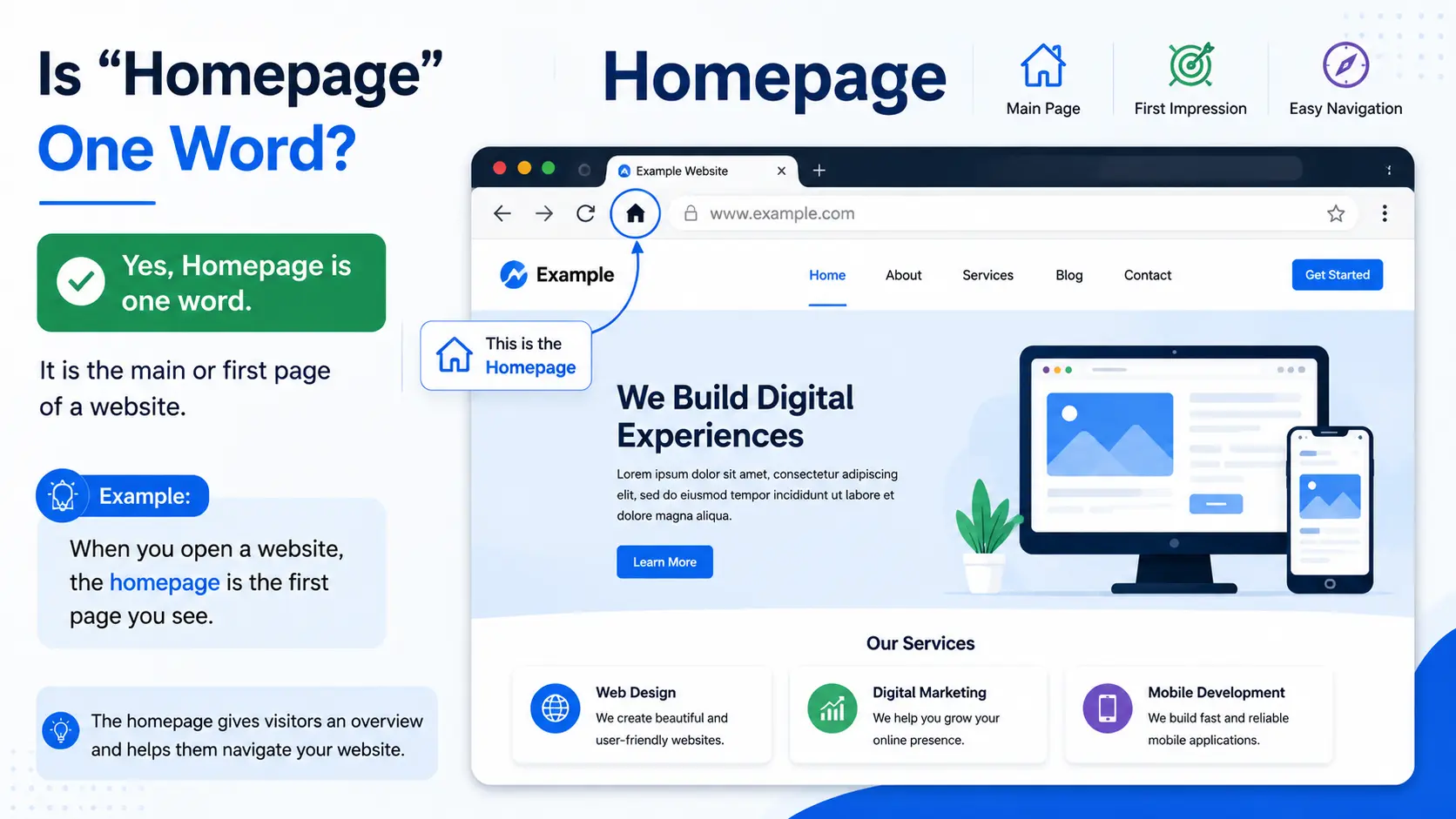
A homepage is the main introductory page of a website — the page a visitor typically lands on first, usually reached by entering the site’s main domain (like example.com) or clicking the site’s logo.
Think of it as the front entrance of a building. It’s not where all the detailed activity happens, but it’s where visitors get their bearings and decide where to go next.
The term has a second, related meaning: a browser homepage, which is the page that opens automatically when you launch your web browser or click its Home button. This is a personal setting controlled by the browser user, not something built into any particular website.
Why Compound Tech Words Change Spelling Over Time
This isn’t unique to “homepage.” Many internet-era terms followed the same pattern as they became part of everyday vocabulary:
| Term | Older Form | Modern Common Form |
| Homepage | home page | homepage |
| Website | web site | website |
| Login (noun) | log in | login |
| Online | on-line | online |
Notice the pattern: as a term is used more frequently, it tends to compress — first losing the hyphen, then merging into a single word entirely. “Homepage” is now firmly in that transition, with the single-word form dominant in everyday and professional tech writing, even while some traditional dictionaries haven’t fully caught up.
How to Use “Homepage” Correctly in a Sentence
Since it’s used as a noun, “homepage” (or “home page”) functions the same way regardless of spelling — just be consistent within a single piece of writing.
Examples:
- “The company redesigned its homepage to load faster on mobile devices.”
- “Click the logo to return to the homepage at any time.”
- “I set Google as my browser’s homepage.”
Avoid switching between “homepage” and “home page” within the same document — pick one and use it consistently, since inconsistency reads as a proofreading oversight.
Common Mistakes
- Using “home-page” with a hyphen. This hyphenated form isn’t standard in either casual or formal usage — stick to either one word or two, never hyphenated.
- Switching spellings mid-document. Inconsistency between “homepage” and “home page” in the same article or webpage looks like an editing error.
- Confusing a website’s homepage with a browser homepage. These are related but distinct concepts — one is a fixed part of a website’s structure, the other is a personal browser setting.
- Assuming there’s one universally “official” spelling. Since usage is actively transitioning, the safest approach is picking the form that matches your specific style guide or audience, not assuming only one is correct everywhere.
Best Practices
- Match your organization’s or publication’s existing style guide, if one exists, rather than defaulting to personal preference.
- Use “homepage” as one word for general web and tech writing, since it reflects current common usage.
- Use “home page” as two words if writing in a more formal or academic context that follows traditional dictionary spelling.
- Stay consistent throughout the same piece of content — this matters more than which specific form you choose.
Frequently Asked Questions
Is homepage one word or two words?
Both are used, but “homepage” as one word is the more common and accepted form in modern tech and everyday writing. “Home page” as two words is the more traditional, dictionary-listed spelling still used in some formal contexts.
What is the definition of homepage?
A homepage is the main introductory page of a website, typically the first page visitors see when entering a site’s main domain. It can also refer to the page a web browser opens to automatically when launched.
Does Merriam-Webster list homepage as one word?
No, Merriam-Webster’s dictionary entry lists it as “home page,” two words. However, this reflects a more traditional spelling, while “homepage” as one word is now widely used in everyday and professional tech writing.
Is “home-page” with a hyphen correct?
No, the hyphenated form isn’t standard. The accepted variations are “homepage” (one word) or “home page” (two words) — not a hyphenated version.
Which spelling should I use for a website or blog?
“Homepage” as one word is generally the better choice for web and tech content, since it matches current common usage and how most browsers and tech companies refer to it.
Final Thoughts
“Homepage” is increasingly treated as one word in everyday and professional use, even though some dictionaries still list the two-word “home page” as the standard entry. Neither is truly wrong — but for modern, tech-focused writing, one word is the safer, more current choice. Whichever you pick, staying consistent throughout your writing matters more than the specific spelling itself.