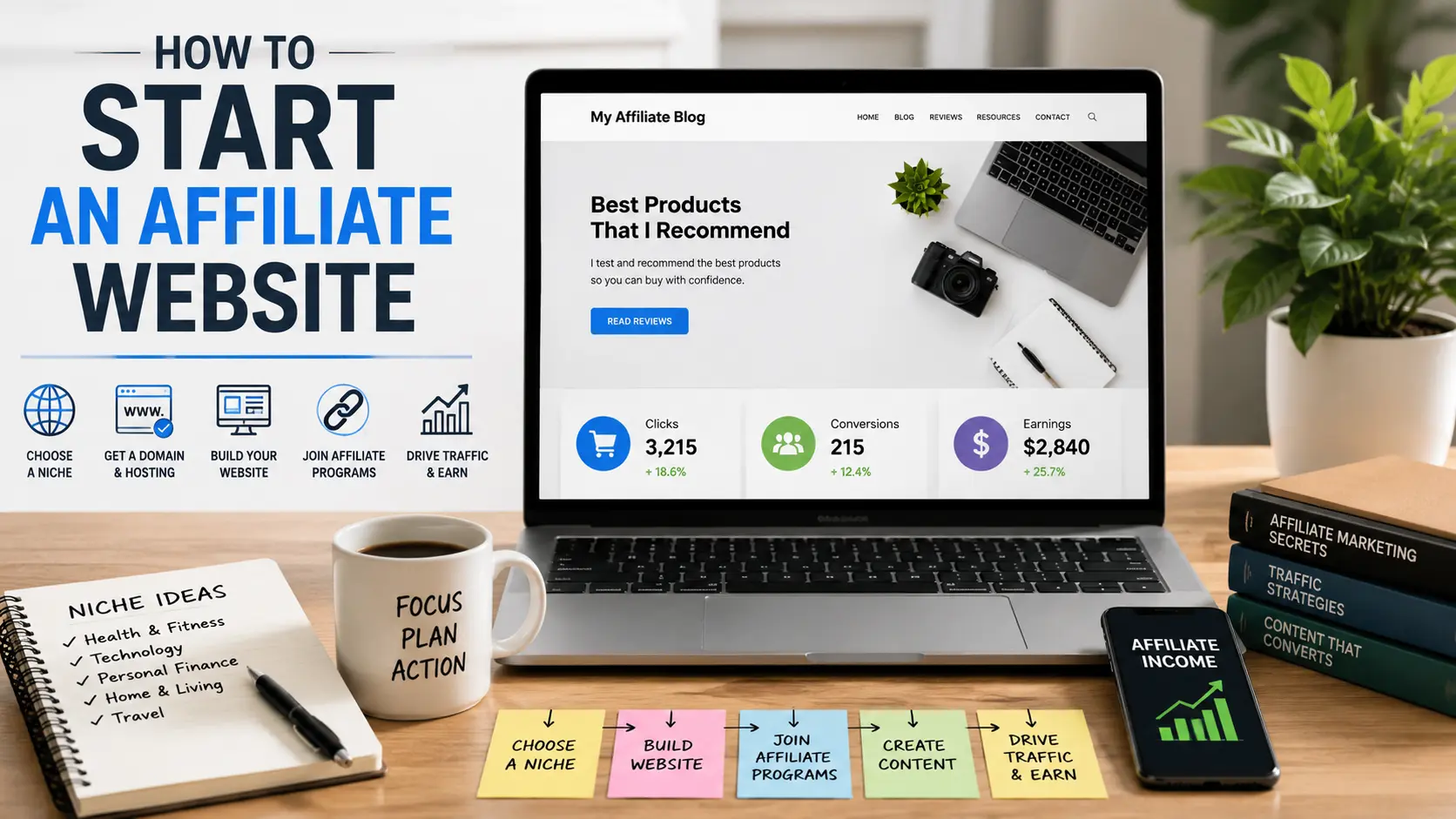
Affiliate marketing sounds simple on the surface: recommend products, earn a commission when someone buys through your link. But most beginners get stuck at the same point — they build a site first and figure out the strategy later, which usually leads to months of work with no income to show for it.
This guide covers how to start an affiliate website in the right order: choosing a niche that can actually make money, setting up the site correctly, joining the right affiliate programs, and building the kind of content that earns trust and clicks. Every step below assumes no prior experience.
Table of Contents
What an Affiliate Website Actually Is
Before building anything, it helps to understand the model clearly. An affiliate website earns money by recommending other companies’ products or services. When a visitor clicks your link and makes a qualifying purchase, you earn a commission — a percentage of the sale, or sometimes a flat fee.
You don’t need to:
- Create your own product.
- Handle shipping, inventory, or customer service.
- Process payments directly.
You do need:
- A specific topic or audience your content genuinely helps.
- Products relevant to that audience worth recommending.
- Enough traffic for a meaningful number of people to click and buy.
The entire model depends on trust. People click affiliate links because they believe the recommendation is genuine, not because a banner ad caught their eye.
Step 1: Choose a Profitable, Specific Niche
This is the step most beginners rush, and it’s the single biggest predictor of whether an affiliate site succeeds. A niche (a specific, focused topic area, rather than a broad general subject) determines everything downstream — your audience, your content ideas, and which affiliate programs are even available to you.
A good niche for a new affiliate website usually has three things:
- Specificity — “budget home coffee gear” beats “coffee,” because it’s easier to rank for and clearly signals who the content is for.
- Buying intent — topics where people research before spending money (electronics, home improvement, fitness gear) convert better than pure entertainment topics.
- Available affiliate programs — check that real, well-paying programs exist in the space before committing.
| Niche Example | Too Broad? | Buying Intent | Realistic for Beginners |
| “Fitness” | Yes | Medium | Difficult — huge competition |
| “Home gym equipment for small apartments” | No | High | Yes |
| “Travel” | Yes | Low-Medium | Difficult |
| “Budget travel gear for solo backpackers” | No | High | Yes |
Narrow niches feel limiting at first, but they’re dramatically easier to rank for in search results and easier to build genuine authority in, which matters more than topic size when you’re starting from zero.
Step 2: Research Affiliate Programs Before You Build Anything
Before choosing a platform or writing a single page, confirm that profitable affiliate programs actually exist for your niche. There’s no point building a beautifully designed site around a topic with no worthwhile programs to join.
Two main types of programs to know:
- Affiliate networks (like Amazon Associates, ShareASale, or CJ Affiliate) act as a middleman, giving you access to thousands of individual brand programs through one dashboard.
- In-house affiliate programs are run directly by a single company, often paying higher commissions than network-based options, but requiring separate applications and tracking for each one.
When comparing programs, check:
- Commission rate — the percentage or flat amount you earn per sale.
- Cookie duration — how long after someone clicks your link you still get credit if they buy later (30 days is common; some programs offer 60–90 days).
- Payout threshold and schedule — the minimum amount you must earn before getting paid, and how often payouts happen.
Step 3: Choose the Right Platform for Your Affiliate Website
You don’t need coding skills to build a functional, professional-looking affiliate website today. The three most common approaches:
| Platform | Best For | Learning Curve | Monthly Cost (Approx.) |
| WordPress (self-hosted) | Full control, best long-term SEO flexibility | Moderate | $5–$25 (hosting) |
| Website builders (Wix, Squarespace) | Fastest setup, less technical | Low | $16–$40 |
| Static site generators / custom code | Developers wanting full control | High | Varies |
For most beginners, self-hosted WordPress remains the standard choice for affiliate sites, mainly because of its flexibility with SEO plugins, its huge ecosystem of themes built specifically for review and comparison content, and the fact that you fully own your site rather than renting space on someone else’s platform.
Step 4: Register a Domain and Set Up Hosting
Once your platform is chosen, you’ll need two things: a domain name (your website’s address, like yoursite.com) and hosting (the service that stores your website’s files and makes it accessible online).
Practical tips for this step:
- Choose a domain name related to your niche, but avoid keyword-stuffed names that sound spammy (like “best-cheap-coffee-gear-reviews-2026.com”).
- Pick a hosting provider with good uptime and speed reviews — page speed directly affects both user experience and search rankings.
- Enable SSL (the padlock icon showing a secure connection) immediately; most hosts include this free.
Step 5: Install Your CMS and Set Up the Basic Structure
If you’re using WordPress, most hosting providers offer one-click installation. Once installed, set up these foundational pieces before publishing content:
- A clean, fast-loading theme — avoid heavy, image-bloated themes that slow down page speed.
- Core pages — Home, About, Contact, and a Privacy Policy at minimum.
- An SEO plugin (like Yoast or RankMath) to manage titles, meta descriptions, and sitemaps easily.
- Clear navigation menu — organized by category so both visitors and search engines understand your site structure.
Step 6: Publish the Affiliate Disclosure Page
This step is often skipped by beginners, but it’s both a legal requirement in the United States and a trust signal for readers.
The Federal Trade Commission (FTC) requires that affiliate relationships be disclosed clearly to readers, not buried in fine print. A proper affiliate disclosure:
- Appears near the top of any post containing affiliate links, not just on a separate hidden page.
- Uses plain language, such as “This post contains affiliate links. If you purchase through them, I may earn a commission at no extra cost to you.”
- Also gets a dedicated, easy-to-find page in your site’s footer or navigation.
Skipping this isn’t just risky legally — readers who feel misled about recommendations rarely return or trust future content.
Step 7: Create Content That Actually Converts
This is where most of your long-term effort goes. Successful affiliate websites are built on a mix of content types, not just generic blog posts.
High-converting content formats:
- Product reviews — in-depth, honest reviews of a single product, including real pros and cons.
- Comparison posts — “Product A vs. Product B,” helping readers choose between two specific options.
- Best-of roundups — “10 Best [Product] for [Specific Use Case],” covering multiple options at once.
- How-to guides with product recommendations woven in naturally, rather than forced.
Avoid writing purely promotional content. The strongest-performing affiliate content reads like a genuinely helpful friend giving advice, including honest downsides of products, not a wall of one-sided sales pitches.
Step 8: Drive Traffic to Your Website
An affiliate website earns nothing without visitors. The main traffic sources, roughly ranked by long-term sustainability:
- Search engine optimization (SEO) — the most durable long-term source, but slowest to build, often taking several months to gain traction.
- Pinterest and visual platforms — especially effective for niches like home decor, recipes, or fashion.
- Email lists — building a subscriber base gives you a direct, repeatable channel independent of any algorithm.
- Social media — useful for driving initial traffic and building an audience, though generally less durable than SEO for long-term, passive income.
New affiliate sites often see little to no traffic for the first few months. This isn’t unusual — it reflects how long search engines take to trust and rank new content, not a sign the strategy is failing.
Common Mistakes When Starting an Affiliate Website
- Choosing a niche based only on personal interest, without checking commercial viability. Passion matters, but so does whether people actually buy in that space.
- Publishing thin, generic reviews. Copying manufacturer descriptions instead of offering real insight rarely ranks or converts.
- Ignoring the FTC disclosure requirement. This isn’t optional in the United States and applies regardless of how small your site is.
- Promoting products you haven’t researched. Recommending low-quality products for a higher commission damages trust and long-term traffic.
- Expecting fast results. Most successful affiliate sites take 6–12 months of consistent publishing before meaningful income appears.
- Overloading pages with too many affiliate links. A handful of well-placed, relevant links converts better than a page cluttered with dozens.
Best Practices for Long-Term Success
- Focus on one specific niche before expanding into related topics later.
- Update older reviews and comparisons regularly — outdated pricing or discontinued products hurt both trust and rankings.
- Diversify affiliate programs within your niche instead of relying on a single company’s commission structure.
- Track which pages and products actually convert, and produce more content around what’s working.
- Build genuine expertise — testing products yourself, when possible, produces stronger, more trustworthy content than research alone.
Frequently Asked Questions
How much does it cost to start an affiliate website? A basic setup with domain registration and hosting typically costs $50–$150 for the first year. Beyond that, costs stay low unless you invest in premium themes, tools, or paid traffic.
How long does it take to make money with an affiliate website? Most successful affiliate sites take 6–12 months of consistent content publishing before generating meaningful income, since both search rankings and audience trust build gradually over time.
Do I need coding skills to build an affiliate marketing website? No. Platforms like WordPress, combined with pre-built themes and page builders, let you create a fully functional affiliate site without writing any code.
Which affiliate program is best for beginners? Amazon Associates is often recommended first because of its huge product catalog and easy approval process, though its commission rates are lower than many niche-specific in-house programs worth exploring as your site grows.
Can I start an affiliate website without any traffic yet? Yes, but focus early efforts on SEO-friendly content and email list building from day one, since both take months to compound and are far easier to grow steadily than to catch up on later.
Is affiliate marketing still profitable in 2026? Yes, though competition has increased significantly. Success now depends more on genuine expertise, specific niches, and trustworthy content than on volume alone.
Final Thoughts How to Start an Affiliate Website
Starting an affiliate website isn’t complicated technically — the real challenge is sequencing the work correctly: pick a specific, buyer-focused niche, confirm real affiliate programs exist, build on a flexible platform, and publish honest, detailed content before chasing traffic. Skip the niche research or disclosure requirements, and even a well-designed site will struggle. Follow the order above, and you’re building on the same foundation that every successful affiliate site actually started with.