The landing page vs website question comes up constantly for anyone starting a business, launching a product, or running their first ad campaign — and the confusion is understandable, since a landing page is technically part of a website, not something separate from it.
This guide clears up exactly how the two relate, when you need a full website, when a landing page alone is enough, and how most successful businesses actually end up using both together rather than choosing one over the other permanently.
Table of Contents
Is a Landing Page a Website? Clearing Up the Confusion
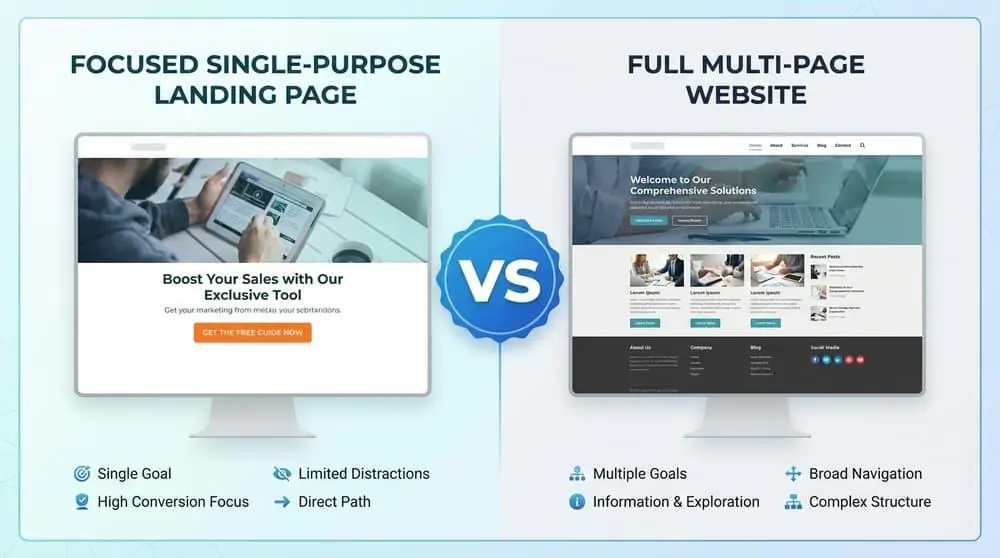
Here’s the key distinction: a landing page is a single page, while a website is a full collection of interconnected pages. A landing page can exist as part of a larger website, or it can stand entirely on its own, hosted independently with no other pages attached to it at all.
So the honest answer to “is a landing page a website” is: it can be, technically, but it’s not built to function like one. A single landing page lacks the structure, navigation, and depth that define a proper website — it’s designed to do one specific job, not to represent an entire business the way a website does.
Analogy: A website is like an entire office building — different departments, floors, and a lobby connecting them all. A landing page is like one specific room set up for a single purpose, like a meeting with one agenda item. That room might exist inside the building, or it could just as easily be a rented space somewhere else entirely — either way, it’s not trying to be the whole building.
What Is a Website?
A website is the full, structured collection of pages representing a business, brand, or individual online — typically including a homepage, an About page, product or service pages, a blog, and a contact page, all connected through navigation.
Purpose: Establish an ongoing, comprehensive online presence. A website serves visitors with many different needs and questions, over an extended period, not just one specific campaign.
Typical structure:
- A homepage acting as the central hub
- Multiple interconnected pages covering different topics or offerings
- A consistent navigation menu linking everything together
- Content built to serve visitors at every stage — first-time visitors, returning customers, and everyone in between
What Is a Landing Page?
A landing page is a standalone page built around a single, specific goal — usually tied to one marketing campaign, ad, or offer — designed to convert a particular type of visitor into a lead or customer.
Purpose: Drive one specific action, for one specific audience, typically arriving from one specific traffic source (an ad, an email, a social post).
Typical structure:
- One focused headline and message matching the campaign that drove the visitor there
- Minimal or no navigation, keeping attention on the single conversion goal
- One primary call to action, repeated throughout the page
- Content that only supports that one offer, without covering unrelated topics
Landing Page vs Website: Side-by-Side Comparison
| Factor | Website | Landing Page |
| Scope | Entire online presence | One specific page or campaign |
| Number of pages | Multiple, interconnected | Usually just one, standalone |
| Purpose | Ongoing brand presence, general information | One specific conversion goal |
| Navigation | Full menu connecting all pages | Minimal or none |
| Lifespan | Long-term, continuously maintained | Often campaign-specific, sometimes temporary |
| Audience | Broad — anyone finding the business | Narrow — visitors from one specific source |
| Can exist independently? | Yes, by definition | Yes — doesn’t require a full website |
| Measured by | Overall traffic, engagement, brand growth | Conversion rate for one specific action |
Do You Need a Website, a Landing Page, or Both?
This is the practical question most people actually want answered, and the right answer depends on your specific goal and stage of business.
When a landing page alone is enough
- Testing a new product idea before committing to building an entire brand presence.
- Running a single, specific campaign — a limited-time offer, a webinar, an early sign-up list — where a broader website isn’t yet needed.
- Validating demand quickly, since a landing page can be built and launched far faster than a full website.
- Running paid ads to one specific offer, where sending traffic to a focused page consistently outperforms sending it to a general homepage.
When you need a full website
- Establishing long-term credibility, since a business with only a landing page and nothing else can appear less established to visitors doing research.
- Offering multiple products or services, which require more structure than a single-purpose page can provide.
- Supporting ongoing content, like a blog, that builds search visibility and authority over time.
- Serving visitors with varied needs — first-time browsers, returning customers, job applicants, press inquiries — who each need a different path through your site.
Why most businesses eventually need both
A landing page and a website aren’t competing options — they typically work together. A business might run paid ad campaigns pointing to dedicated landing pages, while maintaining a full website as the long-term home for its brand, blog, and complete product catalog. The landing page handles focused, short-term conversion goals; the website handles ongoing credibility and broader visitor needs.
Real-World Examples
Landing page only: A solo founder testing a new app idea creates a single landing page describing the concept, with an email sign-up form to gauge interest — before investing in a full website or even building the product itself.
Website only: An established local bakery maintains a full website with a homepage, menu page, About page, and contact form — since their goal is ongoing visibility and information for anyone searching locally, not one specific short-term campaign.
Both together: An ecommerce brand maintains a full website with its entire product catalog, blog, and About page, while also building a dedicated landing page specifically for a Black Friday promotion — linked only from that campaign’s ads and emails, separate from the main site’s navigation.
What Is a Capture Page? (A Related Term Worth Knowing)
A capture page (sometimes called a squeeze page) is a specific, more minimal type of landing page focused almost entirely on capturing one piece of information — usually an email address — often in exchange for a free resource.
The difference from a general landing page is mainly one of scope: a capture page strips content down to the bare minimum needed to get that one piece of contact information, while a broader landing page might include more detail to support a sale, sign-up, or registration. Both are more focused than a full website, but a capture page is the most minimal version of that focus.
Common Mistakes When Confusing a Landing Page and a Website
- Trying to make one landing page function as an entire website. A single page can’t realistically serve the many different needs a full website is built to handle.
- Sending all traffic — including paid campaigns — to a general website homepage. This usually converts worse than a dedicated landing page built specifically to match that traffic source.
- Building a full website before validating an idea. For new products or services, a simple landing page can test demand far faster and cheaper than committing to a complete site upfront.
- Adding full site navigation to a landing page, which pulls visitors away from the single action the page exists to drive.
- Assuming a landing page needs to “grow into” a website. They can, and often do, coexist long-term — a landing page doesn’t need to be replaced once a full website exists.
Best Practices
- Start with a landing page if you’re testing an idea, and build a full website once you’ve validated demand and are ready for a longer-term presence.
- Keep your landing pages separate from your main site navigation, so campaign-specific pages don’t accidentally pull regular website visitors off course.
- Use your website for organic, long-term traffic (SEO, direct visitors, referrals) and reserve landing pages for campaign-specific, paid, or targeted traffic.
- Match each landing page to one specific campaign, rather than trying to make a single page serve multiple unrelated goals.
- Maintain both when your business has matured — a strong website builds lasting credibility, while landing pages keep individual campaigns focused and measurable.
Frequently Asked Questions
Is a landing page the same as a website?
No. A website is a full, interconnected collection of pages representing an entire business. A landing page is typically just one standalone page built for a single specific goal, though it can technically exist as part of a larger website or entirely on its own.
Do I need a website before I can create a landing page?
No. A landing page can be built and hosted completely independently, without any other pages attached to it. This is common for testing new product ideas or running a single campaign before committing to a full website.
What’s the difference between a landing page and a web page?
A web page is a general term for any single page on the internet. A landing page is a specific type of web page built around one focused conversion goal, typically tied to a marketing campaign rather than general site browsing.
What is a capture page, and how is it different from a landing page?
A capture page is a specific, minimal type of landing page focused almost entirely on collecting one piece of information, usually an email address, in exchange for something valuable. It’s a more stripped-down version of a general landing page, which may include more content to support a broader goal.
Should I send paid ad traffic to my website or a landing page?
A dedicated landing page built to match the specific ad is generally the better choice. A general website homepage forces visitors to search for the specific offer, which typically reduces conversion rates compared to a page built to match that exact campaign.
Can a landing page eventually become part of my website?
Yes. Many businesses start with a standalone landing page to test an idea, then later fold it into a full website once they’re ready to build a broader, ongoing online presence.
Final Thoughts Landing Page vs Website
The landing page vs website distinction comes down to scope and purpose: a website is your business’s full, ongoing home online, while a landing page is a focused tool built for one specific goal or campaign.
Neither replaces the other — most businesses end up using both, sending broad, organic traffic to a full website while directing targeted campaign traffic to dedicated landing pages built specifically to match that audience. Understanding which one your current goal actually calls for is the first step to using each effectively.