If you’ve searched for the best AI website builder, you’ve probably noticed the same handful of names showing up everywhere — Wix, Framer, Hostinger, Webflow — and no clear answer about which one actually fits your project. That’s because “best” depends entirely on what you’re building: a small business site, a portfolio, an online store, or a full web app.
This guide breaks down the top AI website builders available right now, explains exactly how they work, and tells you which one to pick based on your budget, skill level, and goals. No fluff, no affiliate hype — just a clear, practical comparison.
Table of Contents
What Is an AI Website Builder?
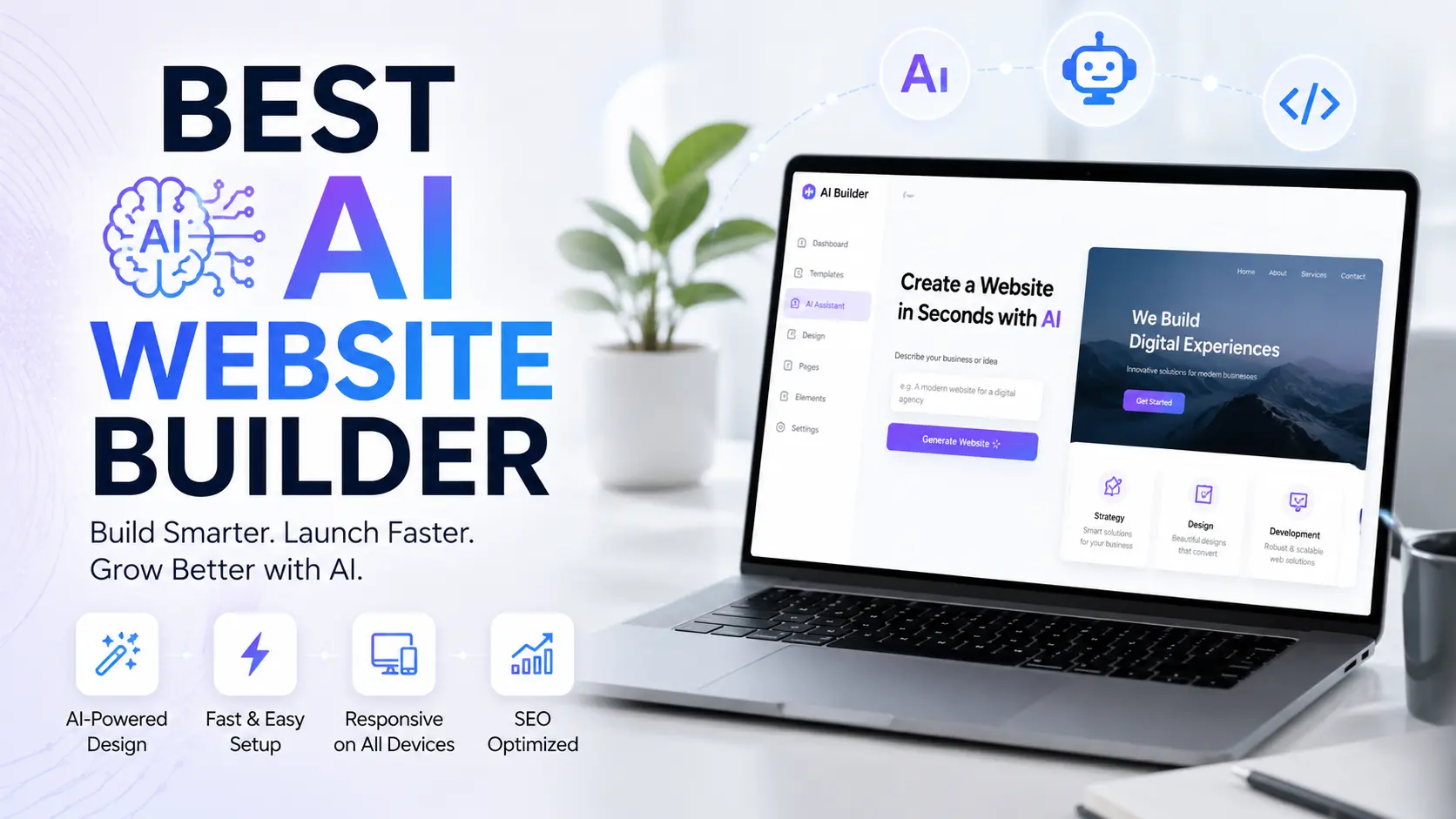
An AI website builder is a tool that uses artificial intelligence to design, write, and structure a website for you, based on a short description or a set of prompts you provide. Instead of dragging blocks onto a blank canvas for hours, you tell the AI what your business does, and it generates a starting layout, color scheme, images, and even the text content.
Think of it like hiring a junior designer who works in seconds instead of weeks. You still review and tweak the result, but you’re editing a finished draft instead of starting from nothing.
Most modern builders combine two things:
- AI generation — creates the first draft of your site (layout, copy, images).
- A visual editor — lets you adjust that draft by clicking, typing, or dragging, without writing code.
A newer category, sometimes called “vibe coding” tools, goes further. Instead of picking from templates, you describe what you want in plain English (“a booking site for my yoga studio with a calendar and payment form”), and the AI writes the actual code behind the scenes.
How AI Website Builders Actually Work
Understanding the process helps you set realistic expectations before you start:
- You answer a few questions or write a prompt — your business name, industry, goals, and style preferences.
- The AI generates a first draft — pulling from design patterns, stock imagery, and AI-written copy that match your input.
- You review and edit — swap sections, rewrite text, change colors, or regenerate parts you don’t like.
- You connect a domain and publish — most builders host the site for you, so there’s no separate hosting setup.
The output quality varies a lot between tools. Some produce a polished, ready-to-launch site. Others give you a rough starting point that still needs real editing work. That gap is the main thing this comparison focuses on.
What to Look for in the Best AI Website Builder
Before comparing specific tools, it helps to know which features actually matter:
- Design quality out of the box — how much cleanup does the AI draft need?
- Editing flexibility — can you fully customize the layout, or are you locked into what the AI gave you?
- Pricing structure — some tools bill per site, others per editor “seat,” which can quietly double your cost.
- E-commerce support — does it handle products, payments, and inventory if you’re selling online?
- SEO controls — can you edit meta titles, alt text, and URL slugs, or is that hidden from you?
- Ownership and portability — can you export the code or move your site elsewhere later, or are you locked into that platform forever?
- Support for your skill level — total beginners need more hand-holding than designers who just want a faster starting point.
The Best AI Website Builders in 2026
Here’s how the leading tools stack up.
1. Wix — Best Overall for Small Businesses
Wix remains the most complete option for small business owners who want a professional site fast without touching code. Its AI system, built on Wix’s Harmony platform, asks you a series of questions about your business and goals, then generates a full site — pages, color palette, tone of voice, and layout — from a short prompt.
Why it stands out: Wix pairs strong AI generation with one of the most mature drag-and-drop editors on the market, plus built-in e-commerce, booking tools, and marketing features. It’s a strong pick if you want everything (site, store, email marketing) in one place.
Best for: Local businesses, freelancers, restaurants, and simple online stores. Starting price: Around $17/month for premium plans with a custom domain. Limitation: Not built for large, highly custom, or code-heavy sites.
2. Framer — Best for Designers and Marketing Teams
Framer blends AI layout generation (called Wireframer) with a design tool that rivals Figma in precision. You can type a prompt to get an instant page layout, then fine-tune every element with pixel-level control.
Why it stands out: The visual quality is the best in this list. Framer is popular with startups and agencies that want a site that looks custom-built, not template-based.
Best for: Designers, agencies, SaaS landing pages, portfolios. Starting price: Free plan available (Framer subdomain, no custom domain); paid plans start around $5–$15/month per site, with separate charges for extra editor seats. Limitation: Pricing is split between site plans and per-editor seats, which can add up fast for teams. There’s a learning curve if you’re used to simpler builders.
3. Hostinger — Best Budget Option
Hostinger’s AI builder focuses on speed and affordability. You add your business name, describe it in a few sentences, and it generates a complete site — copy, images, and a contact form — in under a minute.
Why it stands out: It’s the cheapest reliable option with a genuinely useful AI generator, not just a template picker.
Best for: Freelancers, portfolios, and small businesses on a tight budget. Starting price: Around $3–$12/month depending on the plan and billing term. Limitation: Limited customization depth and fewer advanced SEO controls compared to Wix or Webflow.
4. Webflow — Best for Full Design Control
Webflow’s AI Site Designer generates layouts and sections, but the platform’s real strength is manual control. It exports clean HTML/CSS/JS, giving you an actual code export if you ever want to move off the platform.
Why it stands out: It’s the most transparent, professional-grade builder here, with a built-in CMS for blogs and dynamic content.
Best for: Designers, agencies, and technical founders who want long-term flexibility. Starting price: Free tier available; paid plans start around $15/month (annual billing). Limitation: Steep learning curve, and its AI guidance is more basic than AI-first competitors like Framer or Wix.
5. 10Web — Best for WordPress Users
10Web’s AI builder generates a complete WordPress site from a prompt, then hands you the WordPress dashboard to keep editing. This matters if you want the flexibility of WordPress’s plugin ecosystem without starting from a blank install.
Best for: Users who want AI speed now but WordPress flexibility later. Limitation: WordPress itself has a steeper learning curve than pure no-code tools.
6. Squarespace — Best for Visual Polish
Squarespace’s AI tools generate near-launch-ready designs with minimal cleanup needed, particularly for portfolios, blogs, and creative brands. Its templates were already considered some of the best-looking on the market before AI generation was added.
Best for: Photographers, writers, creatives, and personal brands. Limitation: Less flexible for complex e-commerce or highly custom layouts than Webflow.
7. GoDaddy — Best All-in-One for Local Businesses
GoDaddy’s AI website builder pairs site generation with logo creation, email campaigns, and domain registration in a single dashboard, which appeals to business owners who want one bill and one login for everything.
Best for: Local service businesses that want simplicity over deep customization. Limitation: Design output is more basic than Wix or Framer.
8. Lovable — Best AI-First “Vibe Coding” Builder
Lovable represents the newer wave of AI website and app builders. Instead of picking templates, you describe what you want in plain language, and the AI writes the underlying code — enough to build working web apps, not just static pages.
Best for: Founders and non-developers who want a functional web app or site with real backend logic (forms, databases, logins). Limitation: More powerful than most people need for a simple brochure site; there’s a mindset shift if you’ve only used drag-and-drop builders before.
9. Base44 — Best for Service Businesses Wanting an All-in-One AI Workflow
Base44 lets you describe a website or app in plain language and generates a working result complete with data, logic, and integrations — positioned as an all-in-one platform with marketing tools built in, aimed at service-based businesses.
Best for: Service businesses that want a site plus built-in marketing tools without stitching together separate apps.
Comparison Table: Best AI Website Builders at a Glance
| Tool | Best For | Starting Price | Free Plan | Code Export |
| Wix | Small businesses, e-commerce | ~$17/mo | Yes (Wix branding) | No |
| Framer | Designers, agencies | Free–$15/mo + seats | Yes (subdomain only) | Limited |
| Hostinger | Budget-conscious users | ~$3–$12/mo | No | No |
| Webflow | Full design/code control | Free–$15/mo | Yes (2 pages) | Yes (HTML/CSS/JS) |
| 10Web | WordPress users | Varies | Trial only | Yes (it’s WordPress) |
| Squarespace | Creatives, portfolios | Varies | No | No |
| GoDaddy | Local businesses, all-in-one | Varies | Trial only | No |
| Lovable | Web apps, functional sites | Free tier + usage | Yes | Yes |
| Base44 | Service businesses | Varies | Trial available | Limited |
Pricing changes frequently — always confirm current rates on each provider’s site before purchasing.
AI Website Builder vs. Traditional Website Builder
If you’ve used a “classic” builder like older Wix or Squarespace versions, here’s what’s actually different with AI:
| Traditional Builder | AI Website Builder | |
| Starting point | Blank template you customize | Custom draft generated from your prompt |
| Time to first draft | 1–3 hours | 1–5 minutes |
| Copywriting | You write everything | AI drafts copy you edit |
| Best for | People who enjoy designing from scratch | People who want a fast, guided starting point |
AI doesn’t replace your judgment — it replaces the blank page. You still need to review the copy for accuracy, replace generic stock photos with real ones, and adjust the layout to match your brand.
Common Mistakes When Using an AI Website Builder
- Publishing the AI’s first draft without editing. AI-generated copy is often generic — always personalize it with your actual business details, tone, and offers.
- Ignoring SEO settings. Many builders generate a site but leave page titles, meta descriptions, and image alt text blank. Fill these in manually.
- Choosing a builder based on price alone. A cheap plan that locks you out of custom domains or forces ads on your site can cost you customers.
- Not checking mobile view. AI layouts can look great on desktop and cramped on mobile — always preview both before publishing.
- Skipping the “seat” pricing fine print. Tools like Framer charge per editor in addition to the site plan — a $5 plan can become $25+ once you add a collaborator.
Best Practices for Getting Great Results
- Write a detailed prompt. “A bakery website” gives a generic result. “A cozy neighborhood bakery in Austin, warm and rustic style, focused on custom cakes and online ordering” gives the AI something to actually work with.
- Regenerate instead of settling. Most tools let you regenerate a section or the whole layout — don’t stop at the first result if it doesn’t feel right.
- Add real photos where it matters. Keep AI-generated images for backgrounds or filler, but use real photos for your team, products, or storefront.
- Test your site on a phone before launch. Over half of visitors will likely see your site on mobile first.
- Connect analytics from day one. Most builders offer built-in or Google Analytics integration — turn it on before you launch, not after.
Which AI Website Builder Should You Choose?
- Want the fastest, most complete option? → Wix
- On a tight budget? → Hostinger
- Want the best-looking design with full creative control? → Framer or Squarespace
- Need long-term flexibility and code ownership? → Webflow
- Already run WordPress? → 10Web
- Need a functional web app, not just a brochure site? → Lovable or Base44
Frequently Asked Questions
What is the best AI website builder for beginners? Wix and Hostinger are the easiest for beginners because they ask simple questions and generate a near-complete site with minimal editing required.
Is AI website building actually good, or just a gimmick? It’s genuinely useful in 2026. The best tools can generate a complete site — including working copy and images — in under a minute, saving hours of manual setup. You’ll still want to review and personalize the result rather than publish it as-is.
Can AI website builders help with SEO? AI can generate basic on-page structure, but it can’t guarantee rankings. You still need accurate information, original content, and manual editing to meet search engines’ quality standards.
Do AI website builders work for online stores? Yes. Wix, Squarespace, and Hostinger all support product listings, payments, and inventory management alongside their AI site generation.
Are AI-built websites mobile-friendly by default? Most are responsive out of the box, but you should still preview the mobile version yourself — AI layouts sometimes need manual adjustment on smaller screens.
Can I switch website builders later if I don’t like my AI-generated site? It depends on the platform. Webflow and Lovable let you export code, making a future move easier. Wix, Squarespace, and Hostinger are more closed — moving later usually means rebuilding from scratch.
How much does an AI website builder cost? Prices range from free (with branding and a subdomain) to around $30/month for advanced plans. Budget tools like Hostinger start near $3/month, while design-focused tools like Framer can climb higher once you add custom domains and extra editors.
Final Thoughts
There’s no single best AI website builder for everyone — the right choice depends on your budget, your design standards, and how much control you want over the final result. For most small businesses, Wix offers the best balance of AI speed and completeness. If you care more about visual polish, Framer or Squarespace will get you there. And if you want a site that can grow into a real web app, Lovable and Base44 are worth a serious look.
Whichever tool you pick, treat the AI-generated draft as a starting point, not a finished product — the sites that convert visitors into customers are the ones a real person reviewed, personalized, and tested before hitting publish.