Finding out your perfect domain is already registered doesn’t have to be the end of the search. Learning how to buy a domain name that is taken just means shifting from registration to negotiation — a completely normal, common process that happens thousands of times a day across the domain industry.
Whether the domain is sitting unused, actively redirecting somewhere, or fully in use by another business, there’s usually a path to acquiring it. This guide walks through every legitimate method: checking WHOIS ownership, reaching out directly, using a broker, bidding through auctions, and what to do if the owner won’t sell.
Table of Contents
Why a Taken Domain Isn’t Necessarily Off-Limits
A domain being “taken” just means someone else currently holds the registration — it doesn’t mean it’s permanently unavailable. Domains change hands constantly through direct sales, auctions, expirations, and broker-negotiated deals.
There are generally three situations you’ll run into:
- Actively used domain — a live website or business is operating on it.
- Parked or unused domain — registered but showing only ads or a placeholder page.
- Expired or about-to-expire domain — technically still owned, but nearing the end of its registration.
Each situation calls for a slightly different approach, which we’ll cover step by step.
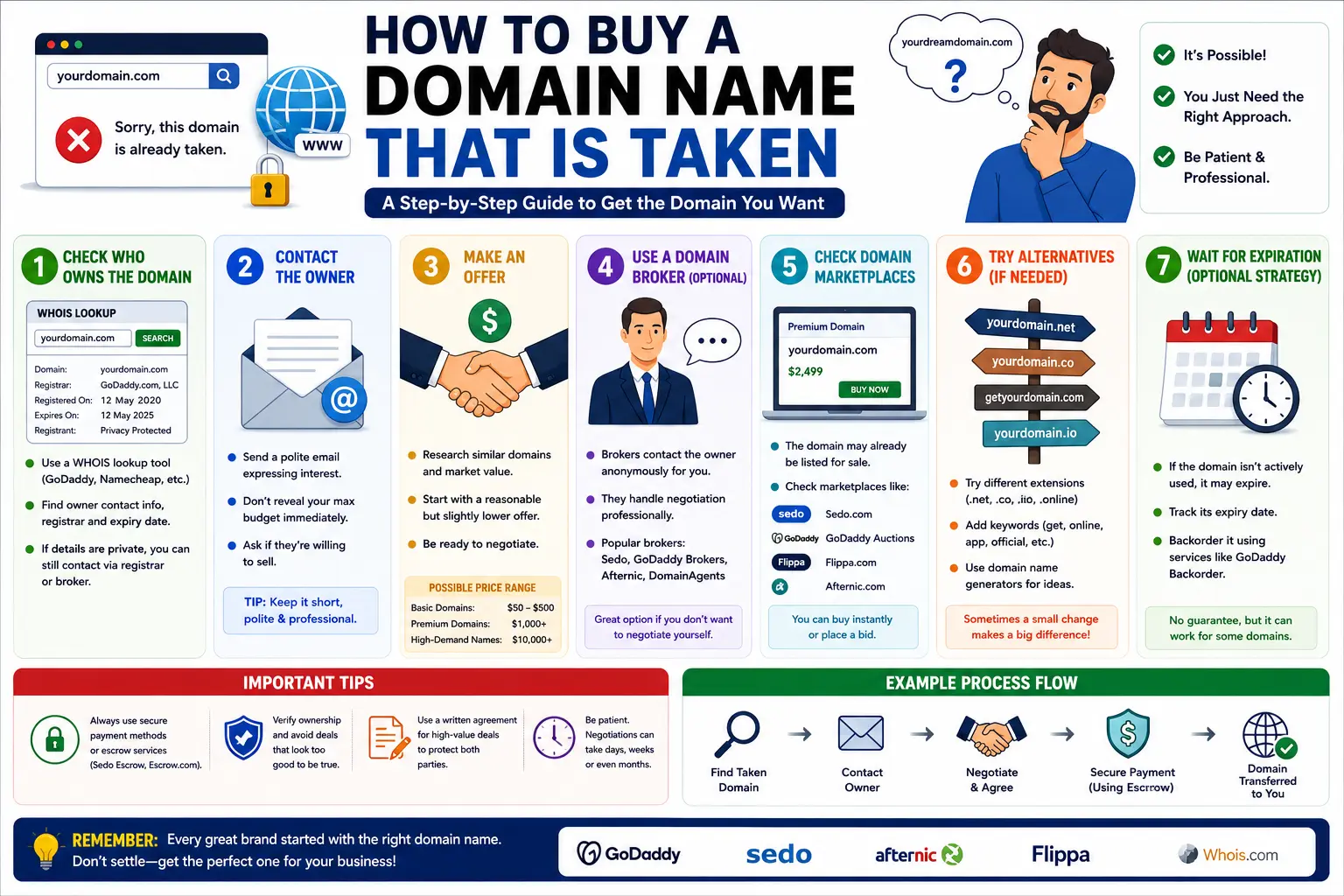
Step 1: Confirm the Domain Is Actually Registered and Active
Before reaching out to anyone, verify the domain’s current status.
- Run a WHOIS lookup (through your registrar or a free WHOIS tool) to see registration and expiration dates.
- Visit the domain directly to see if it’s live, parked, or redirecting elsewhere.
- Check if the WHOIS contact information is public or hidden behind privacy protection.
If WHOIS privacy is enabled, you won’t see the owner’s direct contact info — but that doesn’t block a purchase; it just means you’ll need to go through a different outreach method, covered below.
Step 2: Find Out Who Owns the Domain
- Public WHOIS record — if privacy protection isn’t enabled, the registrant’s name, email, or organization may be listed directly.
- Registrar-forwarded contact form — many registrars provide a “contact the owner” option even when WHOIS is private.
- The website itself — check for a contact page, “About” section, or business listing tied to the domain.
- Domain marketplaces — some registered domains are listed for sale even if they appear to be in casual use; check Sedo, Afternic, or GoDaddy Auctions by searching the domain name directly.
Step 3: Reach Out With a Direct, Professional Offer
Once you’ve identified a contact path, send a short, clear message. Keep it simple:
- Introduce yourself briefly.
- State clearly that you’re interested in purchasing the domain.
- Ask if they’d be open to selling, without immediately naming a price.
- Provide a way to reply (email is standard).
Example outreach message:
Hi, I came across your domain [domain.com] and wanted to check if you’d ever consider selling it. If you’re open to it, I’d love to hear your thoughts on price. Thanks for your time either way.
Avoid opening with a lowball number — it often ends the conversation before it starts. Let the owner respond first, or research fair value before naming a figure.
Step 4: Get a Fair Value Estimate Before Negotiating
Before agreeing to any price, know what the domain is realistically worth. Overpaying is common when buyers get emotionally attached to a specific name.
- Run the domain through automated appraisal tools for a baseline estimate.
- Check recent sales of comparable domains (similar length, keyword, and extension).
- Factor in existing traffic, backlinks, or brand recognition if the domain is actively used.
Our full guide on domain name appraisals covers exactly how to evaluate a domain’s fair market value before you make an offer, including free tools and what actually drives price.
Step 5: Use a Domain Broker for High-Value Negotiations
If the domain is clearly valuable, actively used by a real business, or the owner is unresponsive to a direct approach, a broker can help.
What a broker does:
- Handles anonymous outreach, so the seller doesn’t know a specific buyer’s identity or budget upfront.
- Negotiates price on your behalf using market data and experience.
- Manages secure payment and domain transfer once a deal is reached.
Brokers typically charge a commission (often a percentage of the sale price) but are worth it for names valued in the thousands, since owners often respond more seriously to a broker’s outreach than a cold email from an unknown buyer.
Step 6: Consider Domain Auctions and Marketplaces
Some “taken” domains are already actively for sale, even if it’s not obvious from the website itself.
| Platform | Best For |
| GoDaddy Auctions | Expiring and reseller-listed domains |
| Sedo | Established marketplace for buying and selling domains globally |
| Afternic | Premium and brandable domain listings |
| Flippa | Domains often bundled with an existing website/business |
Search the exact domain name on these platforms before assuming a direct approach is your only option — it may already be listed with a set price or open to offers.
What If the Domain Is About to Expire?
If the domain is close to its expiration date and appears unused, you have a few options:
- Wait for it to expire naturally and attempt to register it the moment it becomes available (competitive, since automated “domain sniping” services do this constantly).
- Use a backorder service — several registrars let you place a backorder that automatically attempts registration the instant the domain releases.
- Reach out before it expires — some owners are simply letting it lapse and may sell it directly rather than risk losing it to someone else for free.
Backordering isn’t guaranteed to succeed, since many expired domains are contested by multiple backorder services simultaneously, but it costs far less than a private negotiation if it works.
Domain Acquisition Methods Compared
| Method | Speed | Cost | Success Rate |
| Direct outreach | Medium | Negotiated (varies widely) | Moderate, depends on owner |
| Domain broker | Slower | Purchase price + commission | Higher for valuable domains |
| Marketplace listing | Fast if listed | Fixed or auction price | High if already for sale |
| Backorder on expiration | Instant at release | Low registration fee | Lower, competitive |
Common Mistakes When Trying to Buy a Taken Domain
- Leading with a lowball offer, which often ends negotiations before they begin.
- Assuming WHOIS privacy means the domain isn’t for sale — it just means outreach requires a different route.
- Skipping a value estimate, leading to either overpaying or losing the deal with an unrealistic offer.
- Contacting the owner publicly (social media, public comments) instead of a direct, professional message.
- Waiting too long to backorder an expiring domain, missing the narrow window when it actually releases.
- Forgetting to verify legal risk — buying a domain closely resembling a registered trademark can create legal complications down the line.
Best Practices for Acquiring an Existing Domain
- Always verify current ownership and registration status before reaching out.
- Keep your first message short, polite, and low-pressure.
- Use a broker once the estimated value crosses into serious money — the commission usually pays for itself in a smoother negotiation.
- Confirm the transfer process in writing before sending payment, including registrar, timeline, and who initiates the transfer.
- Once a deal is agreed, follow the standard registrar transfer process — our guide on transferring a domain name explains what that involves once ownership changes hands.
What Happens After You Agree on a Price?
- Use an escrow service (like Escrow.com) for anything beyond a small transaction — this protects both buyer and seller until the domain transfer completes.
- Get the EPP/authorization code from the seller once payment clears.
- Initiate the transfer to your preferred registrar using that code.
- Confirm the domain shows under your account and update DNS settings as needed.
Never send full payment directly to an unknown seller without an escrow service — this is one of the most common domain-buying scams, especially for higher-value names.
Frequently Asked Questions
Can I buy a domain name that’s already registered? Yes. Most taken domains can be purchased through direct negotiation with the owner, a domain broker, or by checking if it’s already listed on a marketplace like Sedo or Afternic.
How do I find out who owns a domain I want to buy? Start with a WHOIS lookup. If the owner’s contact info is hidden behind privacy protection, use your registrar’s “contact the owner” feature or check the live website for contact details.
Is it expensive to buy a domain that’s already taken? It depends entirely on the domain. Unused, low-demand names can sometimes be bought for a few hundred dollars, while short, brandable, or high-traffic domains can sell for thousands or more.
What if the domain owner doesn’t respond? Try a follow-up message after a couple of weeks, consider a domain broker for a more formal approach, or monitor the domain’s expiration date in case it becomes available later.
Is buying a domain from someone else safe? Yes, as long as you use an escrow service for payment and confirm the transfer process before sending any money. Avoid direct bank transfers to unverified sellers.
Can I just wait for a domain to expire instead of buying it? You can, but it’s competitive. Automated backorder services and domain investors often target valuable expiring domains, so there’s no guarantee you’ll successfully register it the moment it releases.
Final Thoughts
Buying a domain name that’s already taken almost always comes down to three things: identifying the current owner, making a fair and professional offer, and using a secure transfer process once a deal is reached. Whether you go the direct-outreach route, hire a broker, or catch it through a marketplace listing, patience and a realistic value estimate matter more than an aggressive opening offer. The domain you want is rarely as unreachable as it first appears.