If you own a domain name and someone’s offered to buy it — or you’re thinking of selling one — the first question is always the same: what’s it actually worth? That’s exactly what domain name appraisals are for.
A domain appraisal estimates the fair market value of a domain based on factors like length, keywords, extension, age, and existing traffic. It’s not a guarantee of sale price, but a data-informed starting point for negotiation, selling, buying, or even insurance and legal purposes.
This guide explains how domain appraisals actually work, which factors matter most, how to get one for free, and how to avoid the inflated numbers many automated tools produce.
Table of Contents
What Is a Domain Name Appraisal?
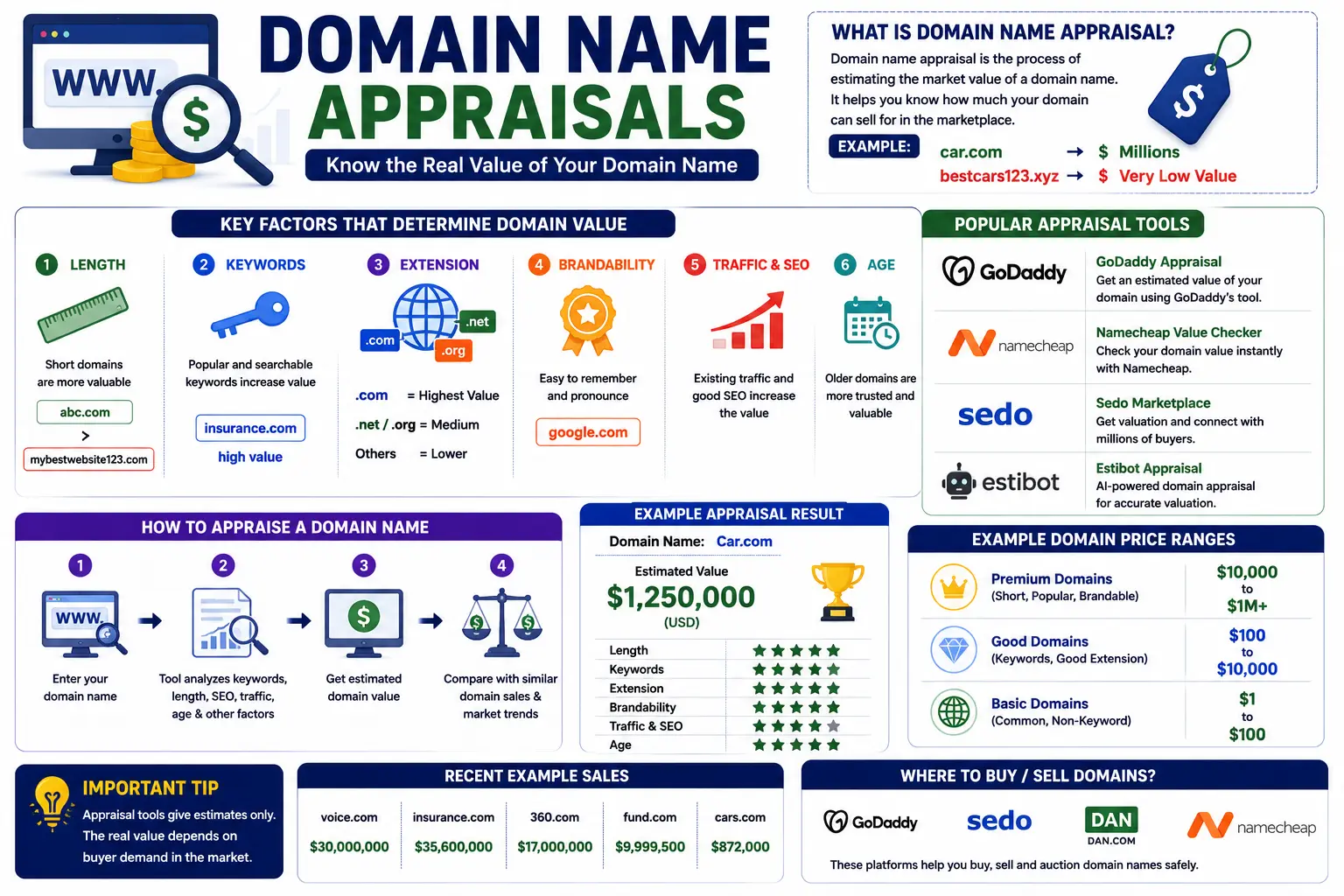
A domain name appraisal is an estimate of what a domain could realistically sell for on the open market. It works similarly to appraising a house or a used car: an appraiser (human or algorithmic) looks at comparable sales and specific characteristics of the asset, then produces a value range.
Unlike physical property, domains have no fixed formula for value. A domain is only worth what a buyer is willing to pay for it, which means appraisals are estimates, not guarantees.
There are two main types:
- Automated appraisals — instant, algorithm-based tools (like GoDaddy’s or Estibot’s) that scan comparable sales data and generate a number in seconds.
- Manual/expert appraisals — done by an experienced domain broker or appraiser who considers market trends, brandability, and buyer demand that algorithms often miss.
Why Domain Appraisals Matter
People request a domain name appraiser’s opinion for several practical reasons:
- Selling a domain — setting a realistic asking price instead of guessing.
- Buying a domain — avoiding overpaying for a name that isn’t actually premium.
- Negotiation leverage — having a documented estimate strengthens your position in a sale.
- Portfolio valuation — investors who own dozens or hundreds of domains need to track overall asset value.
- Legal or insurance purposes — occasionally required for business valuations, disputes, or estate planning.
If you’re earlier in the process and haven’t registered a domain yet, it’s worth understanding how to choose a domain name first — the same qualities that make a name easy to choose are often what make it valuable later.
Key Factors That Determine Domain Value
No single factor decides a domain’s worth. Appraisers weigh several signals together.
| Factor | Why It Matters |
| Length | Shorter domains (especially 3–6 characters) are rarer and more memorable |
| Extension (TLD) | .com typically holds the highest resale value; niche TLDs sell for less |
| Keyword relevance | Domains matching high-search-volume, high-commercial-intent keywords are worth more |
| Brandability | Easy to say, spell, and remember — think one or two syllables |
| Age | Older domains can carry more trust and sometimes existing backlink value |
| Existing traffic/backlinks | A domain with real visitors or SEO history is worth more than a blank one |
| Comparable sales | Recent sales of similar domains set realistic price benchmarks |
| Trademark risk | Domains resembling registered trademarks carry legal risk, which lowers value |
A domain like loans.com scores high across nearly every factor: short, exact-match keyword, .com, and strong commercial intent. A domain like myrandomblogideas247.net scores low on almost all of them.
How Automated Domain Appraisal Tools Work
Most free domain evaluator tools use a similar process:
- They scan a database of historical domain sales.
- They compare your domain’s length, extension, and keyword makeup to similar sold domains.
- They apply weighting algorithms based on search volume and commercial keyword value.
- They output an estimated value, often with a range rather than a single number.
This process is useful for a quick baseline, but it has real limitations. Automated tools can’t judge branding potential, current buyer demand, or niche-specific trends the way an experienced human appraiser can. This is why serious sellers often treat automated numbers as a starting point, not a final answer.
Free vs. Paid Domain Appraisal Services
| Free Automated Tools | Paid/Expert Appraisals | |
| Speed | Instant | Hours to days |
| Cost | $0 | $50–$300+ depending on complexity |
| Accuracy | Good baseline, often inconsistent | More accurate, accounts for market nuance |
| Best for | Quick checks, casual sellers, curiosity | High-value domains, legal/business use, serious sales |
| Examples | GoDaddy Domain Appraisal, Estibot, Dynadot Appraisal | Independent domain brokers, appraisal firms |
If a domain is genuinely valuable — a short .com, a strong keyword match, or something you believe could sell for four or five figures — a paid or broker appraisal is worth the cost before you list it anywhere.
How to Appraise a Domain Name Step by Step
- Check comparable sales — search recent sales of similar domains using marketplaces like Sedo, Flippa, or GoDaddy Auctions.
- Run it through 2–3 free tools — cross-checking multiple automated evaluators gives a more realistic range than trusting one number.
- Evaluate brandability manually — say the domain out loud, check for easy spelling, and confirm it’s free of confusing hyphens or numbers.
- Check search volume for the keyword — a keyword-matching domain is worth more if that keyword actually gets searched.
- Review traffic and backlink history — tools like Ahrefs can show if the domain carries existing SEO value; our guide on Ahrefs URL Rating explains how to read that authority score.
- Factor in trademark risk — a quick search confirms the name doesn’t infringe on an existing registered brand.
- Get a second opinion for high-value names — a broker appraisal is worth it once estimated value crosses into four figures or more.
Common Mistakes When Appraising a Domain
- Trusting a single automated tool’s number as final — different tools can vary by hundreds or thousands of dollars on the same domain.
- Overvaluing personal attachment — a domain that feels meaningful to you may have no resale demand at all.
- Ignoring the extension’s real market value — many sellers assume all extensions hold .com-level worth; most don’t.
- Skipping comparable sales research — appraisal tools alone rarely reflect current, real-world buyer behavior.
- Confusing traffic with value — a domain with random or bot traffic isn’t automatically more valuable than one with none.
Best Practices for Getting an Accurate Appraisal
- Use at least two or three different automated evaluators before trusting a number.
- Search actual recent sales of comparable domains, not just algorithmic estimates.
- For anything you plan to sell for real money, get a broker or expert opinion.
- Document the appraisal (screenshots, dates, sale comparables) if you’ll use it in a negotiation.
- Reassess periodically — domain values shift with search trends and market demand over time.
Real-World Example
Suppose you own fastcarloans.com. Running it through an automated domain name valuator shows a range of $2,000–$4,500, based on keyword volume and comparable .com sales in the finance niche.
You then check completed marketplace sales and find three similar finance-keyword .com domains sold for $2,800, $3,100, and $3,900 over the past year. That confirms your automated estimate is realistic, giving you the confidence to list the domain around $3,000 rather than guessing at a number.
Domain Appraisal vs. Domain Cost: Don’t Confuse the Two
It’s worth being clear about the difference between what a domain costs to register and what it’s worth on resale.
- Registration cost is what you pay a registrar annually to keep the domain active — often $1 to $20 for most extensions, as covered in our guide on how much does a domain name cost.
- Appraisal value is what the domain could sell for on the open market, which can be far higher (or, for most ordinary domains, close to registration cost) depending on demand.
Most domains registered today will never appraise for more than what they cost to renew — and that’s completely normal. Appraisal value only becomes significant for short, keyword-rich, brandable, or aged names.
Frequently Asked Questions
Is domain name appraisal free? Yes, most basic tools like GoDaddy’s Domain Value Appraisal and Estibot offer free automated estimates. Paid, expert-level appraisals from brokers typically cost extra and are reserved for higher-value domains.
How accurate are free domain appraisal tools? They provide a useful baseline but aren’t fully reliable on their own. Automated tools rely on algorithms and historical sales data, so they can miss brandability, current demand, and niche-specific trends that a human appraiser would catch.
What makes a domain name valuable? Short length, a .com extension, strong keyword match, easy pronunciation and spelling, and a clean sale/registration history are the biggest value drivers.
Can I appraise a domain I don’t own yet? Yes. Most appraisal tools let you evaluate any domain, whether you own it or not, which is useful for gauging a fair offer before buying.
Do domain appraisals affect SEO or Google rankings? No. A domain’s appraised resale value has no bearing on how Google ranks a website. Ranking depends on content quality, backlinks, and technical SEO, not the market price of the domain name.
What’s the difference between a domain appraiser and a domain broker? An appraiser estimates value; a broker actively markets and negotiates the sale on your behalf, usually for a commission once the domain sells.
Final Thoughts Domain Name Appraisals
A domain name appraisal is only as useful as the data behind it. Automated tools give you a fast, free starting point, but comparable sales research and, for valuable names, a professional opinion will get you far closer to what a real buyer would actually pay. Treat the number as a negotiation tool, not a guarantee — and always cross-check before you price a domain to sell.