Buying a website address shouldn’t feel like a guessing game. If you’ve searched for a cheap domain name register option, you’ve probably already noticed the problem: prices swing wildly between providers, “cheap” often means expensive after year one, and every registrar claims to be the best deal on the internet.
This guide clears that up. You’ll learn what actually makes a domain name cheap, which registrars are genuinely affordable, what hidden costs to watch for, and how to register your domain the right way — step by step — without wasting money on renewal traps or upsells you don’t need.
Table of Contents
What Does “Cheap Domain Name Register” Actually Mean?
A domain name is the address people type into a browser to reach your website — something like yourbusiness.com. Before you can use one, you need to register it through a company called a domain registrar, which reserves the name for you and links it to the internet’s naming system.
“Cheap” in this context has two layers:
- Low first-year price — many registrars advertise domains for $0.99 to $5 to attract new customers.
- Low renewal price — the amount you pay every year after that first year, which is where the real cost of ownership lives.
Most buyers only compare the first number. That’s the mistake this guide helps you avoid. If you want a deeper breakdown of what determines pricing across extensions and registrars, our guide on how much does a domain name cost covers the full pricing landscape in detail.
Why Domain Prices Vary So Much
Domain pricing isn’t random. A handful of factors decide what you’ll actually pay.
| Factor | How It Affects Price |
| Extension (TLD) | .com costs more than .xyz, .online, or .site |
| Registrar promotions | New customer discounts lower the first-year price only |
| Renewal pricing | Some registrars raise prices sharply after year one |
| Premium status | Short, brandable, or dictionary-word domains cost more |
| Add-ons | Privacy protection, email, and SSL are sometimes bundled, sometimes not |
| Registry fees | Set by the organization that manages each extension, not the registrar |
Understanding this table is the difference between finding a genuinely cheap domain name registrar and falling for a bait-and-switch renewal price.
The Cheapest Domain Extensions in 2026
If budget is the priority, the extension you choose matters more than the registrar in many cases.
- .com — Most trusted and recognizable, but rarely the cheapest, typically $9–$15/year at fair-priced registrars.
- .xyz — Frequently under $2/year on promotion, good for side projects and startups testing an idea.
- .online / .site / .store — Often discounted heavily in year one, useful for niche or e-commerce projects.
- .net / .org — Slightly cheaper than .com in most cases, still widely recognized.
- .info — Usually low-cost, though less trusted for commercial brands.
A cheaper extension is a smart choice for a hobby blog, portfolio, or test project. For a long-term business brand, .com is usually worth the extra few dollars because of trust and recall — something worth weighing alongside our guide on how to choose a domain name.
Best Cheap Domain Name Registrars Compared
Here’s how the market’s most relevant options stack up when you look past the introductory price.
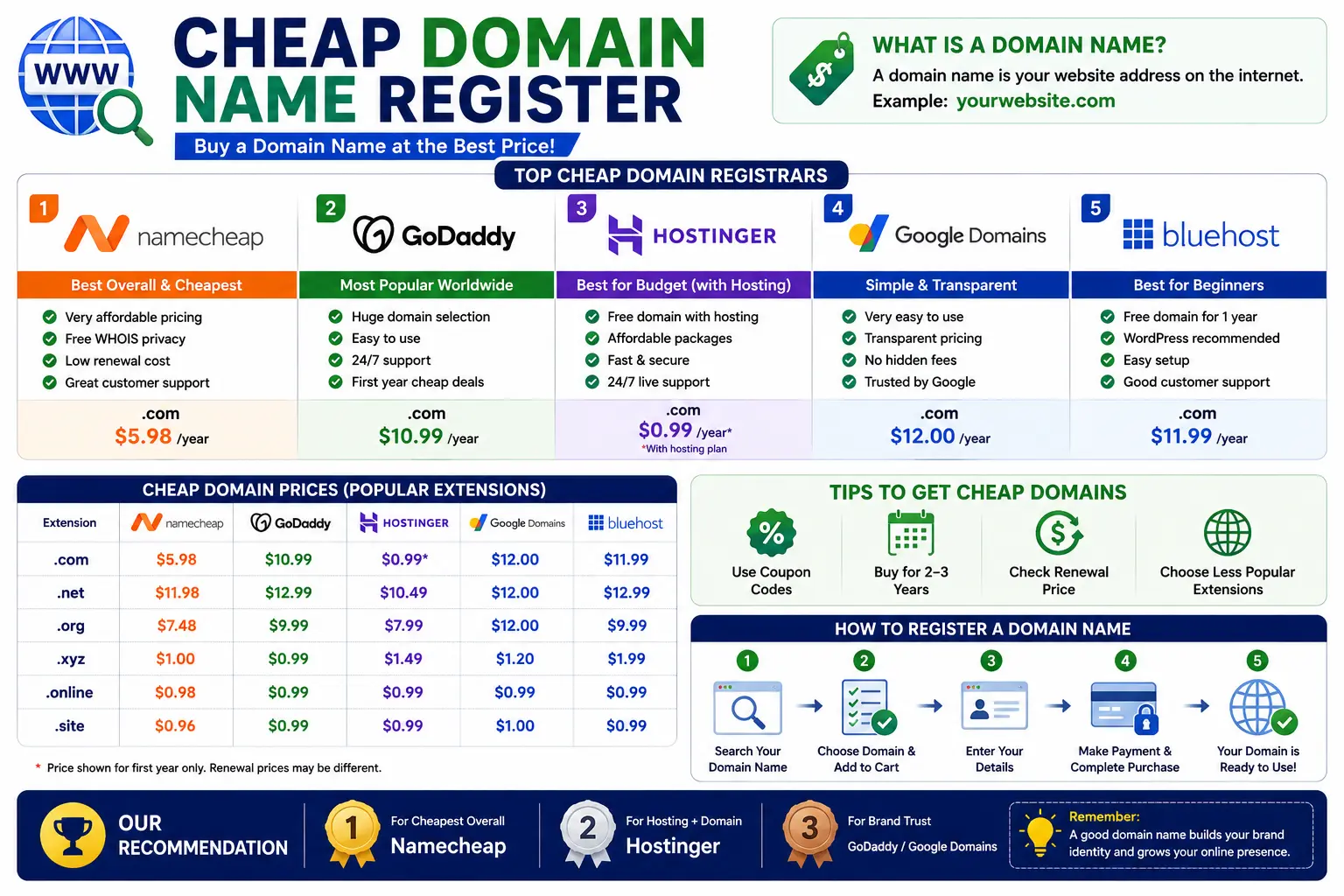
| Registrar | Starting Price (.com) | Renewal Price (.com) | Free WHOIS Privacy | Notes |
| NameSilo | ~$9–10/year | Same as first year | Yes | No aggressive upsells, transparent flat pricing |
| Namecheap | ~$1–9/year (promo) | ~$13–17/year | Yes | Frequent sales, larger renewal jump |
| Porkbun | ~$5–9/year | Close to first-year price | Yes | Clean interface, minimal upselling |
| GoDaddy | ~$0.99–1.99/year (promo) | ~$20+/year | Paid add-on | Aggressive first-year discounts, high renewals |
| Wix | Often bundled with hosting plans | Varies by plan | Sometimes included | Convenient if you’re already building on Wix |
Key takeaway: the registrars that keep renewal prices close to the first-year price — rather than tripling them — are the ones offering a genuinely cheap domain name registry service, not just a cheap first click.
Cheap First Year vs. Cheap Forever: The Trap to Avoid
This is the single biggest mistake buyers make when hunting for the cheapest domain name purchase.
Here’s a realistic example:
- Year 1: $0.99 (promotional price)
- Year 2 onward: $19.99/year
Over five years, that domain costs $80.95 — while a registrar charging a flat $10/year the entire time costs $50. The “cheap” option ends up 60% more expensive.
Before registering, always check:
- The renewal price, not just the sign-up price
- Whether the price is locked for multiple years if you prepay
- Whether privacy protection is free or a paid add-on after year one
- Whether auto-renewal is on by default (it usually is)
This is why comparing the cheapest way to buy a domain name means comparing five-year cost, not day-one cost.
Hidden Costs That Make “Cheap” Domains Expensive
Watch for these common upsells and fees:
- WHOIS/Privacy Protection — hides your personal contact info from public domain records; free at some registrars, $5–15/year at others.
- Domain lock / transfer fees — charged if you want to move your domain to another registrar later.
- SSL certificate upsells — many hosts include free SSL now, so a paid one is rarely necessary.
- Forced hosting bundles — some “cheap domain” offers require you to buy hosting too, raising the real cost.
- ICANN fee — a small, standard $0.18/year fee charged by nearly all registrars; not a scam, just industry-wide.
Step-by-Step: How to Register a Cheap Domain Name
- Decide on your extension — .com for brand trust, or a cheaper alternative for a smaller project.
- Search availability — use the registrar’s search tool to check if your desired name is free.
- Compare renewal prices, not just sign-up prices, across two or three registrars.
- Check what’s included — privacy protection, DNS management, email forwarding.
- Register for multiple years if the registrar offers a locked rate — this avoids future price hikes.
- Turn off unnecessary add-ons during checkout (SSL, site builder, hosting bundles) unless you need them.
- Verify your registration — confirm the domain shows as “active” in your registrar dashboard.
For a more detailed technical walkthrough of this process, see our full guide on how to register a domain name.
Real-World Example
Imagine you’re launching a freelance design portfolio. You don’t need enterprise features — just a clean, professional address.
- You compare .com at $12/year (flat renewal) against a .design extension at $25/year.
- Since brand trust matters for client-facing work, you choose .com.
- You skip the $15/year privacy upsell because your registrar includes it free.
- You prepay two years to lock in the rate before any promotional pricing expires.
Total cost: roughly $24 for two years of ownership, with no surprise renewal jump.
Common Mistakes When Buying a Cheap Domain
- Ignoring renewal pricing and getting locked into a name you can’t afford to keep.
- Choosing an unusual extension purely for price, then struggling with brand recognition.
- Skipping WHOIS privacy, exposing personal name, address, and phone number publicly.
- Letting auto-renewal lapse silently without checking payment methods stay current.
- Confusing the domain with hosting — a domain is just the name; you still need hosting to actually publish a site.
Domain Name vs. Web Hosting: A Quick Clarification
A lot of first-time buyers assume “buying a domain” gets them a live website. It doesn’t. The domain is your address; hosting is the space where your site’s files actually live.
Understanding the structure of a web address itself also helps here — if you’re unfamiliar with the difference between a domain and the full web address, our explainer on what is a URL breaks it down clearly, alongside a deeper look at the individual parts of a URL explained.
Best Practices for Long-Term Domain Ownership
- Buy directly from an ICANN-accredited registrar — avoid resellers with unclear ownership terms.
- Enable auto-renewal, but track your card expiration date so it doesn’t fail silently.
- Use free WHOIS privacy wherever offered instead of paying extra for it elsewhere.
- Register for 2–3 years upfront if your budget allows, to lock in pricing and reduce renewal risk.
- Keep registrar login details secure — domain hijacking is rare but serious.
- Review DNS settings periodically, especially after switching hosting providers.
If you ever decide to leave a registrar for a better renewal rate, our guide on transferring a domain name walks through that process without downtime.
Cheap Domain Registrars vs. Domain Marketplaces
It’s worth distinguishing between two very different purchase paths:
| Domain Registrar | Domain Marketplace | |
| What you’re buying | A brand-new, unregistered name | An already-owned name, resold |
| Typical price | $1–$20/year | $50 to tens of thousands (one-time) |
| Best for | New websites, startups, personal brands | Buying a premium or already-established name |
If your goal is genuinely the cheapest domain name registry option, a standard registrar for a new, available name will almost always beat a marketplace purchase.
Frequently Asked Questions
What is the cheapest way to get a domain name? Choosing a less common extension (like .xyz or .online) from a registrar with flat, low renewal pricing — such as NameSilo or Porkbun — is typically the cheapest sustainable option, especially compared to premium .com names sold on resale marketplaces.
Can I register a domain name for free? Some website builders and hosting plans include a free domain for the first year, but you’ll still pay a renewal fee afterward. There’s no way to own a domain permanently for free, since registries charge ongoing fees to maintain ownership records.
Why do domain prices increase after the first year? Registrars use low first-year pricing as a promotional hook to win new customers, then charge closer to (or above) the standard market rate at renewal. Always check the renewal price before registering.
Is a cheap domain name bad for SEO? No. Google doesn’t rank sites higher or lower based on how much you paid for the domain or which extension you chose. Content quality, backlinks, and site structure matter far more than domain price.
What’s the difference between a domain registrar and a domain name registry? A registry (like Verisign for .com) manages the master database for an entire extension. A registrar (like NameSilo or Namecheap) is the company you actually buy the domain from, which then registers it with the appropriate registry.
Do I need to buy hosting and a domain from the same company? No. You can register your domain with one company and host your website with another. Keeping them separate often gives you more flexibility and better pricing on both.
Final Thoughts
The cheapest domain name isn’t the one with the flashiest first-year discount — it’s the one with fair, predictable pricing over the years you’ll actually own it. Compare renewal costs, skip unnecessary add-ons, and choose an extension that matches your project’s goals, and you’ll come out ahead of nearly everyone chasing the $0.99 headline price.