A company website is the digital front door of your business. Before a customer ever calls you, visits your office, or buys your product, they usually check your website first. If that website looks outdated, loads slowly, or doesn’t explain what you do, you lose the sale before the conversation even starts.
This guide breaks down everything you need to know about a company website — what it is, why it matters, what a great one looks like, real examples across industries, and the exact mistakes that quietly cost businesses customers every day. Whether you’re a solo founder building your first site or a marketing manager planning a redesign, this is written so every term is explained, with no assumed background knowledge.
Table of Contents
What Is a Company Website?
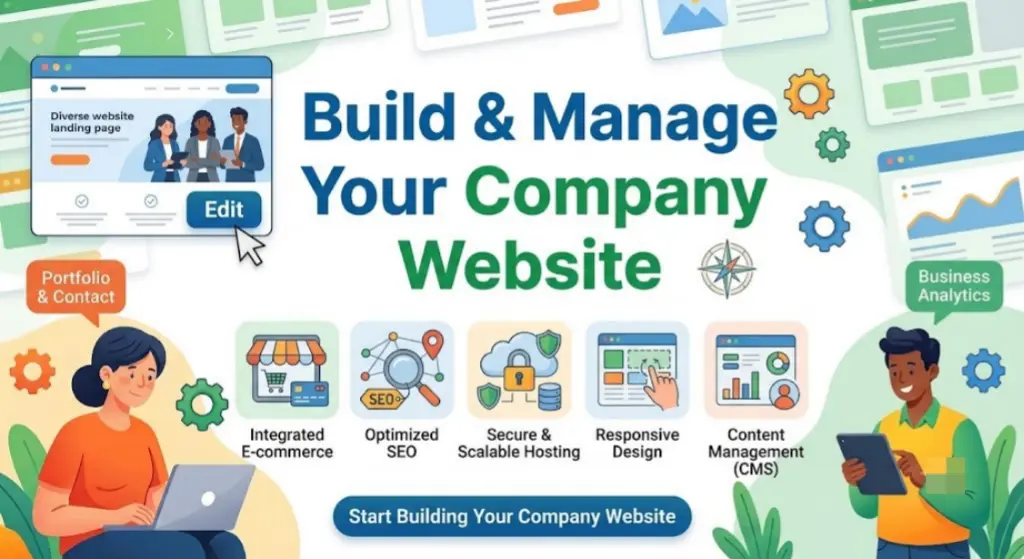
A company website is an official online platform owned and operated by a business to represent itself on the internet. It typically includes information about the company’s products or services, its team, its values, and ways for visitors to get in touch or make a purchase.
Think of it like a digital storefront combined with a brochure, a sales rep, and a customer service desk — all working 24 hours a day, even when your team is asleep.
A company website is different from:
- A social media page — you don’t own the platform or the data, and the design is limited to what the platform allows.
- A marketplace listing (like an Amazon or Etsy shop) — you’re renting space on someone else’s platform and competing with other sellers on the same page.
- A landing page — a single page built for one campaign or offer, not a full representation of the business.
A proper company website gives you full control over branding, messaging, user experience, and data — which is why it remains the most trusted format for businesses of every size.
Why a Company Website Still Matters in 2026
Some business owners assume social media has replaced the need for a website. It hasn’t — it has made a good website more important, not less.
Here’s why:
- Credibility. Most buyers, whether B2B or B2C, check a company’s website before making a decision. A missing or broken website raises doubt about whether the business is legitimate.
- Ownership. Social platforms can change algorithms, suspend accounts, or shut down. Your website is an asset you fully control.
- Search visibility. A website can be found on Google for years after it’s published, generating free traffic — something a social post can’t do after the first few days.
- Conversion control. You decide exactly what a visitor sees, in what order, and what action they take next (call, buy, book, sign up).
- Lead generation. Contact forms, live chat, and booking tools turn visitors into leads without any manual effort from your sales team.
| Channel | Owned by you | Searchable long-term | Full design control | Captures leads directly |
| Company website | Yes | Yes | Yes | Yes |
| Social media page | No | Limited | No | Limited |
| Marketplace listing | No | Limited | No | No |
| Print brochure | Yes | No | Yes | No |
Types of Company Websites
Not every business needs the same kind of site. Here are the main categories, so you can identify which one fits your situation.
1. Corporate Website
A corporate website represents the entire company — its mission, leadership, history, investor information (if public), press coverage, and career openings. Large organizations like banks, manufacturers, and enterprise software companies typically use this format. The focus is trust, authority, and information depth rather than direct sales.
2. Small Business Website
Smaller companies — local shops, agencies, contractors, clinics — need a simpler structure: home page, services, about, testimonials, and contact. The goal is usually to generate calls, bookings, or store visits rather than to communicate to investors or the press.
3. E-commerce Website
Built specifically to sell products online, with a shopping cart, product pages, and checkout system (Shopify and WooCommerce are common platforms for this).
4. Portfolio / Service Website
Used by freelancers, agencies, and consultants to showcase past work and convert visitors into inquiries.
5. SaaS / Product Website
Used by software companies to explain a product, show pricing, and drive free trial or demo sign-ups.
Knowing which type applies to you determines almost every decision that follows — structure, content, and design.
Core Pages Every Company Website Needs
Regardless of industry, most effective business websites share a common structure:
- Home page — a clear statement of what you do and who you help, within the first few seconds of landing.
- About page — your story, team, and why customers should trust you.
- Services or Products page — what you offer, explained in plain language, not jargon.
- Case studies or testimonials — social proof from real clients or customers.
- Contact page — phone number, email, address (if applicable), and a simple contact form.
- Blog or resources (optional but powerful) — builds search traffic and demonstrates expertise over time.
A common mistake is treating the home page like a company brochure — cramming in every detail about the business instead of quickly answering the visitor’s real question: “Can this business solve my problem?”
What Great Corporate Website Design Looks Like
Corporate website design isn’t just about looking modern — it’s about making information easy to find and easy to trust. The best business websites tend to share these traits:
1. Clarity Over Cleverness
Visitors decide whether to stay on a page within seconds. A confusing headline or abstract tagline (“Reimagining Tomorrow, Together”) tells the visitor nothing. Clear, specific language performs better: “Accounting software for freelancers who hate spreadsheets” tells the visitor exactly what they’re getting.
2. Fast Load Times
Every additional second a page takes to load increases the chance a visitor leaves before it even finishes rendering. Compressed images, clean code, and reliable hosting matter as much as visual design.
3. Mobile-First Layout
More than half of web traffic today comes from phones. A website design for company use should be built and tested on mobile first, then scaled up to desktop — not the other way around.
4. Consistent Branding
Colors, fonts, and tone of voice should match across every page — and ideally match the company’s other marketing materials, from business cards to social media.
5. Clear Calls to Action (CTAs)
Every page should guide the visitor toward one clear next step: “Book a Call,” “Get a Quote,” “Start Free Trial.” Pages with multiple competing CTAs confuse visitors and lower conversions.
6. Accessibility
Text should have enough contrast to read easily, buttons should be large enough to tap on mobile, and images should include alt text for screen readers. This isn’t just good ethics — it also affects how well Google can understand and rank your site.
Business Website Examples by Industry
Seeing real structure helps more than abstract advice. Here’s how the same principles apply differently across industries:
Local service business (e.g., plumber, electrician, dentist) Home page leads with a phone number and service area, followed by trust signals (reviews, licenses, years in business), then a simple service list and a booking form.
Professional services (e.g., law firm, accounting firm, agency) Home page emphasizes expertise and results, with case studies, team bios featuring credentials, and a consultation request form.
Manufacturer or B2B supplier Home page focuses on product categories, certifications, and a request-a-quote system, since B2B buyers usually research extensively before contacting sales.
E-commerce brand Home page highlights bestsellers, promotions, and trust badges (secure checkout, return policy), with a fast path from homepage to product to cart.
SaaS / software company Home page explains the problem solved, shows a product screenshot or short demo video, and drives to a free trial or demo booking, with pricing usually one click away.
Small Business Website Design: What’s Different
Small business owners often have limited time and budget, so priorities shift slightly compared to a large corporation:
- Simplicity wins. A 5–7 page website that loads fast and clearly explains your offer will usually outperform a large, complex site that’s hard to maintain.
- Local SEO matters more. Including your city/region in page titles, and setting up a Google Business Profile linked to your website, drives more local visibility than broad national SEO efforts.
- Trust signals carry extra weight. Reviews, before/after photos, and years-in-business badges matter more for a local business than for an e-commerce brand, since customers are often meeting the business in person.
- Budget-friendly platforms work well. Tools like Squarespace, Wix, and WordPress let small businesses launch professional sites without hiring a full development team.
DIY Website Builders vs. Custom Development
| Factor | Website Builder (Wix, Squarespace) | Custom Development |
| Cost | Low ($15–$50/month) | High ($3,000–$50,000+) |
| Setup time | Days | Weeks to months |
| Design flexibility | Template-based, some customization | Fully custom |
| Technical skill needed | Minimal | Requires developers |
| Best for | Small businesses, startups, portfolios | Large enterprises, complex functionality |
| Scalability | Limited at high traffic/complexity | High, built for growth |
For most small and mid-sized businesses, a website builder or a WordPress site built by a freelancer is enough. Custom development typically only makes sense once the business has outgrown template limitations — for example, needing a custom booking system, complex integrations, or very high traffic volumes.
How Much Does a Company Website Cost?
Costs vary widely depending on complexity:
- DIY website builder: $15–$50/month, plus a domain name (roughly $10–$20/year).
- Freelancer-built website (WordPress, Webflow, etc.): $500–$5,000, depending on page count and design complexity.
- Agency-built corporate website: $5,000–$50,000+, including strategy, custom design, and development.
- Enterprise website with custom features: $50,000+, especially with integrations into CRM, ERP, or internal systems.
A useful rule: your website budget should match how much revenue the site is expected to generate or influence. A local bakery doesn’t need a $30,000 website. A B2B company closing $100,000 contracts through its website absolutely can justify a larger investment.
Common Mistakes in Company Website Design
- No clear value proposition on the home page. Visitors leave before understanding what you offer.
- Slow load times. Large, uncompressed images are the most common cause.
- Outdated content. Old team photos, expired promotions, or a copyright year stuck in 2019 quietly damage trust.
- No mobile optimization. A site that looks broken on a phone loses the majority of modern traffic instantly.
- Too many CTAs competing for attention. Pick one primary action per page.
- Missing contact information. Hiding your phone number or address behind multiple clicks frustrates visitors, especially local customers.
- Ignoring SEO basics. No page titles, no meta descriptions, and no structured headings make it harder for Google to understand and rank the site.
- Stock photography overload. Generic stock photos of “business people shaking hands” reduce authenticity compared to real team and workplace photos.
Best Practices Checklist
Use this as a quick audit for your own site:
- [ ] Home page explains what you do within 5 seconds
- [ ] Site loads in under 3 seconds on mobile
- [ ] Every page has one clear call to action
- [ ] Contact information is visible in the header or footer on every page
- [ ] Design is fully responsive on phone, tablet, and desktop
- [ ] Real photos are used instead of generic stock images
- [ ] Testimonials or reviews are visible near key decision points
- [ ] Page titles and meta descriptions are written for both users and search engines
- [ ] Content is updated at least once every few months
Frequently Asked Questions
Does every business need a website, even if they’re active on social media? Yes. Social media builds awareness, but a website builds trust and converts that awareness into leads or sales — and it’s the one platform you fully control.
What’s the difference between a corporate website and a small business website? A corporate website typically covers a larger company’s full structure — investor relations, press, careers, and multiple departments. A small business website is usually more focused: services, testimonials, and a direct path to contact or purchase.
How many pages should a company website have? Most small businesses need 5–7 pages (home, about, services, testimonials, contact, and sometimes a blog). Larger corporations often need dozens of pages to cover products, locations, careers, and investor information.
Can I build a professional company website myself? Yes, using platforms like Wix, Squarespace, or WordPress. These tools have improved significantly and can produce a professional-looking result without coding, though a hired designer or developer usually still outperforms DIY for complex needs.
How often should a company website be updated? At minimum, contact information, pricing, and testimonials should be checked every few months. A full redesign is typically worth considering every 3–5 years as design trends and technology evolve.
Does website design actually affect SEO rankings? Yes. Page speed, mobile-friendliness, and clear site structure are all factors Google considers when ranking pages, in addition to the quality of the content itself.
Final Thoughts
A company website isn’t a one-time project — it’s an ongoing asset that should evolve with your business. The strongest business websites aren’t necessarily the most expensive or the most visually elaborate; they’re the ones that make it effortless for a visitor to understand what the company does and take the next step.
Whether you’re building your very first small business website or redesigning a corporate site that’s grown outdated, the fundamentals stay the same: clarity, speed, trust, and a clear path to action.