You’ve registered a domain, paid your renewal fee, and now you’re wondering: can you buy a domain name forever, or do you have to keep paying for it indefinitely? It’s one of the most misunderstood parts of owning a website address.
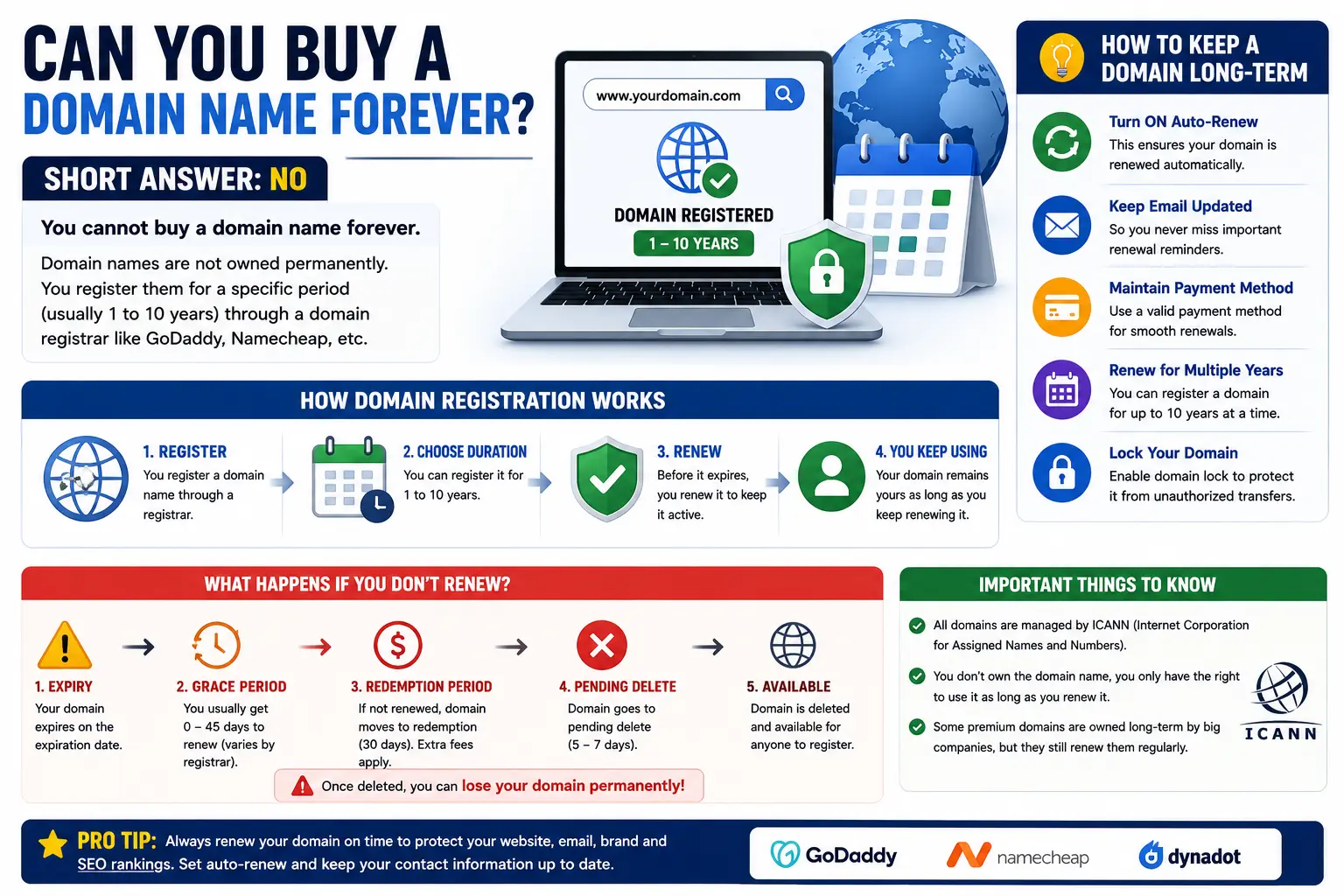
The short answer is no — you can’t buy a domain name outright the way you’d buy a piece of property. Every domain is technically leased through annual (or multi-year) registration, and there’s no option to pay once and own it permanently. But that doesn’t mean your domain is at risk as long as you keep renewing it. This guide explains exactly how domain ownership works, why there’s no “forever” purchase option, and how to make sure you never lose a domain you depend on.
Table of Contents
Why You Can’t Buy a Domain Name Outright
Domain names aren’t sold like physical property. Instead, they’re licensed through a global system managed by ICANN (the Internet Corporation for Assigned Names and Numbers), the nonprofit organization that oversees how domain names are structured and distributed worldwide.
Here’s the structure:
- ICANN sets the rules for how domains are registered and renewed.
- Registries manage specific extensions (Verisign runs .com, for example).
- Registrars (like GoDaddy, Namecheap, or NameSilo) sell registration access to individual users like you.
When you “buy” a domain, you’re actually paying for a registration period — the right to use that name exclusively for a set number of years. If you’re new to how this system works, our explainer on what is a domain name system covers how domains connect to the broader internet infrastructure this registry system supports.
Is a Domain Name Yours Forever Once You Buy It?
Not in the sense of permanent ownership — but effectively, yes, as long as you keep renewing it. Think of it less like buying a house and more like leasing land with an automatic renewal option that never has to expire, as long as you keep paying and follow the rules.
There’s no legal mechanism, anywhere in the domain system, to convert a registration into permanent, no-renewal-required ownership. This applies to every registrar and every extension, including .com, .net, .org, and country-code domains.
What’s the Maximum You Can Register a Domain For?
ICANN caps how far in advance you can register or renew a domain.
| Detail | Rule |
| Maximum registration period | 10 years at a time |
| Renewal option | Renew again before or after it expires (within a grace period) |
| Permanent/lifetime option | Does not exist |
| Multi-year prepay | Allowed, but still capped at a 10-year maximum at any point |
So even if you wanted to lock in a domain for the rest of your life in one transaction, the system caps you at a 10-year registration — after which you simply renew again.
What Happens If You Don’t Renew a Domain?
Missing a renewal doesn’t mean instant loss, but it does start a countdown with real consequences.
- Expiration date passes — the domain typically stops resolving (your website and email go down).
- Grace period (usually ~30-45 days) — you can still renew at the standard price.
- Redemption period (usually ~30 days) — the domain is suspended, and renewing now often requires a redemption fee, sometimes $80-$200 depending on the registrar.
- Pending delete (about 5 days) — a final short window before the domain is released.
- Released to the public — anyone, including domain investors who actively watch for expiring names, can register it.
This is exactly why abandoned domains with existing traffic or backlinks sometimes get scooped up by others — a risk covered in more detail in our guide on domain name appraisals, which explains how expired, valuable domains get resold.
How to Effectively “Own” a Domain Name Forever
While there’s no literal forever-purchase option, you can get as close as the system allows with the right habits.
- Enable auto-renewal and keep your payment method current — this is the single most effective step.
- Register for the maximum 10-year term to reduce how often you have to think about it.
- Keep your WHOIS/contact email updated so renewal reminders actually reach you.
- Set a calendar reminder outside the registrar’s system, as a backup in case an email gets missed or filtered as spam.
- Use a registrar with clear renewal pricing, so a surprise cost increase doesn’t cause you to skip a payment. Our guide on finding a cheap domain name register option covers how to compare renewal pricing before you commit long-term.
- Avoid frequent registrar transfers right before expiration, since transfers can occasionally complicate renewal timing.
Domain Registration vs. Buying Property: A Quick Comparison
| Domain Name | Physical Property | |
| Ownership model | Leased/licensed, renewed periodically | Purchased outright, deed transferred |
| Maximum term per transaction | 10 years | No cap; can be permanent |
| Risk of loss | Expires if not renewed | Doesn’t expire from non-payment (aside from taxes) |
| Ongoing cost | Annual/multi-year renewal fee | Property taxes, but ownership itself is permanent |
| Resale | Possible via marketplaces or brokers | Possible via standard real estate sale |
This comparison is exactly why people search for a “forever” purchase option — the domain system feels like it should work like property ownership, but structurally, it never will.
Can You Buy a Domain Name for Life With a Premium Package?
Some registrars and hosting companies advertise “lifetime domain” deals, especially bundled with hosting plans. It’s worth understanding what these actually offer:
- In most cases, “lifetime” refers to the lifetime of your hosting plan or subscription, not a literal permanent registration exempt from ICANN’s rules.
- The company is typically pre-paying and managing renewals on your behalf for as long as you remain a customer.
- If the company shuts down, changes terms, or you cancel the underlying plan, the domain can still be affected.
Always read the fine print on “lifetime” domain offers — no registrar can override ICANN’s renewal requirement, so the term is a marketing simplification, not a technical exception.
Common Mistakes People Make About Domain Ownership
- Assuming a one-time payment means permanent ownership — every domain requires ongoing renewal, no exceptions.
- Letting auto-renewal fail silently due to an expired card, without a backup reminder system.
- Ignoring renewal emails, assuming they’re spam or marketing, and missing the actual expiration notice.
- Believing “lifetime” hosting deals include truly permanent domain registration — they don’t override ICANN’s system.
- Waiting until the last day to renew, leaving no buffer if a payment fails or the registrar has an issue.
Best Practices for Long-Term Domain Security
- Register important domains for the maximum available term (up to 10 years) to reduce renewal frequency.
- Keep two forms of contact info updated (primary and backup email) with your registrar.
- Review your domain portfolio at least once a year, especially if you own multiple names.
- Choose a registrar with transparent, non-inflating renewal prices to avoid unpleasant surprises down the line — something to check before you ever register a domain name in the first place.
- If a domain is business-critical, consider registering it under a company account with more than one authorized administrator, so renewal doesn’t depend on a single person.
Frequently Asked Questions
Can you buy a domain name forever? No. Domain names can’t be purchased outright or permanently. Every domain is registered for a term of up to 10 years at a time and must be renewed to remain yours, no matter which registrar you use.
If I buy a domain name, is it mine forever? It’s yours for as long as you keep renewing it on time. There’s no version of ownership that removes the renewal requirement, but consistent renewal effectively keeps a domain under your control indefinitely.
What is the longest you can register a domain for? ICANN sets a maximum registration period of 10 years per transaction. You can renew again after that, but you can’t prepay beyond a 10-year window at once.
What happens if I forget to renew my domain? It typically enters a grace period, then a more expensive redemption period, and if still unrenewed, becomes available for anyone else to register after a final pending-delete window.
Are “lifetime domain” offers legitimate? They’re usually tied to the lifetime of a hosting subscription, not a literal exception to ICANN’s renewal rules. No registrar can bypass the requirement to periodically renew a domain.
Can someone else register my domain the moment it expires? Not instantly. There’s typically a grace period and redemption period first, but once those windows pass, the domain becomes available to anyone, including automated registration services that target expired names.
Final Thoughts
There’s no way to buy a domain name outright and skip renewals forever — the entire system is built on periodic registration, capped at 10 years per transaction. But with auto-renewal enabled, an up-to-date contact email, and a registrar with fair renewal pricing, you can hold onto a domain indefinitely without ever coming close to losing it. The goal isn’t finding a nonexistent “forever” purchase — it’s building a renewal habit that makes the difference invisible.